
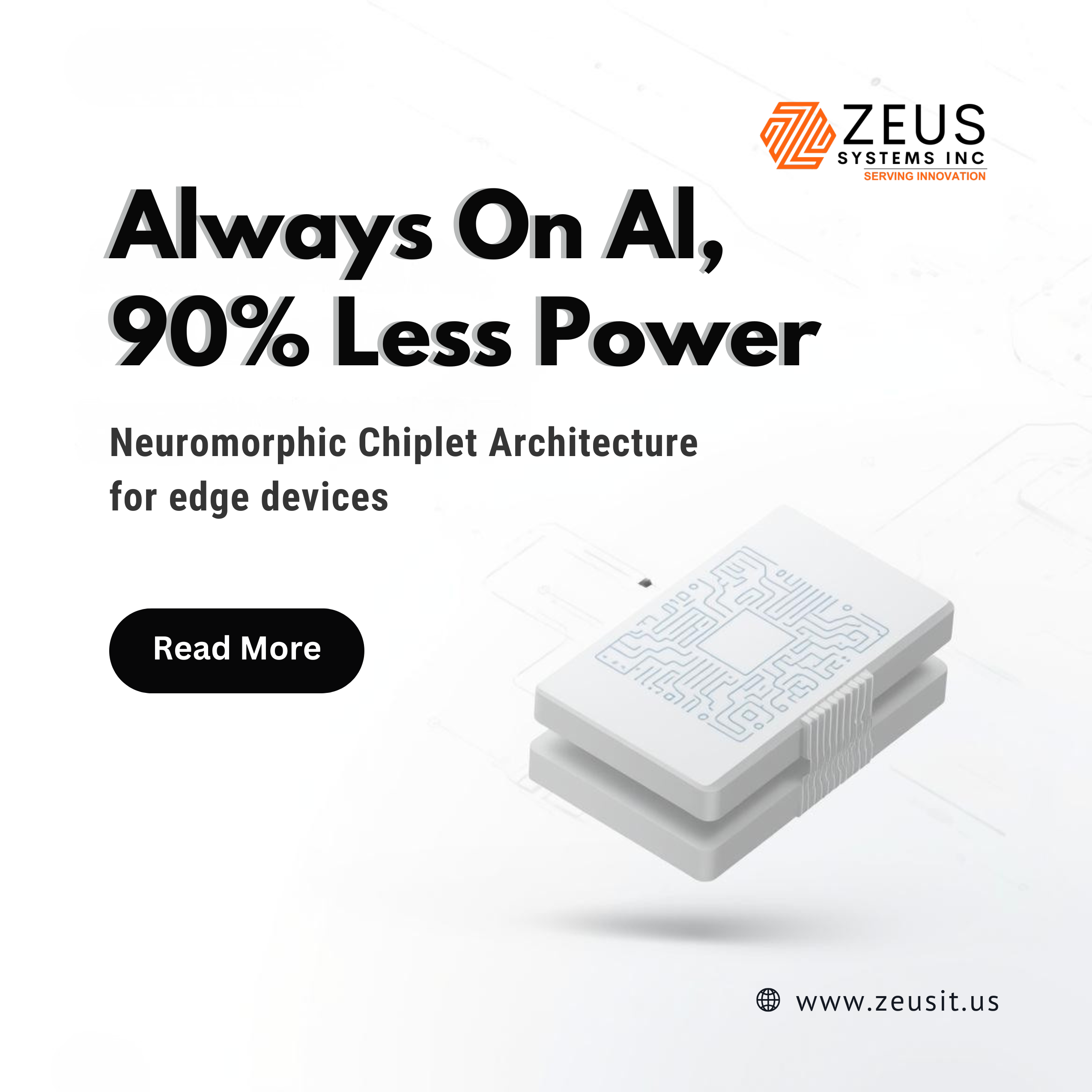
1. The Collapse of Conventional AI Scaling
For over a decade, AI progress has been driven by brute-force scaling-larger models, more GPUs, and exponentially rising power consumption. However, this trajectory is hitting a structural wall.
Modern AI infrastructure is fundamentally constrained by the von Neumann bottleneck, where memory and compute are separated, forcing constant data movement. This inefficiency is especially problematic for edge systems—drones, robots, and autonomous devices where energy is scarce.
Emerging research indicates that neuromorphic computing, inspired by biological brains, could drastically reduce power consumption while maintaining intelligence capabilities . In fact, experimental frameworks show orders-of-magnitude energy savings (up to 300×) in edge AI workloads .
This is where the convergence begins:
Chiplet-based architectures + neuromorphic computation = a new class of AI systems
2. Chiplet Stacks: The Physical Foundation of Next-Gen AI
The semiconductor industry is shifting from monolithic chips to modular chiplet architectures, where multiple specialized dies are interconnected into a unified system.
Recent developments in advanced packaging demonstrate:
- Multi-tile compute architectures
- 3D stacking with memory (HBM)
- Ultra-fast die-to-die interconnects
- Embedded power delivery systems
This modularity enables:
- Heterogeneous integration (CPU + AI + memory + sensors)
- Scalable manufacturing yields
- Task-specific optimization
Chiplets are not just a hardware trend they are the substrate for intelligence specialization.
3. Neuromorphic Computing: Rewriting the Rules of Intelligence
Unlike traditional AI, neuromorphic systems operate using spiking neural networks (SNNs)—event-driven models that only compute when necessary.
This leads to:
- Near-zero idle power consumption
- Temporal awareness (time-based reasoning)
- Local learning (on-device adaptation)
Systems like Intel’s Loihi demonstrate how artificial neurons can scale into the millions while maintaining efficiency .
The key shift:
Traditional AI = continuous computation
Neuromorphic AI = event-driven cognition
4. Introducing the Concept: “Pickle-1 Soul Computer”
Let’s define a hypothetical but technically plausible—architecture:
Pickle-1 Soul Computer
A neuromorphic, chiplet-stacked, self-aware edge AI system designed for always-on autonomy.
4.1 Architectural Philosophy
Pickle-1 is built on three principles:
- Cognitive Locality
Intelligence resides where data is generated (edge-first). - Energy-Proportional Intelligence
Power consumption scales with meaningful events, not clock cycles. - Distributed Conscious Processing
Intelligence emerges from interconnected micro-brains (chiplets).
4.2 Core Hardware Stack
a) Neuro-Compute Chiplets
- Each chiplet = 1–10 million spiking neurons
- Implements local perception modules (vision, audio, motion)
b) Memory-Cognition Fusion Layer
- Uses in-memory computing (ReRAM / memristors)
- Eliminates data transfer overhead
c) Synaptic Interconnect Fabric
- Based on UCIe-like protocols
- Enables spike-based communication between chiplets
d) Adaptive Power Mesh
- Fine-grained voltage scaling per neuron cluster
- Inspired by metabolic energy distribution in the brain
4.3 The “Soul Layer” (Novel Concept)
What differentiates Pickle-1 from existing neuromorphic systems is the “Soul Layer”:
- A meta-learning orchestration system
- Tracks internal state, intent, and environmental context
- Enables:
- Self-prioritization
- Attention routing
- Behavioral continuity
Think of it as:
Not just processing signals but deciding what matters
5. 90% Power Reduction: Myth or Reality?
Claims of 90% energy reduction are not unrealistic.
Recent neuromorphic systems already demonstrate:
- Massive reductions in energy vs traditional AI
- Efficient real-time processing for robotics and navigation
Even commercial-scale brain-inspired machines have reported:
- Up to 90% lower power consumption compared to traditional AI servers
Why such drastic savings are possible:
- Sparse Activation
Only active neurons consume power - No Global Clock
Eliminates constant switching energy - Local Learning
Reduces data movement - Sensor-Level Processing
Example: neuromorphic cameras process only changes, not full frames
6. Edge AI Transformation: Drones & Robotics
6.1 Today’s Problem
Autonomous systems today suffer from:
- High latency (cloud dependency)
- Power-hungry GPUs
- Limited real-time adaptability
6.2 Pickle-1 Enabled Systems
Autonomous Drones
- Always-on perception at <5W
- Real-time navigation without GPS
- Continuous learning mid-flight
Industrial Robots
- Event-driven control loops
- Zero idle power during inactivity
- Adaptive motor control
Swarm Intelligence
- Distributed cognition across devices
- Collective decision-making without central servers
6.3 Always-On Autonomy
Pickle-1 systems enable:
Perpetual awareness without perpetual energy drain
This is the foundation of:
- Smart surveillance
- Disaster response robotics
- Space exploration rovers
7. Software Stack: The Missing Piece
Hardware alone is insufficient.
Pickle-1 requires a new software paradigm:
a) Spike-Native Programming
- Event-driven frameworks
- Temporal coding APIs
b) Hardware-Aware Training
- Co-optimization of model + silicon
- Reduced spike activity without losing accuracy
c) Cognitive OS (cOS)
- Scheduler for attention and intent
- Resource allocation based on context
8. Challenges Ahead
Despite its promise, several barriers remain:
8.1 Training Complexity
Spiking neural networks are harder to train than traditional deep learning.
8.2 Tooling Ecosystem
Lack of mature frameworks and developer tools.
8.3 Manufacturing Complexity
3D chiplet stacking introduces:
- Thermal challenges
- Yield issues
- Interconnect bottlenecks
8.4 Standardization
No universal architecture or programming model yet.
9. The Future: From Intelligence to Conscious Systems?
If chiplet-based neuromorphic systems evolve further, we may see:
- Self-organizing hardware
- Emotion-aware AI systems
- Edge devices with persistent identity
The line between computation and cognition will blur.
10. Final Thought: The End of Power-Hungry AI
The industry is approaching a turning point.
Traditional AI scaling:
- More data
- More compute
- More energy
Neuromorphic chiplet systems like the conceptual Pickle-1 Soul Computer represent a different path:
Less power, more intelligence, deeper autonomy
By mimicking the brain not just in structure but in philosophy—we are moving toward machines that are not just faster…
…but fundamentally smarter in how they exist.