
In the realm of artificial intelligence, few developments have captured the imagination quite like OpenAI’s ChatGPT. Wit ...

info@zeusit.us
+1 (248) 658 8644
In the realm of artificial intelligence, few developments have captured the imagination quite like OpenAI’s ChatGPT. Wit ...
In the realm of technological innovation, cloud technology continues to evolve, captivating hearts and minds alike. With ...
the conversational companion that brings a touch of humanity to our digital interactions. What is Chat GPT?A Conversa ...
A journey to the 3D mapping using drones. The latest trend in 3D mapping using drones revolves around enhanced precis ...
1. The Collapse of Conventional AI Scaling For over a decade, AI progress has been driven by brute-force scaling-lar ...
For decades, healthcare digitization has been trapped behind glass—mobile apps, dashboards, telemedicine windows. Even ...
For decades, lunar exploration has been constrained by two fundamental challenges: extreme terrain unpredictability and ...
For decades, the architecture of industrial enterprises followed a rigid separation.Information Technology (IT) governe ...
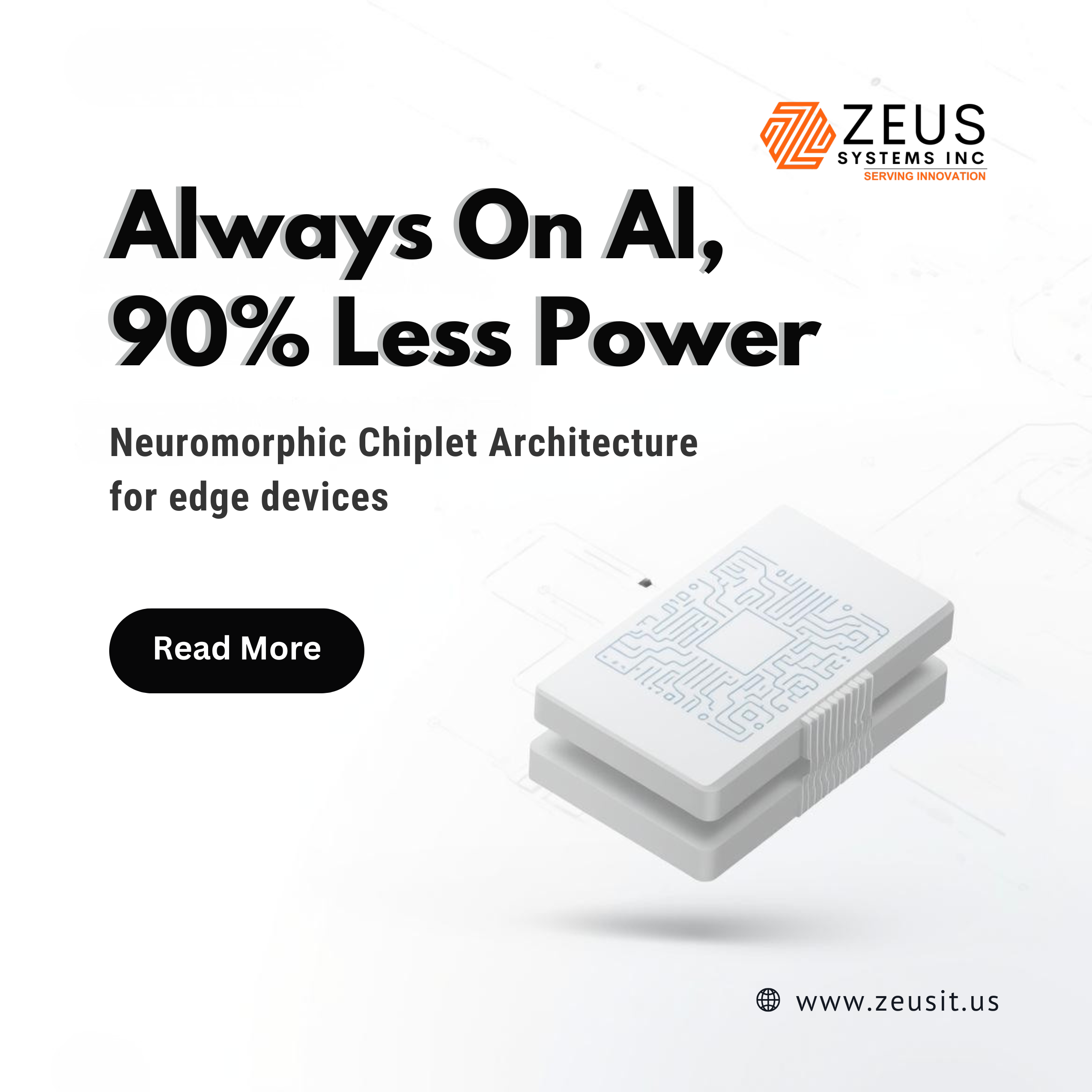
1. The Collapse of Conventional AI Scaling
For over a decade, AI progress has been driven by brute-force scaling-larger models, more GPUs, and exponentially rising power consumption. However, this trajectory is hitting a structural wall.
Modern AI infrastructure is fundamentally constrained by the von Neumann bottleneck, where memory and compute are separated, forcing constant data movement. This inefficiency is especially problematic for edge systems—drones, robots, and autonomous devices where energy is scarce.
Emerging research indicates that neuromorphic computing, inspired by biological brains, could drastically reduce power consumption while maintaining intelligence capabilities . In fact, experimental frameworks show orders-of-magnitude energy savings (up to 300×) in edge AI workloads .
This is where the convergence begins:
Chiplet-based architectures + neuromorphic computation = a new class of AI systems
2. Chiplet Stacks: The Physical Foundation of Next-Gen AI
The semiconductor industry is shifting from monolithic chips to modular chiplet architectures, where multiple specialized dies are interconnected into a unified system.
Recent developments in advanced packaging demonstrate:
This modularity enables:
Chiplets are not just a hardware trend they are the substrate for intelligence specialization.
3. Neuromorphic Computing: Rewriting the Rules of Intelligence
Unlike traditional AI, neuromorphic systems operate using spiking neural networks (SNNs)—event-driven models that only compute when necessary.
This leads to:
Systems like Intel’s Loihi demonstrate how artificial neurons can scale into the millions while maintaining efficiency .
The key shift:
Traditional AI = continuous computation
Neuromorphic AI = event-driven cognition
4. Introducing the Concept: “Pickle-1 Soul Computer”
Let’s define a hypothetical but technically plausible—architecture:
Pickle-1 Soul Computer
A neuromorphic, chiplet-stacked, self-aware edge AI system designed for always-on autonomy.
4.1 Architectural Philosophy
Pickle-1 is built on three principles:
4.2 Core Hardware Stack
a) Neuro-Compute Chiplets
b) Memory-Cognition Fusion Layer
c) Synaptic Interconnect Fabric
d) Adaptive Power Mesh
4.3 The “Soul Layer” (Novel Concept)
What differentiates Pickle-1 from existing neuromorphic systems is the “Soul Layer”:
Think of it as:
Not just processing signals but deciding what matters
5. 90% Power Reduction: Myth or Reality?
Claims of 90% energy reduction are not unrealistic.
Recent neuromorphic systems already demonstrate:
Even commercial-scale brain-inspired machines have reported:
Why such drastic savings are possible:
6. Edge AI Transformation: Drones & Robotics
6.1 Today’s Problem
Autonomous systems today suffer from:
6.2 Pickle-1 Enabled Systems
Autonomous Drones
Industrial Robots
Swarm Intelligence
6.3 Always-On Autonomy
Pickle-1 systems enable:
Perpetual awareness without perpetual energy drain
This is the foundation of:
7. Software Stack: The Missing Piece
Hardware alone is insufficient.
Pickle-1 requires a new software paradigm:
a) Spike-Native Programming
b) Hardware-Aware Training
c) Cognitive OS (cOS)
8. Challenges Ahead
Despite its promise, several barriers remain:
8.1 Training Complexity
Spiking neural networks are harder to train than traditional deep learning.
8.2 Tooling Ecosystem
Lack of mature frameworks and developer tools.
8.3 Manufacturing Complexity
3D chiplet stacking introduces:
8.4 Standardization
No universal architecture or programming model yet.
9. The Future: From Intelligence to Conscious Systems?
If chiplet-based neuromorphic systems evolve further, we may see:
The line between computation and cognition will blur.
10. Final Thought: The End of Power-Hungry AI
The industry is approaching a turning point.
Traditional AI scaling:
Neuromorphic chiplet systems like the conceptual Pickle-1 Soul Computer represent a different path:
Less power, more intelligence, deeper autonomy
By mimicking the brain not just in structure but in philosophy—we are moving toward machines that are not just faster…
…but fundamentally smarter in how they exist.