AI driven drones

Heavy-Duty AI Drones: Force-Controlled Xer Drones Redefining Logistics in Extreme Environments

For years, drones have hovered on the edge of transforming logistics-promising faster deliveries, reduced human risk, and access to unreachable terrains. Yet, most existing systems are constrained by payload limits, fragile control systems, and rigid pre-programmed intelligence. They perform well in controlled environments but falter under real-world volatility: high winds, uneven loads, dynamic obstacles, or extreme climates.

Enter a new class of aerial systems: Heavy-Duty AI Xer Drones-machines that combine force-controlled actuators, adaptive structural intelligence, and generative AI-driven payload optimization. These drones don’t just carry loads; they understand them, adapt to them, and reconfigure themselves mid-flight to surpass traditional physical and computational limits.

This is not an incremental improvement. It’s a paradigm shift.

The Xer Drone Architecture: Designed for Extremes

At the core of this innovation is the Xer Drone, a modular, heavy-lift aerial platform engineered for harsh, unpredictable environments such as:

  • Arctic supply routes
  • Offshore oil rigs
  • Disaster-stricken zones
  • Dense mining operations
  • High-altitude military logistics

Unlike conventional drones that rely on fixed propulsion-to-weight ratios, Xer drones integrate force-controlled actuators across their propulsion arms and payload interfaces.

What Makes Force-Controlled Actuators Different?

Traditional drones use position-controlled motors—meaning they attempt to maintain a fixed speed or position regardless of external forces. Xer drones, however, incorporate actuators that:

  • Sense real-time force vectors (load shifts, wind resistance, torque imbalance)
  • Dynamically redistribute thrust across rotors
  • Adjust mechanical stiffness of joints and mounts
  • Absorb shock and vibration during turbulent flight

This allows the drone to behave less like a rigid machine and more like a self-balancing organism, continuously negotiating with its environment.

Generative AI in Flight: Beyond Static Intelligence

The most groundbreaking element is the integration of onboard generative AI models—not for content creation, but for real-time decision synthesis.

Traditional AI vs Generative Flight Intelligence

CapabilityTraditional Drone AIXer Drone Generative AI
Path PlanningPredefined or reactiveContinuously re-generated
Payload HandlingFixed parametersDynamic reconfiguration
Environmental ResponseRule-basedScenario-simulated adaptation
LearningOffline trainingOn-the-fly model refinement

The generative AI system inside Xer drones performs continuous simulation loops mid-flight, predicting multiple future states based on:

  • Payload distribution changes
  • Wind shear patterns
  • Rotor efficiency degradation
  • Structural stress thresholds

It then generates optimal control strategies in real time, rather than selecting from pre-coded options.

Self-Optimizing Payloads: Breaking the Weight Barrier

One of the most radical breakthroughs is the concept of mid-flight payload optimization.

The Problem with Payload Limits

Traditional drones are bound by strict payload ceilings determined by:

  • Motor thrust capacity
  • Battery discharge rates
  • Frame stress tolerances

Exceed these, and the drone becomes unstable or crashes.

Xer Drone Solution: Adaptive Payload Intelligence

Instead of treating payload as a static burden, Xer drones treat it as a dynamic system variable.

Using embedded sensors and AI modeling, the drone can:

  1. Analyze payload composition
    • Weight distribution
    • Center of gravity shifts
    • Material flexibility
  2. Reconfigure carrying strategy mid-air
    • Adjust grip tension via actuator arms
    • Redistribute load across multiple attachment points
    • Alter flight posture (tilt, altitude, rotor pitch)
  3. Generate micro-adjustments continuously
    • Compensate for swinging loads
    • Counteract wind-induced oscillations
    • Reduce drag by altering orientation
  4. Extend effective payload capacity
    • Not by increasing raw power
    • But by optimizing physics in motion

This enables Xer drones to carry loads previously considered unsafe or impossible, effectively redefining payload limits without violating mechanical constraints.

Harsh Environment Mastery

What truly sets Xer drones apart is their ability to function where other systems fail.

Environmental Adaptation Capabilities

  • Extreme Winds: Real-time force balancing prevents drift and rollover
  • Temperature Extremes: AI adjusts energy consumption and actuator stiffness
  • Low Visibility: Generative models simulate unseen obstacles using partial data
  • Electromagnetic Interference: Redundant decision layers maintain control integrity

The drone doesn’t just react—it anticipates.

Swarm Intelligence: Collective Optimization

Xer drones are not limited to individual performance. When deployed in fleets, they exhibit collaborative generative intelligence.

Swarm Capabilities

  • Load sharing between drones mid-air
  • Dynamic route redistribution based on failures or delays
  • Collective wind modeling for formation stability
  • Distributed learning across the fleet

Imagine multiple drones carrying a single भारी industrial component, each adjusting its force output in harmony, guided by a shared generative model.

Safety and Ethical Control Layers

With such autonomy comes risk. Xer drones integrate multi-layered safety systems:

  • Constraint-aware AI: Never generates actions beyond structural limits
  • Explainability modules: Logs decision rationale for audit
  • Human override channels: Real-time intervention capability
  • Ethical boundary frameworks: Prevent misuse in sensitive zones

This ensures that while the system is autonomous, it remains accountable.

Real-World Use Cases

1. Disaster Relief

Delivering medical supplies into collapsed urban zones where terrain shifts unpredictably.

2. Industrial Logistics

Transporting parts across active mining sites with uneven load dynamics.

3. Military Operations

Supplying remote units in high-risk environments without exposing human pilots.

4. Space Analog Missions

Testing payload adaptability in Mars-like terrains on Earth.

The Physics-Intelligence Convergence

What makes Xer drones revolutionary is not just AI, nor just hardware—but the fusion of both into a single adaptive system.

  • Physics is no longer a constraint—it becomes a variable
  • AI is no longer reactive—it becomes generative and predictive
  • Payload is no longer static—it becomes negotiable

This convergence allows drones to operate beyond fixed design limitations, entering a realm where machines continuously redefine their own capabilities.

Challenges Ahead

Despite the promise, several hurdles remain:

  • Computational load of real-time generative modeling
  • Energy efficiency under continuous adaptation
  • Regulatory frameworks for autonomous heavy-lift drones
  • Public trust and safety validation

However, these are engineering and policy challenges—not conceptual limitations.

Conclusion: A New Frontier in Autonomous Systems

Heavy-Duty AI Xer Drones represent a shift from programmed machines to self-evolving systems. By combining force-controlled actuation with generative AI, they unlock a new category of logistics—one that thrives in uncertainty rather than avoiding it.

This is not just about delivering packages.
It’s about redefining what machines can carry, how they think, and where they can go.

The sky is no longer the limit. It’s the testing ground.

neuromorphic computing

AI Driven Chiplet Stacks & Neuromorphic Hardware

1. The Collapse of Conventional AI Scaling

For over a decade, AI progress has been driven by brute-force scaling-larger models, more GPUs, and exponentially rising power consumption. However, this trajectory is hitting a structural wall.

Modern AI infrastructure is fundamentally constrained by the von Neumann bottleneck, where memory and compute are separated, forcing constant data movement. This inefficiency is especially problematic for edge systems—drones, robots, and autonomous devices where energy is scarce.

Emerging research indicates that neuromorphic computing, inspired by biological brains, could drastically reduce power consumption while maintaining intelligence capabilities . In fact, experimental frameworks show orders-of-magnitude energy savings (up to 300×) in edge AI workloads .

This is where the convergence begins:

Chiplet-based architectures + neuromorphic computation = a new class of AI systems

2. Chiplet Stacks: The Physical Foundation of Next-Gen AI

The semiconductor industry is shifting from monolithic chips to modular chiplet architectures, where multiple specialized dies are interconnected into a unified system.

Recent developments in advanced packaging demonstrate:

  • Multi-tile compute architectures
  • 3D stacking with memory (HBM)
  • Ultra-fast die-to-die interconnects
  • Embedded power delivery systems

This modularity enables:

  • Heterogeneous integration (CPU + AI + memory + sensors)
  • Scalable manufacturing yields
  • Task-specific optimization

Chiplets are not just a hardware trend they are the substrate for intelligence specialization.

3. Neuromorphic Computing: Rewriting the Rules of Intelligence

Unlike traditional AI, neuromorphic systems operate using spiking neural networks (SNNs)—event-driven models that only compute when necessary.

This leads to:

  • Near-zero idle power consumption
  • Temporal awareness (time-based reasoning)
  • Local learning (on-device adaptation)

Systems like Intel’s Loihi demonstrate how artificial neurons can scale into the millions while maintaining efficiency .

The key shift:

Traditional AI = continuous computation
Neuromorphic AI = event-driven cognition

4. Introducing the Concept: “Pickle-1 Soul Computer”

Let’s define a hypothetical but technically plausible—architecture:

Pickle-1 Soul Computer

A neuromorphic, chiplet-stacked, self-aware edge AI system designed for always-on autonomy.

4.1 Architectural Philosophy

Pickle-1 is built on three principles:

  1. Cognitive Locality
    Intelligence resides where data is generated (edge-first).
  2. Energy-Proportional Intelligence
    Power consumption scales with meaningful events, not clock cycles.
  3. Distributed Conscious Processing
    Intelligence emerges from interconnected micro-brains (chiplets).

4.2 Core Hardware Stack

a) Neuro-Compute Chiplets

  • Each chiplet = 1–10 million spiking neurons
  • Implements local perception modules (vision, audio, motion)

b) Memory-Cognition Fusion Layer

  • Uses in-memory computing (ReRAM / memristors)
  • Eliminates data transfer overhead

c) Synaptic Interconnect Fabric

  • Based on UCIe-like protocols
  • Enables spike-based communication between chiplets

d) Adaptive Power Mesh

  • Fine-grained voltage scaling per neuron cluster
  • Inspired by metabolic energy distribution in the brain

4.3 The “Soul Layer” (Novel Concept)

What differentiates Pickle-1 from existing neuromorphic systems is the “Soul Layer”:

  • A meta-learning orchestration system
  • Tracks internal state, intent, and environmental context
  • Enables:
    • Self-prioritization
    • Attention routing
    • Behavioral continuity

Think of it as:

Not just processing signals but deciding what matters

5. 90% Power Reduction: Myth or Reality?

Claims of 90% energy reduction are not unrealistic.

Recent neuromorphic systems already demonstrate:

  • Massive reductions in energy vs traditional AI
  • Efficient real-time processing for robotics and navigation

Even commercial-scale brain-inspired machines have reported:

  • Up to 90% lower power consumption compared to traditional AI servers

Why such drastic savings are possible:

  1. Sparse Activation
    Only active neurons consume power
  2. No Global Clock
    Eliminates constant switching energy
  3. Local Learning
    Reduces data movement
  4. Sensor-Level Processing
    Example: neuromorphic cameras process only changes, not full frames

6. Edge AI Transformation: Drones & Robotics

6.1 Today’s Problem

Autonomous systems today suffer from:

  • High latency (cloud dependency)
  • Power-hungry GPUs
  • Limited real-time adaptability

6.2 Pickle-1 Enabled Systems

Autonomous Drones

  • Always-on perception at <5W
  • Real-time navigation without GPS
  • Continuous learning mid-flight

Industrial Robots

  • Event-driven control loops
  • Zero idle power during inactivity
  • Adaptive motor control

Swarm Intelligence

  • Distributed cognition across devices
  • Collective decision-making without central servers

6.3 Always-On Autonomy

Pickle-1 systems enable:

Perpetual awareness without perpetual energy drain

This is the foundation of:

  • Smart surveillance
  • Disaster response robotics
  • Space exploration rovers

7. Software Stack: The Missing Piece

Hardware alone is insufficient.

Pickle-1 requires a new software paradigm:

a) Spike-Native Programming

  • Event-driven frameworks
  • Temporal coding APIs

b) Hardware-Aware Training

  • Co-optimization of model + silicon
  • Reduced spike activity without losing accuracy

c) Cognitive OS (cOS)

  • Scheduler for attention and intent
  • Resource allocation based on context

8. Challenges Ahead

Despite its promise, several barriers remain:

8.1 Training Complexity

Spiking neural networks are harder to train than traditional deep learning.

8.2 Tooling Ecosystem

Lack of mature frameworks and developer tools.

8.3 Manufacturing Complexity

3D chiplet stacking introduces:

  • Thermal challenges
  • Yield issues
  • Interconnect bottlenecks

8.4 Standardization

No universal architecture or programming model yet.

9. The Future: From Intelligence to Conscious Systems?

If chiplet-based neuromorphic systems evolve further, we may see:

  • Self-organizing hardware
  • Emotion-aware AI systems
  • Edge devices with persistent identity

The line between computation and cognition will blur.

10. Final Thought: The End of Power-Hungry AI

The industry is approaching a turning point.

Traditional AI scaling:

  • More data
  • More compute
  • More energy

Neuromorphic chiplet systems like the conceptual Pickle-1 Soul Computer represent a different path:

Less power, more intelligence, deeper autonomy

By mimicking the brain not just in structure but in philosophy—we are moving toward machines that are not just faster…

…but fundamentally smarter in how they exist.

bio inspired learning robots

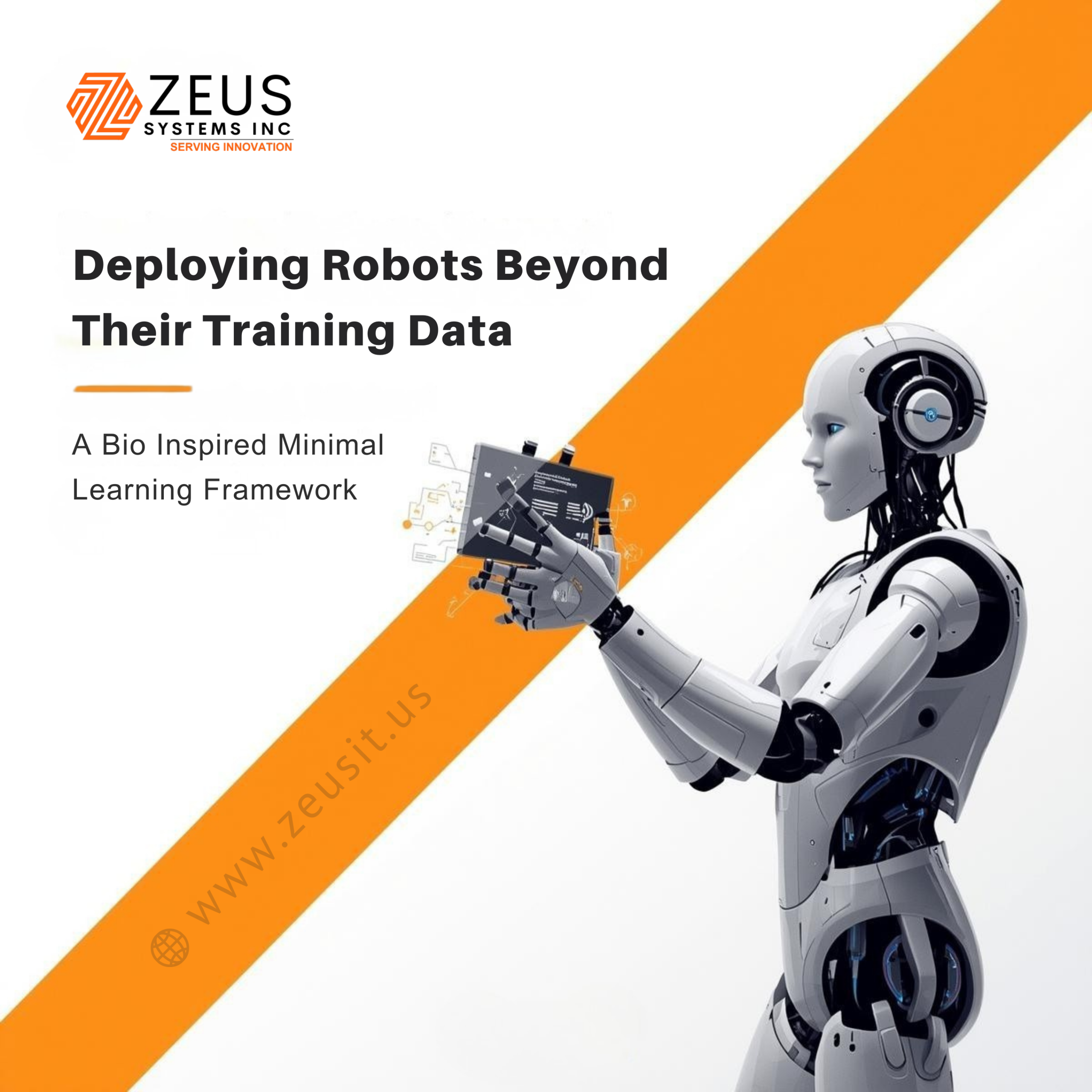
Bio Inspired Robot Learning from Minimal Data

As robotic systems increasingly enter unstructured human environments, traditional paradigms based on extensive labeled datasets and task-specific engineering are no longer adequate. Inspired by biological intelligence — which thrives on learning from sparse experience — this article proposes a framework for minimal-data robot learning that combines few-shot learning, self-supervised trial-generation, and dynamic embodiment adaptation. We argue that the next breakthrough in robotic autonomy will not come from larger models trained on bigger datasets, but from systems that learn more with less — leveraging principles from neural plasticity, motor synergies, and intrinsic motivation. We introduce the concept of “Neural/Physical Coupled Memory” (NPCM) and propose new research directions that transcend current state of the art.

1. The Problem: Robots Learn Too Much From Too Much

Contemporary robot learning relies heavily on:

  • Large labeled datasets (supervised imitation learning),
  • Simulated task replay with domain randomization,
  • Reward-based reinforcement learning requiring thousands of episodes.

However, biological organisms often learn tasks in minutes, not millions of trials, and generalize abilities to novel contexts without explicit instruction. Robots, by contrast, are brittle outside their training distribution.

We propose a new paradigm: bio-inspired minimal data learning, where robotic systems can acquire robust, generalizable behaviors using very few real interactions.

2. Biological Inspirations for Minimal Data Learning

Biology demonstrates several principles that can transform robot learning:

a. Sparse but Structured Experiences

Humans do not need millions of repetitions to learn to grasp a cup — structured interactions and feedback rich perception facilitate learning.

b. Motor Synergy Primitives

Biological motor control reuses synergies — low-dimensional action primitives. Efficient robot control can similarly decompose motion into reusable modules.

c. Intrinsic Motivation

Animals explore driven by curiosity, novelty, and surprise — not explicit external rewards. This suggests integrating self-guided exploration in robots to form internal representations.

d. Memory Consolidation

Unlike replay buffers in RL, biological memory consolidates through sleep and biological processes. Robots could simulate a similar offline structural consolidation to strengthen representations after minimal real interactions.

3. Core Contributions: New Concepts and Frameworks

3.1 Neural/Physical Coupled Memory (NPCM)

We introduce NPCM, a unified memory architecture that binds:

  • Neural representations — abstract task features,
  • Physical dynamics — embodied context such as joint states, force feedback, and proprioception.

Unlike current neural networks, NPCM would store embodied experience traces that encode both sensory observations and the physical consequences of actions. This enables:

  • Recall of how interactions felt and changed the world;
  • Rapid adaptation of strategies when faced with novel constraints;
  • Continuous update of the action–consequence manifold without large replay datasets.

Example: A robot learns to balance a flexible object by encoding not just actions but the change in physical stability — enabling transfer to other unstable objects with minimal new examples.

3.2 Self-Supervised Trial Generation (SSTG)

Instead of collecting labeled data, robots can generate self-supervised pseudo-tasks through controlled perturbations. These perturbations produce diverse interaction outcomes that enrich representation learning without human annotation.

Key difference from standard methods:

  • Not random exploration — perturbations are guided by intrinsic uncertainty;
  • Data is structured by outcome classes discovered by the agent itself;
  • Self-supervised goals emerge dynamically from prediction errors.

This yields few-shot learning seeds that the robot can combine into larger capabilities.

3.3 Cross-Modal Synergy Transfer (CMST)

Biology seamlessly integrates vision, touch, and proprioception. We propose a mechanism to transfer skill representations across modalities such that learning in one sensory channel immediately improves others.

Novel point: Most multi-modal work fuses data at input level; CMST fuses at a structural representation level, allowing:

  • Learned visual affordances to immediately bootstrap tactile understanding;
  • Motor actions to reorganize proprioceptive maps dynamically.

4. Innovative Applications

4.1 Task-Agnostic Skill Libraries

Instead of storing task labels, the robot builds experience graphs — small collections of interaction motifs that can recombine into new task solutions.

Hypothesis: Robots that store interaction motifs rather than task policies will:

  • Require fewer examples to generalize;
  • Be robust to novel constraints;
  • Discover behaviors humans did not predefine.

4.2 Embodied Cause-Effect Prediction

Robots actively predict the physical consequences of actions relative to their current body configuration. This embodied prediction allows inference of affordances without external supervision. Minimal data becomes sufficient if prediction systems capture the physics priors of actions.

5. A Roadmap for Minimal Data Robot Autonomy

We propose five research thrusts:

  1. NPCM Architecture Development: Integrate neural and physical memory traces.
  2. Guided Self-Supervision Algorithms: From curiosity to intrinsic task discovery.
  3. Cross-Modal Structural Alignment: Joint representation learning beyond fusion.
  4. Hierarchical Motor Synergy Libraries: Reusable, composable motor modules.
  5. Human-Robot Shared Representations: Enabling robots to internalize human corrections with minimal examples.

6. Challenges and Ethical Considerations

  • Safety in self-supervised perturbations: Systems must bound exploration to safe regions.
  • Representational transparency: Embodied memories must be interpretable for debugging.
  • Transfer understanding: Robots must not overgeneralize from few examples where contexts differ significantly.

7. Conclusion: Learning Less to Learn More The future of robot learning lies not in bigger datasets but in smarter learning mechanisms. By emulating how biological organisms learn from minimal data, leveraging sparse interactions, intrinsic motivation, and coupled memory structures, robots can become capable agents in unseen environments with unprecedented efficiency.

Responsible Compute Markets

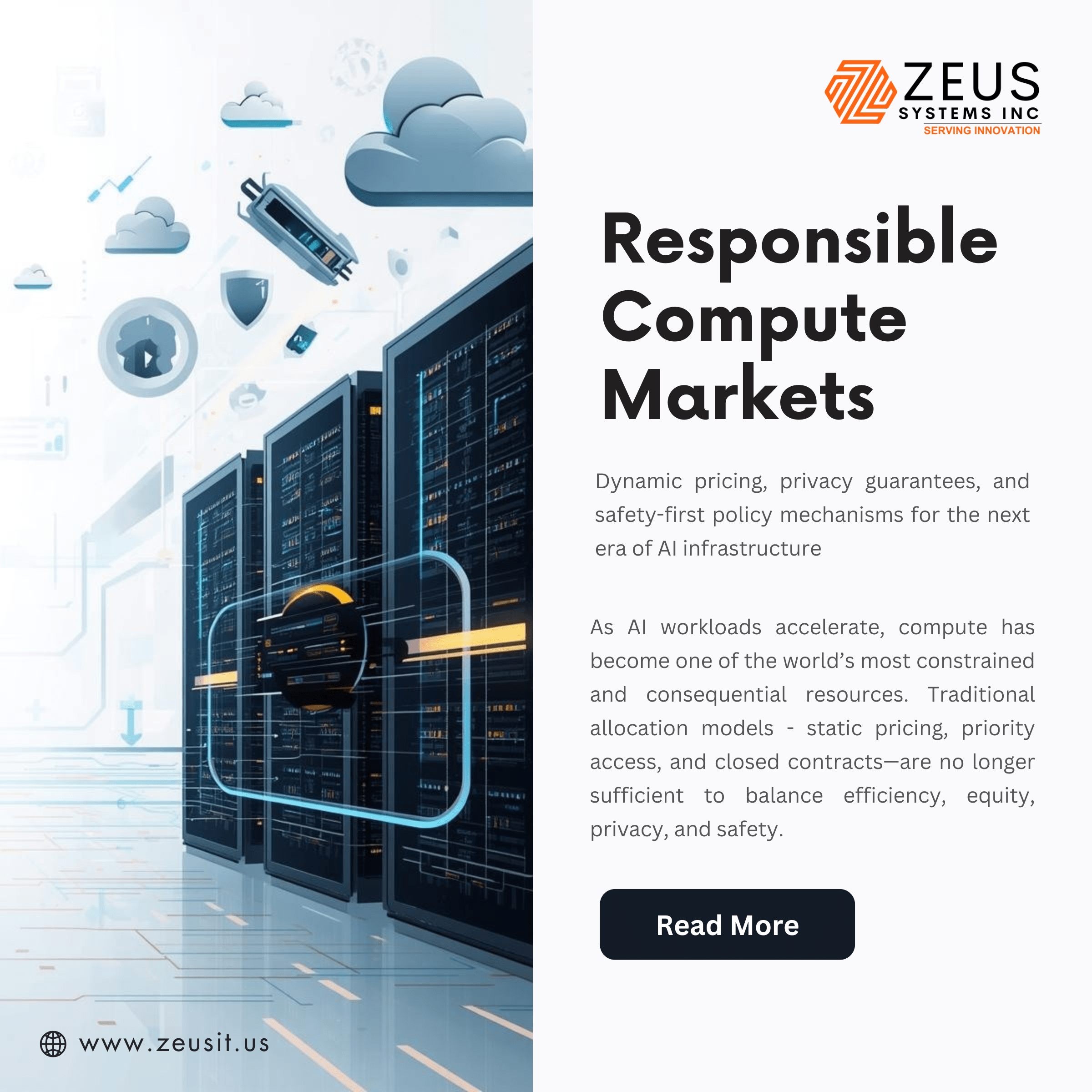
Responsible Compute Markets

Dynamic Pricing and Policy Mechanisms for Sharing Scarce Compute Resources with Guaranteed Privacy and Safety

In an era where advanced AI workloads increasingly strain global compute infrastructure, current allocation strategies – static pricing, priority queuing, and fixed quotas – are insufficient to balance efficiency, equity, privacy, and safety. This article proposes a novel paradigm called Responsible Compute Markets (RCMs): dynamic, multi-agent economic systems that allocate scarce compute resources through real-time pricing, enforceable policy contracts, and built-in guarantees for privacy and system safety. We introduce three groundbreaking concepts:

  1. Privacy-aware Compute Futures Markets
  2. Compute Safety Tokenization
  3. Multi-Stakeholder Trust Enforcement via Verifiable Policy Oracles

Together, these reshape how organizations share compute at scale – turning static infrastructure into a responsible, market-driven commons.

1. The Problem Landscape: Scarcity, Risk, and Misaligned Incentives

Modern compute ecosystems face a trilemma:

  1. Scarcity – dramatically rising demand for GPU/TPU cycles (training large AI models, real-time simulation, genomics).
  2. Privacy Risk – workloads with sensitive data (health, finance) cannot be arbitrarily scheduled or priced without safeguarding confidentiality.
  3. Safety Externalities – computational workflows can create downstream harms (e.g., malicious model development).

Traditional markets – fixed pricing, short-term leasing, negotiated enterprise contracts – fail on three fronts:

  • They do not adapt to real-time strain on compute supply.
  • They do not embed privacy costs into pricing.
  • They do not enforce safety constraints as enforceable economic penalties.

2. Responsible Compute Markets: A New Paradigm

RCMs reframe compute allocation as a policy-driven economic coordination mechanism:

Compute resources are priced dynamically based on supply, projected societal impact, and privacy risk, with enforceable contracts that ensure safety compliance.

Three components define an RCM:

3. Privacy-Aware Compute Futures Markets

Concept: Enable organizations to trade compute futures contracts that encode quantified privacy guarantees.

  • Instead of reserving raw cycles, buyers purchase compute contracts (C(P,r,ε)) where:
    • P = privacy budget (e.g., differential privacy ε),
    • r = safety risk rating,
    • ε = allowable statistical leakage.

These contracts trade like assets:

  • High privacy guarantees (low ε) cost more.
  • Buyers can hedge by selling portions of unused privacy budgets.
  • Market prices reveal real-time scarcity and privacy valuations.

Why It’s Groundbreaking:
Rather than treating privacy as a compliance checkbox, RCMs monetize privacy guarantees, enabling:

  • Transparent privacy risk pricing
  • Efficient allocation among privacy-sensitive workloads
  • Market incentives to minimize data exposure

This approach guarantees privacy by economic design: workloads with low privacy tolerance signal higher willingness to pay, aligning allocation with societal values.

4. Compute Safety Tokenization and Reputation Bonds

Compute Safety Tokens (CSTs) are digital assets representing risk tolerance and safety compliance capacity.

  • Each compute request must be backed by CSTs proportional to expected externality risk.
  • Higher-risk computations (e.g., dual-use AI research) require more CSTs.
  • CSTs are burned on violation or staked to reserve resource priority.

Reputation Bonds:

  • Entities accumulate safety reputation scores by completing compliance audits.
  • Higher reputation reduces CST costs – incentivizing ongoing safety diligence.

Innovative Impact:

  • Turns safety assurances into a quantifiable economic instrument.
  • Aligns long-term reputation with short-term compute access.
  • Discourages high-risk behavior through tokenized cost.

5. Verifiable Policy Oracles: Enforcing Multi-Stakeholder Governance

RCMs require strong enforcement of privacy and safety contracts without centralized trust. We propose Verifiable Policy Oracles (VPOs):

  • Distributed entities that interpret and enforce compliance policies against compute jobs.
  • VPOs verify:
    • Differential privacy settings
    • Model behavior constraints
    • Safe use policies (no banned data, no harmful outputs)
  • Enforcement is automated via verifiable execution proofs (e.g., zero-knowledge attestations).

VPOs mediate between stakeholders:

StakeholderPolicy Role
RegulatorsSafety constraints, legal compliance
Data OwnersPrivacy budgets, consent limits
Platform OperatorsPhysical resource availability
BuyersRisk profiles and compute needs

Why It Matters:
Traditional scheduling layers have no mechanism to enforce real-world policy beyond ACLs. VPOs embed policy into execution itself – making violations provable and enforceable economically (via CST slashing or contract invalidation).

6. Dynamic Pricing with Ethical Market Constraints

Unlike spot pricing or surge pricing alone, RCMs introduce Ethical Pricing Functions (EPFs) that factor:

  • Compute scarcity
  • Privacy cost
  • Safety risk weighting
  • Equity adjustments (protecting underserved researchers/organizations)

EPFs use multi-objective optimization, balancing market efficiency with ethical safeguards:

Price = f(Supply Demand, PrivacyRisk, SafetyRisk, EquityFactor)

This ensures:

  • Price signals reflect real societal costs.
  • High-impact research isn’t priced out of access.
  • Risky compute demands compensate for externalities.

7. A Use-Case Walkthrough: Global Health AI Consortium

Imagine a coalition of medical researchers across nations needing urgent compute for:

  • training disease spread models with patient records,
  • generating synthetic data for analysis,
  • optimizing vaccine distribution.

Under RCM:

  • Researchers purchase compute futures with strict privacy budgets.
  • Safety reputations enhance CST rebates.
  • VPOs verify compliance before execution.
  • Dynamic pricing ensures urgent workloads get prioritized but honor ethical constraints.

The result:

  • Protected patient data.
  • Fair allocation across geographies.
  • Transparent economic incentives for safe, beneficial outcomes.

8. Implementation Challenges & Research Directions

To operationalize RCMs, critical research is needed in:

A. Privacy Cost Quantification

Developing accurate metrics that reflect real societal privacy risk inside market pricing.

B. Safety Risk Assessment Algorithms

Automated tools that can score computing workloads for dual use or negative externalities.

C. Distributed Policy Enforcement

Scalable, verifiable compute attestations that work cross-provider and cross-jurisdiction.

D. Market Stability Mechanisms

Ensuring futures markets don’t create perverse incentives or speculative bubbles.

9. Conclusion: Toward Responsible Compute Commons

Responsible Compute Markets are more than a pricing model – they are an emergent eco-economic infrastructure for the compute century. By embedding privacy, safety, and equitable access into the very mechanisms that allocate scarce compute power, RCMs reimagine:

  • What it means to own compute.
  • How economic incentives shape ethical technology.
  • How multi-stakeholder systems can cooperate, compete, and regulate dynamically.

As AI and compute continue to proliferate, we need frameworks that are not just efficient, but responsible by design.

Agentic Cybersecurity

Agentic Cybersecurity: Relentless Defense

Agentic cybersecurity stands at the dawn of a new era, defined by advanced AI systems that go beyond conventional automation to deliver truly autonomous management of cybersecurity defenses, cyber threat response, and endpoint protection. These agentic systems are not merely tools—they are digital sentinels, empowered to think, adapt, and act without human intervention, transforming the very concept of how organizations defend themselves against relentless, evolving threats.​

The Core Paradigm: From Automation to Autonomy

Traditional cybersecurity relies on human experts and manually coded rules, often leaving gaps exploited by sophisticated attackers. Recent advances brought automation and machine learning, but these still depend on human oversight and signature-based detection. Agentic cybersecurity leaps further by giving AI true decision-making agency. These agents can independently monitor networks, analyze complex data streams, simulate attacker strategies, and execute nuanced actions in real time across endpoints, cloud platforms, and internal networks.​

  • Autonomous Threat Detection: Agentic AI systems are designed to recognize behavioral anomalies, not just known malware signatures. By establishing a baseline of normal operation, they can flag unexpected patterns—such as unusual file access or abnormal account activity—allowing them to spot zero-day attacks and insider threats that evade legacy tools.​
  • Machine-Speed Incident Response: Modern agentic defense platforms can isolate infected devices, terminate malicious processes, and adjust organizational policies in seconds. This speed drastically reduces “dwell time”—the window during which threats remain undetected, minimizing damage and preventing lateral movement.​

Key Innovations: Uncharted Frontiers

Today’s agentic cybersecurity is evolving to deliver capabilities previously out of reach:

  • AI-on-AI Defense: Defensive agents detect and counter malicious AI adversaries. As attackers embrace agentic AI to morph malware tactics in real time, defenders must use equally adaptive agents, engaged in continuous AI-versus-AI battles with evolving strategies.​
  • Proactive Threat Hunting: Autonomous agents simulate attacks to discover vulnerabilities before malicious actors do. They recommend or directly implement preventative measures, shifting security from passive reaction to active prediction and mitigation.​
  • Self-Healing Endpoints: Advanced endpoint protection now includes agents that autonomously patch vulnerabilities, rollback systems to safe states, and enforce new security policies without requiring manual intervention. This creates a dynamic defense perimeter capable of adapting to new threat landscapes instantly.​

The Breathtaking Scale and Speed

Unlike human security teams limited by working hours and manual analysis, agentic systems operate 24/7, processing vast amounts of information from servers, devices, cloud instances, and user accounts simultaneously. Organizations facing exponential data growth and complex hybrid environments rely on these AI agents to deliver scalable, always-on protection.​

Technical Foundations: How Agentic AI Works

At the heart of agentic cybersecurity lie innovations in machine learning, deep reinforcement learning, and behavioral analytics:

  • Continuous Learning: AI models constantly recalibrate their understanding of threats using new data. This means defenses grow stronger with every attempted breach or anomaly—keeping pace with attackers’ evolving techniques.​
  • Contextual Intelligence: Agentic systems pull data from endpoints, networks, identity platforms, and global threat feeds to build a comprehensive picture of organizational risk, making investigations faster and more accurate than ever before.​
  • Automated Response and Recovery: These systems can autonomously quarantine devices, reset credentials, deploy patches, and even initiate forensic investigations, freeing human analysts to focus on complex, creative problem-solving.​

Unexplored Challenges and Risks

Agentic cybersecurity opens doors to new vulnerabilities and ethical dilemmas—not yet fully researched or widely discussed:

  • Loss of Human Control: Autonomous agents, if not carefully bounded, could act beyond their intended scope, potentially causing business disruptions through misidentification or overly aggressive defense measures.​
  • Explainability and Accountability: Many agentic systems operate as opaque “black boxes.” Their lack of transparency complicates efforts to assign responsibility, investigate incidents, or guarantee compliance with regulatory requirements.​
  • Adversarial AI Attacks: Attackers can poison AI training data or engineer subtle malware variations to trick agentic systems into missing threats or executing harmful actions. Defending agentic AI from these attacks remains a largely unexplored frontier.​
  • Security-By-Design: Embedding robust controls, ethical frameworks, and fail-safe mechanisms from inception is vital to prevent autonomous systems from harming their host organization—an area where best practices are still emerging.​

Next-Gen Perspectives: The Road Ahead

Future agentic cybersecurity systems will push the boundaries of intelligence, adaptability, and context awareness:

  • Deeper Autonomous Reasoning: Next-generation systems will understand business priorities, critical assets, and regulatory risks, making decisions with strategic nuance—not just technical severity.​
  • Enhanced Human-AI Collaboration: Agentic systems will empower security analysts, offering transparent visualization tools, natural language explanations, and dynamic dashboards to simplify oversight, audit actions, and guide response.​
  • Predictive and Preventative Defense: By continuously modeling attack scenarios, agentic cybersecurity has the potential to move organizations from reactive defense to predictive risk management—actively neutralizing threats before they surface.​

Real-World Impact: Shifting the Balance

Early adopters of agentic cybersecurity report reduced alert fatigue, lower operational costs, and greater resilience against increasingly complex and coordinated attacks. With AI agents handling routine investigations and rapid incident response, human experts are freed to innovate on high-value business challenges and strategic risk management.​

Yet, as organizations hand over increasing autonomy, issues of trust, transparency, and safety become mission-critical. Full visibility, robust governance, and constant checks are required to prevent unintended consequences and maintain confidence in the AI’s judgments.​

Conclusion: Innovation and Vigilance Hand in Hand Agentic cybersecurity exemplifies the full potential—and peril—of autonomous artificial intelligence. The drive toward agentic systems represents a paradigm shift, promising machine-speed vigilance, adaptive self-healing perimeters, and truly proactive defense in a cyber arms race where only the most innovative and responsible players thrive. As the technology matures, success will depend not only on embracing the extraordinary capabilities of agentic AI, but on establishing rigorous security frameworks that keep innovation and ethical control in lockstep.​

Quantum Optics

Meta‑Photonics at the Edge: Bringing Quantum Optical Capabilities into Consumer Devices

As Moore’s Law slows and conventional electronics approach physical and thermal limits, new paradigms are being explored to deliver leaps in sensing, secure communication, imaging, and computation. Among the most promising is meta‑photonics (including metasurfaces, subwavelength dielectric and plasmonic resonators, metamaterials in general) combined with quantum optics. Together, they can potentially enable quantum sensors, secure quantum communication, LiDAR, imaging etc., miniaturised to chip scale, suitable even for edge devices like smartphones, wearables, IoT nodes.

“Quantum metaphotonics” (a term increasingly used in recent preprints) refers to leveraging subwavelength resonators / metasurface structures to generate, manipulate, and detect non‑classical light (entanglement, squeezed states, single photons), in thin, planar / chip‑integrated form. Optica Open Preprints+3arXiv+3Open Research+3

However, moving quantum optical capabilities from the lab into consumer‑grade edge hardware carries deep challenges — materials, integration, thermal, alignment, stability, cost, etc. But the potential payoffs (on‑device secure communication, super‑sensitive sensors, compact LiDAR, etc.) suggest tremendous value if these can be overcome.

In this article, I sketch what truly novel, under‑researched paths might lie ahead: what meta‑photonics at the edge could become, what technical breakthroughs are needed, what systemic constraints will have to be addressed, and what the future timeline and applications might look like.

What Already Exists / State of the Art (Baseline)

To understand what is unexplored, here’s a quick survey of where things stand:

  • Metasurfaces for quantum photonics: Thin nanostructured films have been used to generate/manipulate non‑classical light: entanglement, controlling photon statistics, quantum state superposition, single‑photon detection etc. These are mostly in controlled lab environments. Open Research+2Nature+2
  • Integrated meta‑photonics & subwavelength grating metamaterials: e.g. KAIST work on anisotropic subwavelength grating metamaterials to reduce crosstalk in photonic integrated circuits (PICs), enabling denser integration and scaling. KAIST Integrated Metaphotonics Group
  • Optoelectronic metadevices: Metasurfaces combined with photodetectors, LEDs, modulators etc. to improve classical optical functions (filtering, beam steering, spectral/polarization control). Science+1

What is rare or absent currently:

  • Fully integrated quantum‑grade optical modules in consumer edge devices (phones, wearables) that combine quantum source + manipulation + detection, with acceptable power/size/robustness.
  • LiDAR or ranging sensors with quantum enhancements (e.g. quantum advantage in photon‑starved / high noise regimes) implemented via meta‑photonics in mass producible form.
  • Secure quantum communications (e.g. QKD, quantum key distribution / quantum encryption) using on‑chip metaphotonic components that are robust in daylight, temperature variation, mechanical shock etc., in everyday devices.
  • Integration of meta‑photonics with low‑cost, flexible, maybe even printed or polymer‑based electronics for large scale IoT, or even wearable skin‑like devices.

What Could Be Groundbreaking: Novel Concepts & Speculative Directions

Here are ideas and perspectives that appear under‑explored or nascent, which might define “quantum metaphotonics at the edge” in coming years. Some are speculative; others are plausible next steps.

  1. Hybrid Quantum Metaphotonic LiDAR in Smartphones
    • LiDAR systems that use quantum correlations (e.g. entangled photon pairs, squeezed light) to improve sensitivity in low‑light or high ambient noise. Instead of classical pulsed LiDAR (lots of photons, high power), use fewer photons but more quantum‑aware detection to discern the return signal.
    • Use metasurfaces on emitters and receivers to shape beam profiles, reduce divergence, or suppress ambient light interference. For example, a metasurface that strongly suppresses wavelengths outside the target, plus spatial filtering, polarization filtering, time‑gated detection etc.
    • The emitter portion may use subwavelength dielectric resonators to shape the temporal profile of pulses; the detector side may employ integrated single photon avalanche diodes (SPADs) or superconducting nanowire detectors, combined with metamaterial filters. Such a system could reduce power, size, cost.
    • Challenges: heat (from emitter and associated electronics), alignment, background noise (especially outdoors), timing precision, photon losses in optical paths (especially through small metasurfaces), yield.
  2. On‑Chip Quantum Random Number Generators (QRNG) via Metaphotonics
    • While QRNGs exist, embedding them in everyday devices using metaphotonic chips can make “true randomness” ubiquitous (phones, network cards, IoT). For example, a metasurface that sends photons through two paths; quantum interference plus detector randomness → bitstream.
    • Could use metasurface‑engineered path splitting or disorder to generate superpositions, enabling multiplexed randomness sources.
    • Also: embedding such QRNGs inside secure enclaves for encryption / authentication. A QRNG co‑located with the communication hardware would reduce vulnerability.
  3. Quantum Secure Communication / QKD Integration
    • Metaphotonic optical chips that support approximate QKD for short‑distance device‑to‑device or device‑to‑hub communication. For example, phones or IoT devices communicating over visible/near‑IR or even free‑space optical links secured via quantum protocols.
    • Embedding miniature quantum memories or entangled photon sources so that devices can “handshake” via quantum channels to verify identity.
    • Use of metasurfaces for “steering” free‑space quantum signals, e.g. a phone’s camera or front sensor acting as receiver, with a metasurface front‑end to reject ambient light or to focus incoming quantum signal.
  4. Berth of Quantum Sensors with Ultra‑Low Power & Ultra High Sensitivity
    • Sensors for magnetic, electric, gravitational, or inertial measurements using quantum effects — e.g. NV centers in diamond, or atom interferometry — integrated with metaphotonic optics to miniaturize the optical paths, perhaps even enabling cold‑atom systems or MEMS traps in chip form with metasurface based beam splitters, mirrors etc.
    • Potential for consumer health monitoring: detecting weak bioelectric or magnetic fields (e.g. from heart/brain), or gas sensors with single‑molecule sensitivity, using quantum enhanced detection.
  5. Meta‑Photonics + Edge AI: Photonic Quantum Pre‑Processing
    • Edge devices often perform sensing, some preprocessing (filtering, feature extraction) before handing off to more intensive computation. Suppose the optical front‑end (metasurfaces + quantum detection) could perform “quantum pre‑processing” — e.g. absorbing certain classes of inputs, detecting patterns of photon arrival times / correlations that classical sensors cannot.
    • Example: quantum ghost imaging (where image is formed using correlations even when direct light path is blocked). Could allow novel imaging under very low light, or through obstructions, with metaphotonic chips.
    • Another: optical analog quantum filters that reduce upstream compute load (e.g. reject background, enhance signal) using quantum interference, entangled photon suppression, squeezed light.
  6. Programmable / Reconfigurable Meta‑Photonics for Quantum Tasks
    • Not just fixed metasurfaces; reconfigurable metasurfaces (via MEMS, liquid crystals, phase‑change materials, electro‑optic effects) that allow dynamically changing wavefronts–to‑adapt to environment (e.g. angle of incoming light, noise), or to reconfigure for different tasks (e.g. imaging, LiDAR, QKD). Combine with quantum detection / sources to adapt on the fly.
    • Example: in an AR/VR headset, the same optical front‑end could switch between being a quantum sensor (for low light) and a classical imaging front.
  7. Material and Thermal Innovations
    • Use of novel materials: high‑index dielectrics with low loss, 2D materials, quantum materials (e.g. rare earth doped, color centers in diamond, NV centers), materials with strong nonlinearities but room‑temperature stable.
    • Integration of cooling / thermal management strategies compatible with consumer edge: perhaps passive cooling of metasurfaces; use of heat‑conducting substrate materials; quantum detectors that work at elevated temperature, or photonic designs that decouple heat from active regions.
  8. Reliability, Manufacturability & Standardization
    • As with all high‑precision optical / quantum systems, alignment, stability, variability matter. Propose architectures that are robust to fabrication errors, environmental factors (humidity, vibration, temperature), aging etc.
    • Develop “meta‑photonics process kits” for foundry‑compatible processes; standard building blocks (emitters, detectors, waveguides, metasurfaces) that can be composed, tested, integrated.

Key Technical & Integration Challenges

To realize the above, many challenges will need solving. Some are known; others are less explored.

ChallengeWhy It MattersWhat Is Under‑researched / Possible Breakthroughs
Photon Loss & EfficiencyEvery photon lost reduces signal, degrades quantum correlations / fidelity. Edge devices have constrained optical paths, small collection apertures.Metasurface designs that maximize coupling efficiency, subwavelength waveguides that minimize scattering; use of near‑zero or epsilon‑near‑zero (ENZ) materials; mode converters that efficiently couple free‑space to chip; novel geometries for emitters/detectors.
Single‑Photon / Quantum Source ImplementationTo generate entangled / non‑classical light or squeezed states on chip, stable quantum emitters or nonlinear processes are needed. Many such sources require low temperature, precise conditions.Room‑temperature quantum emitters (color centers, defect centers in 2D materials, etc.); integrating nonlinear materials (e.g. certain dielectrics, lithium niobate, etc.) into CMOS‑friendly processes; using metamaterials to enhance nonlinearity; designing microresonators etc.
DetectorsNeed to detect with high quantum efficiency, low dark counts, low jitter. Single photon detection is still expensive, bulky, or cryogenic.Developing SPADs or superconducting nanowire single photon detectors that are miniaturised, perhaps built into CMOS; integrating with metasurfaces to increase absorption; making arrays of photon detectors with manageable power.
Thermal ManagementOptical components can generate heat (emitters, electronics) and degrade quantum behavior; detectors may require cooling. Edge devices must be safe, portable, power‑efficient.Passive cooling via substrate materials; minimizing active heating; designs that isolate hot spots; exploring quantum materials tolerant to higher temps; perhaps using photonic crystal cavities that reduce necessary powers.
Manufacturability and VariabilityLab prototypes often work under tightly controlled conditions; consumer devices must tolerate large production volumes, variation, rough handling, environmental variation.Robust design tolerances; error‑corrected optical components; self‑calibration; standardization; design for manufacturability; using scalable nanofabrication (e.g. nanoimprint lithography) for metasurfaces.
Interference / Ambient Light, NoiseIn free‑space or partially open systems, ambient environmental noise (light, temperature, vibration) can swamp quantum signals. For example, for QKD or quantum LiDAR outdoors.Adaptive filtering by metasurfaces; occupancy gating in time; polarization / spectral filtering; use of novel materials that reject unwanted wavelengths; dynamic reconfiguration; software/hardware hybrid error mitigation.
Integration with Classical Electronics / Edge ComputeEdge devices are dominated by electronics; optical/quantum components must interface (work with) electronics, power, existing SoCs. Latency, synchronization, packaging are nontrivial.Co‑design of optics + electronics; integrating optical waveguides into chips; packaging that preserves optical alignment; on‑chip synchronization; perhaps moving toward optical interconnects even inside the device.
Cost & PowerEdge devices must be cheap, low power; quantum optical components often cost very highly.Innovations in materials, low‑cost fabrication; leveraging economies of scale; design for low‑power quantum sources/detectors; perhaps shared modules (one quantum sensor used by many functions) to amortize cost.

Speculative Proposals: Architectural Concepts

These are more futuristic or ‘moonshots’ but may guide what to aim for or investigate.

  • “Quantum Metasurface Sensor Patch”: A skin‑patch or sticker with metasurface optics + quantum emitter/detector that adheres or integrates to wearables. Could detect trace chemicals, biological signatures, or environmental data (pollutants, gases) with high sensitivity. Powered via low‑energy, possibly even energy harvesting, using photon counts or correlation detection rather than large measurement systems.
  • Embedded Quantum Camera Module: In phones, a dual‑mode camera module: standard imaging, but when in low light or high security mode, it switches to quantum imaging using entangled or squeezed light, with meta‑optics to filter, shape, improve signal. Could allow e.g. seeing through fog or scattering media more effectively, or at very low photon flux.
  • Quantum Encrypted Peripheral Communication: For example, keyboards, mice, or IoT sensors communicate with hubs using free‑space optical quantum channels secured with metasurface optics (e.g. IR lasers / LEDs + receiver metasurfaces). Would reduce dependence on RF, improve security.
  • Quantum Edge Co‑Processors: A small photonic quantum module inside devices that accelerates certain tasks: e.g. template matching, correlation computation, certain inverse problems where quantum advantage is plausible. Combined with the optical front‑ends shaped by meta‑optics to do part of the computation optically, reducing electrical load.

What’s Truly Novel / Underexplored

In order to break new ground, research and development should explore directions that are underrepresented. Some ideas:

  • Combining ENZ (epsilon‑near‑zero) metamaterials with quantum emitters in edge devices to exploit uniform phase fields to couple many emitters collectively, enhancing light‑matter interaction, perhaps enabling superradiant effects or collective quantum states.
  • On‑chip cold atom or atom interferometry systems miniaturised via metasurface chips (beam splitters, mirrors) to do quantum gravimeters or inertial sensors inside handheld devices or drones.
  • Photon counting & time‑correlated detection under ambient daylight in wearable sizes, using new metasurfaces to suppress background light, perhaps via time/frequency/polarization multiplexing.
  • Self‑calibrating meta‑optical systems: Using adaptive metasurfaces + onboard feedback to adjust for alignment drift, temperature, mechanical stress, etc., to maintain quantum optical fidelity.
  • Integration of quantum error‑correction for photonic edge modules: For example, small scale error correcting codes for photon loss/detector noise built into the module so that even if individual components are imperfect, the overall system is usable.
  • Flexible/stretchable metaphotonics: e.g. flexible meta‑optics that conform to curved surfaces (e.g. wearables, implants) plus flexible quantum detectors / sources. That’s almost untouched currently: making robust quantum metaphotonic devices that work on non‑rigid, deformable substrates.

Potential Application Scenarios & Societal Impacts

  • Consumer Privacy & Security: On‑device quantum random number generation & QKD for authentication and communication could unlock trust in IoT, reduce vulnerabilities.
  • Health & Environmental Monitoring: Portable quantum sensors could detect trace biomolecules, pathogens, pollutants, or measure electromagnetic fields (e.g. for brain/heart) in noninvasive ways.
  • AR/VR / XR Devices: Ultra‑thin meta‑optics + quantum detection could improve imaging in low light, reduce motion artefact, enable seeing in scattering media; perhaps could allow mixed reality with more realistic depth perception using quantum LiDAR.
  • Autonomous Vehicles / Drones: LiDAR and imaging in high ambient noise / fog / dust could benefit from quantum enhanced detection / meta‑beam shaping.
  • Space & Extreme Environments: Spacecraft, cubesats etc benefit from compact low‑mass, low‑power quantum sensors and communication modules; metaphotonics helps reduce size/weight; robust materials help with radiation etc.

Roadmap & Timeframes

Below is a speculative roadmap for when certain capabilities might become feasible, what milestones to aim for.

TimeframeMilestonesWhat Must Be Achieved
0‑2 yearsPrototypes of quantum metaphotonic components in lab: e.g. small metasurface + single photon detector modules; small QRNGs with meta‑optics; optical path shaping via metasurfaces to improve signal/noise in sensors.Improved materials; better losses; lab demonstrations of robustness; integrating with some electronics; characterising performance under non‑ideal environmental conditions.
2‑5 yearsDemonstration of embedded LiDAR or imaging modules using quantum metaphotonics in mobile/wearable prototypes; early commercial QRNG / quantum sensor modules; meta‑optics designs moving toward manufacturable processes; small scale quantum communication between devices.Process standardization; cost reduction; packaging & alignment solutions; power and thermal budgets optimised; perhaps first commercial products in niche high‑value settings.
5‑10 yearsIntegration into mainstream consumer devices: phones, AR glasses, wearables; quantum sensor patches; quantum augmentation for mixed reality; quantum LiDAR standard features; device‑level quantum security; flexible / conformal metaphotonics in wearables.Large scale manufacturability; supply chains for quantum materials; robust systems tolerant to environmental and aging effects; cost parity enough for mass adoption; regulatory / standards work in quantum communication etc.
10+ yearsUbiquitous quantum metaphotonic edge computing/sensing; perhaps quantum optical co‑processors; ambient quantum communications; novel imaging modalities commonplace; major shifts in device architectures.Breakthroughs in quantum materials; powerful, efficient, robust detectors & emitters; full integration (optics + electronics + packaging + cooling etc.); standard platforms; widespread trust and regulatory frameworks.

Risks, Bottlenecks, and Non‑Technical Barriers

While the technical challenges are significant, non‑technical issues may stall or shape the trajectory even more sharply.

  • Regulatory & Standards: Quantum communication, especially free‐space or visible/IR channels, might face regulation; optical RF interference; safety for lasers etc.
  • Intellectual Property & Semiconductor / Photonic Foundries: Many quantum/mataphotonic patents are held in universities or emerging startups. Foundries may be slow to adapt to quantum/metamaterial process requirements.
  • Cost vs Value in Consumer Markets: Consumers may not immediately value quantum features unless clearly visible (e.g. better image/low light, security). Premium price points may be needed initially; business case must be clear.
  • User Acceptance & Trust: Especially for sensors or communication claimed to be “quantum secure”, users may demand transparency, testing, certification. Mis‑claims or overhype could lead to backlash.
  • Talent & Materials Supply: Skilled personnel who can unify photonics, quantum optics, materials science, electronics are rare. Also rare earths, special crystals, etc. may have supply constraints.

What Research / Experiments Should Begin Now to Push Boundaries

Here are suggestions for specific experiments, studies or prototypes that could help open up the under‑explored paths.

  • Build a mini LiDAR module using entangled photon pairs or squeezed light, with meta‑surface beam shaping, test it outdoors in fog / haze vs classical LiDAR; compare power consumption and detection thresholds.
  • Prototyping flexible meta‑optic elements + quantum detectors on polymer/PDMS substrates, test mechanical bending, alignment drift, durability under thermal cycling.
  • Demonstrate ENZ metamaterials + quantum emitters in chip form to see collective coupling or superradiant effects.
  • Benchmark QRNGs embedded in phones with meta‑optics to measure randomness quality under realistic environmental noise, power constraints.
  • Investigate integrated/correlated quantum sensor + edge AI: e.g. a sensor front‑end that uses quantum correlation detection to prefilter or compress data before feeding to a neural network in an edge device.
  • Study failure modes: what happens to quantum metaphotonic modules under shock, vibration, humidity, dirt—simulate real‑world use. Design for self‑calibration or fault detection.

Hypothesis & Predictions

To synthesize, here are a few hypotheses about how the field might evolve, which may seem speculative but could be useful markers.

  1. “Quantum Quality Camera” Feature: In 5–7 years, flagship phones will advertise a “quantum quality” mode (for imaging / LiDAR) that uses photon correlation / quantum enhanced detection + meta‑optics to achieve imaging in extreme low light, and perhaps reduced motion blur.
  2. Security Chips with Integrated QRNG + QKD: Edge devices (phones, secure IoT) will include hardware security modules with integrated quantum random number sources, potentially short‑range quantum communication (e.g. device to base station) for identity/authenticity, aided by meta‑optics for beam shaping and filtering.
  3. Wearable Quantum Sensors: Health monitoring, environmental sensing via meta‑photonics + quantum detectors, in devices as small as patches, smart clothing.
  4. Reconfigurable Meta‑optics Becomes Mass‑Producible: MEMS or phase‑change / liquid crystal based meta‑optics that can dynamically adapt at runtime become cost‑competitive, enabling multifunction optical systems in consumer devices (switching between imaging / communication / sensing modes).
  5. Convergence of Edge Optics + Edge AI + Quantum: The front‑end optics (meta + quantum detection) will be tightly co‑designed with on‑device machine learning models to optimize the entire pipeline (e.g. minimize data, improve signal quality, reduce energy consumption).

Conclusion “Meta‑Photonics at the Edge” is more than a buzz phrase. It sits at the intersection of quantum science, nanophotonics, materials innovation, and systems engineering. While many components exist in labs, combining them in a robust, low‑cost, low‑power package for consumer edge devices is still largely uncharted territory. For article writers, content creators, innovators, and R&D teams, the best stories and breakthroughs will likely come from cross‑disciplinary work: bringing together quantum physicists, photonics engineers, materials scientists, device designers, and system integrators.

AI climate

Algorithmic Rewilding: AI-Directed CRISPR for Ecological Resilience

The rapid advancement of Artificial Intelligence (AI) and gene-editing technologies like CRISPR presents an unprecedented opportunity to address some of the most pressing environmental challenges of our time. While AI-assisted CRISPR gene editing is widely discussed within the realm of medicine and agriculture, its potential applications in ecosystem engineering and climate adaptation remain largely unexplored. One such groundbreaking concept that could revolutionize the field of ecological resilience is Algorithmic Rewilding—a novel intersection of AI, CRISPR, and ecological science aimed at restoring ecosystems, mitigating climate change, and enhancing biodiversity through precision bioengineering.

This article delves into the futuristic concept of AI-directed CRISPR for ecosystem rewilding, a process wherein AI algorithms not only guide genetic modifications but also aid in crafting entirely new organisms or modifying existing ones to restore ecological balance. From engineered carbon-capture organisms to climate-adaptive species, AI-driven gene-editing could pave the way for ecosystems that are not just protected but actively thrive in the face of climate change.

1. The Concept of Algorithmic Rewilding

At its core, Algorithmic Rewilding is a vision where AI assists in the reengineering of ecosystems, not just through the restoration of species but by dynamically creating or modifying organisms to suit ecological needs in real-time. Traditional rewilding efforts focus on reintroducing species to degraded ecosystems with the hope of restoring natural processes. However, climate change, habitat loss, and human intervention have disrupted these systems to such an extent that the original species or ecosystems may no longer be viable.

AI-directed CRISPR could solve this problem by using machine learning and predictive algorithms to design genetic modifications tailored to local environmental conditions. These algorithms could simulate complex ecological interactions, predict the resilience of new species, and even recommend genetic edits that enhance biodiversity and ecosystem stability. By intelligently guiding the gene-editing process, AI could ensure that species are not only reintroduced but also adapted for future environmental conditions.

2. Reprogramming Organisms for Carbon Capture

One of the most ambitious possibilities within this framework is the creation of genetically engineered organisms capable of carbon capture on an unprecedented scale. With the help of AI and CRISPR, scientists could design bacteria, algae, or even trees that are significantly more efficient at sequestering carbon from the atmosphere.

Traditional approaches to carbon capture often rely on mechanical methods, such as CO2 scrubbers, or on planting vast forests. But AI-directed CRISPR could enhance the ability of organisms to photosynthesize more efficiently, increase their carbon storage capacity, or even enable them to absorb atmospheric pollutants like methane and nitrogen oxides. Such organisms could be deployed in carbon-negative bioreactors, across vast tracts of land, or even in oceans to reverse the effects of climate change more effectively than current methods allow.

Imagine a scenario where AI models identify specific genetic pathways in algae that can accelerate carbon fixation or design fungi that break down pollutants in the soil, transforming it into a carbon sink. AI algorithms could continuously monitor environmental changes and adjust the organism’s genetic makeup to optimize its performance in real-time.

3. Creating Climate-Resilient Species through AI

AI-directed CRISPR can also be pivotal in creating climate-resilient species. As climate patterns shift unpredictably, many species are ill-equipped to adapt quickly enough. By using AI models to study the genomes of species in various ecosystems, we could predict which genetic traits are most conducive to survival in the face of extreme weather events, such as droughts, floods, or heatwaves.

The reengineering of species like corals, trees, or crops through AI-guided CRISPR could make them more resistant to temperature extremes, water scarcity, or even soil degradation. For instance, coral reefs, which are being decimated by ocean warming, could be reengineered to tolerate higher temperatures or acidification. AI algorithms could analyze environmental data to determine which coral genes are linked to heat resistance and then use CRISPR to enhance those traits in existing coral populations.

4. Predictive Ecosystem Modeling and Genetic Customization

A particularly compelling aspect of Algorithmic Rewilding is the ability of AI to create predictive ecosystem models. These models could simulate the outcomes of gene-editing interventions across entire ecosystems, factoring in variables like temperature, biodiversity, and ecological stability. Unlike traditional conservation methods, which are often based on trial and error, AI-directed CRISPR could test thousands of genetic modifications virtually before they are physically implemented.

For example, an AI algorithm might propose introducing a genetically engineered tree species that is resistant to both drought and pests. It could simulate how this tree would interact with local wildlife, the soil microbiome, and the surrounding plants. By continuously collecting data on ecosystem performance, the AI can recommend genetic edits to further optimize the species’ survival or ecological impact.

5. The Ethics and Risks of Algorithmic Rewilding

As groundbreaking as the concept of AI-directed CRISPR is, it raises profound ethical questions that need to be carefully considered. For one, how far should humans go in genetically modifying ecosystems? While the potential for environmental restoration is enormous, the unintended consequences of releasing genetically modified organisms into the wild could be disastrous. The genetic edits that AI proposes might work in simulations, but how will they perform in the real world, where factors are far more complex and unpredictable?

Moreover, the equity of such interventions must be considered. Will these technologies be controlled by a few powerful entities, or will they be accessible to everyone, particularly those in vulnerable regions most affected by climate change? Establishing global governance and ethical frameworks around the use of AI-directed CRISPR will be paramount to ensuring that these powerful tools benefit humanity and the planet as a whole.

6. A New Era of Ecological Restoration: The Long-Term Vision

Looking beyond the immediate future, the potential for algorithmic rewilding is virtually limitless. With further advancements in AI, CRISPR, and synthetic biology, we could witness the creation of entirely new ecosystems that are better suited to a rapidly changing world. These ecosystems could be optimized not just for carbon sequestration but also for biodiversity preservation, habitat restoration, and food security.

Moreover, as AI systems become more sophisticated, they could also account for social dynamics and cultural factors when designing genetic interventions. Imagine a world where local communities collaborate with AI to design rewilding projects tailored to both their environmental and socio-economic needs, ensuring a sustainable, harmonious balance between nature and human societies.

7. Conclusion: Charting the Course for a New Ecological Future

The fusion of AI and CRISPR for ecological resilience and climate adaptation represents a transformative leap forward in our relationship with the planet. While the full potential of algorithmic rewilding is still a long way from being realized, the research and development of AI-directed gene editing in wild ecosystems could revolutionize the way we approach conservation, climate change, and biodiversity.

By leveraging AI to optimize the design and deployment of genetic interventions, we can create ecosystems that are not just surviving but thriving in an era of unprecedented environmental change. The future may hold a world where algorithmic rewilding becomes the key to ensuring the resilience and sustainability of our planet’s ecosystems for generations to come. In a sense, we may be on the brink of an era where the biological fabric of our world is not only preserved but intelligently engineered for a future we can’t yet fully imagine—one that is more resilient, adaptive, and in harmony with the planet’s natural rhythms.

AI Agentic Systems

AI Agentic Systems in Luxury & Customer Engagement: Toward Autonomous Couture and Virtual Connoisseurs

1. Beyond Chat‑based Stylists: Agents as Autonomous Personal Curators

Most luxury AI pilots today rely on conversational assistants or data tools that assist human touchpoints—“visible intelligence” (~customer‑facing) and “invisible intelligence” (~operations). Imagine the next level: multi‑agent orchestration frameworks (akin to agentic AI’s highest maturity levels) capable of executing entire seasonal capsule designs with minimal human input.

A speculative architecture:

·  A Trend‑Mapping Agent ingests real‑time runway, social media, and streetwear signals.

·  A Customer Persona Agent maintains a persistent style memory of VIP clients (e.g. LVMH’s “MaIA” platform handling 2M+ internal requests/month)

·  A Micro‑Collection Agent drafts mini capsule products tailored for top clients’ tastes based on the Trend and Persona Agents.

·  A Styling & Campaign Agent auto‑generates visuals, AR filters, and narrative-led marketing campaigns, customized per client persona.

This forms an agentic collective that autonomously manages ideation-to-delivery pipelines—designing limited-edition pieces, testing them in simulated social environments, and pitching them directly to clients with full creative autonomy.

2. Invisible Agents Acting as “Connoisseur Outpost”

LVMH’s internal agents already assist sales advisors by summarizing interaction histories and suggesting complementary products (e.g. Tiffany), but future agents could operate “ahead of the advisor”:

  • Proactive Outpost Agents scan urban signals—geolocation heatmaps, luxury foot-traffic, social-photo detection of brand logos—to dynamically reposition inventory or recommend emergent styles before a customer even lands in-store.
  • These agents could suggest a bespoke accessory on arrival, preemptively prepared in local stock or lightning‑shipped from another boutique.

This invisible agent framework sits behind the scenes yet shapes real-world physical experiences, anticipating clients in ways that feel utterly effortless.

3. AI-Generated “Fashion Personas” as Co-Creators

Borrowing from generative agents research that simulates believable human behavior in environments like The Sims, visionary luxury brands could chart digital alter-egos of iconic designers or archetypal patrons. For Diane von Furstenberg, one could engineer a DVF‑Persona Agent—trained on archival interviews, design history, and aesthetic language—that autonomously proposes new style threads, mood boards, even dialogues with customers.

These virtual personas could engage directly with clients through AR showrooms, voice, or chat—feeling as real and evocative as iconic human designers themselves.

4. Trend‑Forecasting with Simulation Agents for Supply Chain & Capsule Launch Timing

Despite current AI in forecasting and inventory planning, luxury brands operate on long lead times and curated scarcity. An agentic forecasting network—Simulated Humanistic Colony of Customer Personas—from academic frameworks could model how different socioeconomic segments, culture clusters, and fashion archetypes respond to proposed capsule releases. A Forecasting Agent could simulate segmented launch windows, price sensitivity experiments, and campaign narratives—with no physical risk until a final curated rollout.

5. Ethics/Alignment Agents Guarding Brand Integrity

With agentic autonomy comes trust risk. Research into human-agent alignment highlights six essential alignment dimensions: knowledge schema, autonomy, reputational heuristics, ethics, and engagement alignment. Luxury brands could deploy Ethics & Brand‑Voice Agents that oversee content generation, ensuring alignment with heritage, brand tone and legal/regulatory constraints—especially for limited-edition collaborations or campaign narratives.

6. Pipeline Overview: A Speculative Agentic Architecture

Agent ClusterFunctionality & AutonomyOutput Example
Trend Mapping AgentIngests global fashion signals & micro-trendsPredict emerging color pattern in APAC streetwear
Persona Memory AgentPersistent client–profile across brands & history“Client X prefers botanical prints, neutral tones”
Micro‑Collection AgentDrafts limited capsule designs and prototypes10‑piece DVF‑inspired organza botanical-print mini collection
Campaign & Styling AgentGenerates AR filters, campaign copy, lookbooks per PersonaPersonalized campaign sent to top‑tier clients
Outpost Logistics AgentCoordinates inventory routing and store displaysHold generated capsule items at city boutique on client arrival
Simulation Forecasting AgentTests persona reactions to capsule, price, timingOptimize launch week yield +20%, reduce returns by 15%
Ethics/Brand‑Voice AgentMonitors output to ensure heritage alignment and safetyGrade output tone match; flag misaligned generative copy

Why This Is Groundbreaking

  • Luxury applications today combine generative tools for visuals or clienteling chatbots—these speculations elevate to fully autonomous multi‑agent orchestration, where agents conceive design, forecasting, marketing, and logistics.
  • Agents become co‑creators, not just assistants—simulating personas of designers, customers, and trend clusters.
  • The architecture marries real-time emotion‑based trend sensing, persistent client memory, pricing optimization, inventory orchestration, and ethical governance in a cohesive, agentic mesh.

Pilots at LVMH & Diane von Furstenberg Today

LVMH already fields its “MaIA” agent network: a central generative AI platform servicing 40 K employees and handling millions of queries across forecasting, pricing, marketing, and sales assistant workflows Diane von Furstenberg’s early collaborations with Google Cloud on stylistic agents fall into emerging visible-intelligence space.

But full agentic, multi-agent orchestration, with autonomous persona-driven design pipelines or outpost logistics, remains largely uncharted. These ideas aim to leap beyond pilot scale into truly hands-off, purpose-driven creative ecosystems inside luxury fashion—integrating internal and customer-facing roles.

Hurdles and Alignment Considerations

  • Trust & transparency: Consumers interacting with agentic stylists must understand the AI’s boundaries; brand‑voice agents need to ensure authenticity and avoid “generic” output.
  • Data privacy & personalization: Persistent style agents must comply with privacy regulations across geographies and maintain opt‑in clarity.
  • Brand dilution vs. automation: LVMH’s “quiet tech” strategy shows the balance of pervasive AI without overt automation in consumer view

Conclusion

We are on the cusp of a new paradigm—where agentic AI systems do more than assist; they conceive, coordinate, and curate the luxury fashion narrative—from initial concept to client-facing delivery. For LVMH and Diane von Furstenberg, pilots around “visible” and “invisible” stylistic assistants hint at what’s possible. The next frontier is building multi‑agent orchestration frameworks—virtual designers, persona curators, forecasting simulators, logistics agents, and ethics guardians—all aligned to the brand’s DNA, autonomy, and exclusivity. This is not just efficiency—it’s autonomous couture: tailor‑made, adaptive, and resonant with the highest‑tier clients, powered by fully agentic AI ecosystems.

memory as a service

Memory-as-a-Service: Subscription Models for Selective Memory Augmentation

Speculating on a future where neurotechnology and AI converge to offer memory enhancement, suppression, and sharing as cloud-based services.

Imagine logging into your neural dashboard and selecting which memories to relive, suppress, upgrade — or even share with someone else. Welcome to the era of Memory-as-a-Service (MaaS) — a potential future in which memory becomes modular, tradable, upgradable, and subscribable.

Just as we subscribe to streaming platforms for entertainment or SaaS platforms for productivity, the next quantum leap may come through neuro-cloud integration, where memory becomes a programmable interface. In this speculative but conceivable future, neurotechnology and artificial intelligence transform human cognition into a service-based paradigm — revolutionizing identity, therapy, communication, and even ethics.


The Building Blocks: Tech Convergence Behind MaaS

The path to MaaS is paved by breakthroughs across multiple disciplines:

  • Neuroprosthetics and Brain-Computer Interfaces (BCIs)
    Advanced non-invasive BCIs, such as optogenetic sensors or nanofiber-based electrodes, offer real-time read/write access to specific neural circuits.
  • Synthetic Memory Encoding and Editing
    CRISPR-like tools for neurons (e.g., NeuroCRISPR) might allow encoding memories with metadata tags — enabling searchability, compression, and replication.
  • Cognitive AI Agents
    Trained on individual user memory profiles, these agents can optimize emotional tone, bias correction, or even perform preemptive memory audits.
  • Edge-to-Cloud Neural Streaming
    Real-time uplink/downlink of neural data to distributed cloud environments enables scalable memory storage, collaborative memory sessions, and zero-latency recall.

This convergence is not just about storing memory but reimagining memory as interactive digital assets, operable through UX/UI paradigms and monetizable through subscription models.


The Subscription Stack: From Enhancement to Erasure

MaaS would likely exist as tiered service offerings, not unlike current digital subscriptions. Here’s how the stack might look:

1. Memory Enhancement Tier

  • Resolution Boost: HD-like sharpening of episodic memory using neural vector enhancement.
  • Contextual Filling: AI interpolates and reconstructs missing fragments for memory continuity.
  • Emotive Amplification: Tune emotional valence — increase joy, reduce fear — per memory instance.

2. Memory Suppression/Redaction Tier

  • Trauma Minimization Pack: Algorithmic suppression of PTSD triggers while retaining contextual learning.
  • Behavioral Detachment API: Rewire associations between memory and behavioral compulsion loops (e.g., addiction).
  • Expiration Scheduler: Set decay timers on memories (e.g., unwanted breakups) — auto-fade over time.

3. Memory Sharing & Collaboration Tier

  • Selective Broadcast: Share memories with others via secure tokens — view-only or co-experiential.
  • Memory Fusion: Merge memories between individuals — enabling collective experience reconstruction.
  • Neural Feedback Engine: See how others emotionally react to your memories — enhance empathy and interpersonal understanding.

Each memory object could come with version control, privacy layers, and licensing, creating a completely new personal data economy.


Social Dynamics: Memory as a Marketplace

MaaS will not be isolated to personal use. A memory economy could emerge, where organizations, creators, and even governments leverage MaaS:

  • Therapists & Coaches: Offer curated memory audit plans — “emotional decluttering” subscriptions.
  • Memory Influencers: Share crafted life experiences as “Memory Reels” — immersive empathy content.
  • Corporate Use: Teams share memory capsules for onboarding, training, or building collective intuition.
  • Legal Systems: Regulate admissible memory-sharing under neural forensics or memory consent doctrine.

Ethical Frontiers and Existential Dilemmas

With great memory power comes great philosophical complexity:

1. Authenticity vs. Optimization

If a memory is enhanced, is it still yours? How do we define authenticity in a reality of retroactive augmentation?

2. Memory Inequality

Who gets to remember? MaaS might create cognitive class divisions — “neuropoor” vs. “neuroaffluent.”

3. Consent and Memory Hacking

Encrypted memory tokens and neural firewalls may be required to prevent unauthorized access, manipulation, or theft.

4. Identity Fragmentation

Users who aggressively edit or suppress memories may develop fragmented identities — digital dissociative disorders.


Speculative Innovations on the Horizon

Looking further into the speculative future, here are disruptive ideas yet to be explored:

  • Crowdsourced Collective Memory Cloud (CCMC)
    Decentralized networks that aggregate anonymized memories to simulate cultural consciousness or “zeitgeist clouds”.
  • Temporal Reframing Plugins
    Allow users to relive past memories with updated context — e.g., seeing a childhood trauma from an adult perspective, or vice versa.
  • Memeory Banks
    Curated, tradable memory NFTs where famous moments (e.g., “First Moon Walk”) are mintable for educational, historical, or experiential immersion.
  • Emotion-as-a-Service Layer
    Integrate an emotional filter across memories — plug in “nostalgia mode,” “motivation boost,” or “humor remix.”

A New Cognitive Contract

MaaS demands a redefinition of human cognition. In a society where memory is no longer fixed but programmable, our sense of time, self, and reality becomes negotiable. Memory will evolve from something passively retained into something actively curated — akin to digital content, but far more intimate.

Governments, neuro-ethics bodies, and technologists must work together to establish a Cognitive Rights Framework, ensuring autonomy, dignity, and transparency in this new age of memory as a service.


Conclusion: The Ultimate Interface

Memory-as-a-Service is not just about altering the past — it’s about shaping the future through controlled cognition. As AI and neurotech blur the lines between biology and software, memory becomes the ultimate UX — editable, augmentable, shareable.

Protocol as Product

Protocol as Product: A New Design Methodology for Invisible, Backend-First Experiences in Decentralized Applications

Introduction: The Dawn of Protocol-First Product Thinking

The rapid evolution of decentralized technologies and autonomous AI agents is fundamentally transforming the digital product landscape. In Web3 and agent-driven environments, the locus of value, trust, and interaction is shifting from visible interfaces to invisible protocols-the foundational rulesets that govern how data, assets, and logic flow between participants.

Traditionally, product design has been interface-first: designers and developers focus on crafting intuitive, engaging front-end experiences, while the backend-the protocol layer-is treated as an implementation detail. But in decentralized and agentic systems, the protocol is no longer a passive backend. It is the product.

This article proposes a groundbreaking design methodology: treating protocols as core products and designing user experiences (UX) around their affordances, composability, and emergent behaviors. This approach is especially vital in a world where users are often autonomous agents, and the most valuable experiences are invisible, backend-first, and composable by design.

Theoretical Foundations: Why Protocols Are the New Products

1. Protocols Outlive Applications

In Web3, protocols-such as decentralized exchanges, lending markets, or identity standards-are persistent, permissionless, and composable. They form the substrate upon which countless applications, interfaces, and agents are built. Unlike traditional apps, which can be deprecated or replaced, protocols are designed to be immutable or upgradeable only via community governance, ensuring their longevity and resilience.

2. The Rise of Invisible UX

With the proliferation of AI agents, bots, and composable smart contracts, the primary “users” of protocols are often not humans, but autonomous entities. These agents interact with protocols directly, negotiating, transacting, and composing actions without human intervention. In this context, the protocol’s affordances and constraints become the de facto user experience.

3. Value Capture Shifts to the Protocol Layer

In a protocol-centric world, value is captured not by the interface, but by the protocol itself. Fees, governance rights, and network effects accrue to the protocol, not to any single front-end. This creates new incentives for designers, developers, and communities to focus on protocol-level KPIs-such as adoption by agents, composability, and ecosystem impact-rather than vanity metrics like app downloads or UI engagement.

The Protocol as Product Framework

To operationalize this paradigm shift, we propose a comprehensive framework for designing, building, and measuring protocols as products, with a special focus on invisible, backend-first experiences.

1. Protocol Affordance Mapping

Affordances are the set of actions a user (human or agent) can take within a system. In protocol-first design, the first step is to map out all possible protocol-level actions, their preconditions, and their effects.

  • Enumerate Actions: List every protocol function (e.g., swap, stake, vote, delegate, mint, burn).
  • Define Inputs/Outputs: Specify required inputs, expected outputs, and side effects for each action.
  • Permissioning: Determine who/what can perform each action (user, agent, contract, DAO).
  • Composability: Identify how actions can be chained, composed, or extended by other protocols or agents.

Example: DeFi Lending Protocol

  • Actions: Deposit collateral, borrow asset, repay loan, liquidate position.
  • Inputs: Asset type, amount, user address.
  • Outputs: Updated balances, interest accrued, liquidation events.
  • Permissioning: Any address can deposit/borrow; only eligible agents can liquidate.
  • Composability: Can be integrated into yield aggregators, automated trading bots, or cross-chain bridges.

2. Invisible Interaction Design

In a protocol-as-product world, the primary “users” may be agents, not humans. Designing for invisible, agent-mediated interactions requires new approaches:

  • Machine-Readable Interfaces: Define protocol actions using standardized schemas (e.g., OpenAPI, JSON-LD, GraphQL) to enable seamless agent integration.
  • Agent Communication Protocols: Adopt or invent agent communication standards (e.g., FIPA ACL, MCP, custom DSLs) for negotiation, intent expression, and error handling.
  • Semantic Clarity: Ensure every protocol action is unambiguous and machine-interpretable, reducing the risk of agent misbehavior.
  • Feedback Mechanisms: Build robust event streams (e.g., Webhooks, pub/sub), logs, and error codes so agents can monitor protocol state and adapt their behavior.

Example: Autonomous Trading Agents

  • Agents subscribe to protocol events (e.g., price changes, liquidity shifts).
  • Agents negotiate trades, execute arbitrage, or rebalance portfolios based on protocol state.
  • Protocol provides clear error messages and state transitions for agent debugging.

3. Protocol Experience Layers

Not all users are the same. Protocols should offer differentiated experience layers:

  • Human-Facing Layer: Optional, minimal UI for direct human interaction (e.g., dashboards, explorers, governance portals).
  • Agent-Facing Layer: Comprehensive, machine-readable documentation, SDKs, and testnets for agent developers.
  • Composability Layer: Templates, wrappers, and APIs for other protocols to integrate and extend functionality.

Example: Decentralized Identity Protocol

  • Human Layer: Simple wallet interface for managing credentials.
  • Agent Layer: DIDComm or similar messaging protocols for agent-to-agent credential exchange.
  • Composability: Open APIs for integrating with authentication, KYC, or access control systems.

4. Protocol UX Metrics

Traditional UX metrics (e.g., time-on-page, NPS) are insufficient for protocol-centric products. Instead, focus on protocol-level KPIs:

  • Agent/Protocol Adoption: Number and diversity of agents or protocols integrating with yours.
  • Transaction Quality: Depth, complexity, and success rate of composed actions, not just raw transaction count.
  • Ecosystem Impact: Downstream value generated by protocol integrations (e.g., secondary markets, new dApps).
  • Resilience and Reliability: Uptime, error rates, and successful recovery from edge cases.

Example: Protocol Health Dashboard

  • Visualizes agent diversity, integration partners, transaction complexity, and ecosystem growth.
  • Tracks protocol upgrades, governance participation, and incident response times.

Groundbreaking Perspectives: New Concepts and Unexplored Frontiers

1. Protocol Onboarding for Agents

Just as products have onboarding flows for users, protocols should have onboarding for agents:

  • Capability Discovery: Agents query the protocol to discover available actions, permissions, and constraints.
  • Intent Negotiation: Protocol and agent negotiate capabilities, limits, and fees before executing actions.
  • Progressive Disclosure: Protocol reveals advanced features or higher limits as agents demonstrate reliability.

2. Protocol as a Living Product

Protocols should be designed for continuous evolution:

  • Upgradability: Use modular, upgradeable architectures (e.g., proxy contracts, governance-controlled upgrades) to add features or fix bugs without breaking integrations.
  • Community-Driven Roadmaps: Protocol users (human and agent) can propose, vote on, and fund enhancements.
  • Backward Compatibility: Ensure that upgrades do not disrupt existing agent integrations or composability.

3. Zero-UI and Ambient UX

The ultimate invisible experience is zero-UI: the protocol operates entirely in the background, orchestrated by agents.

  • Ambient UX: Users experience benefits (e.g., optimized yields, automated compliance, personalized recommendations) without direct interaction.
  • Edge-Case Escalation: Human intervention is only required for exceptions, disputes, or governance.

4. Protocol Branding and Differentiation

Protocols can compete not just on technical features, but on the quality of their agent-facing experiences:

  • Clear Schemas: Well-documented, versioned, and machine-readable.
  • Predictable Behaviors: Stable, reliable, and well-tested.
  • Developer/Agent Support: Active community, responsive maintainers, and robust tooling.

5. Protocol-Driven Value Distribution

With protocol-level KPIs, value (tokens, fees, governance rights) can be distributed meritocratically:

  • Agent Reputation Systems: Track agent reliability, performance, and contributions.
  • Dynamic Incentives: Reward agents, developers, and protocols that drive adoption, composability, and ecosystem growth.
  • On-Chain Attribution: Use cryptographic proofs to attribute value creation to specific agents or integrations.

Practical Application: Designing a Decentralized AI Agent Marketplace

Let’s apply the Protocol as Product methodology to a hypothetical decentralized AI agent marketplace.

Protocol Affordances

  • Register Agent: Agents publish their capabilities, pricing, and availability.
  • Request Service: Users or agents request tasks (e.g., data labeling, prediction, translation).
  • Negotiate Terms: Agents and requesters negotiate price, deadlines, and quality metrics using a standardized negotiation protocol.
  • Submit Result: Agents deliver results, which are verified and accepted or rejected.
  • Rate Agent: Requesters provide feedback, contributing to agent reputation.

Invisible UX

  • Agent-to-Protocol: Agents autonomously register, negotiate, and transact using standardized schemas and negotiation protocols.
  • Protocol Events: Agents subscribe to task requests, bid opportunities, and feedback events.
  • Error Handling: Protocol provides granular error codes and state transitions for debugging and recovery.

Experience Layers

  • Human Layer: Dashboard for monitoring agent performance, managing payments, and resolving disputes.
  • Agent Layer: SDKs, testnets, and simulators for agent developers.
  • Composability: Open APIs for integrating with other protocols (e.g., DeFi payments, decentralized storage).

Protocol UX Metrics

  • Agent Diversity: Number and specialization of registered agents.
  • Transaction Complexity: Multi-step negotiations, cross-protocol task orchestration.
  • Reputation Dynamics: Distribution and evolution of agent reputations.
  • Ecosystem Growth: Number of integrated protocols, volume of cross-protocol transactions.

Future Directions: Research Opportunities and Open Questions

1. Emergent Behaviors in Protocol Ecosystems

How do protocols interact, compete, and cooperate in complex ecosystems? What new forms of emergent behavior arise when protocols are composable by design, and how can we design for positive-sum outcomes?

2. Protocol Governance by Agents

Can autonomous agents participate in protocol governance, proposing and voting on upgrades, parameter changes, or incentive structures? What new forms of decentralized, agent-driven governance might emerge?

3. Protocol Interoperability Standards

What new standards are needed for protocol-to-protocol and agent-to-protocol interoperability? How can we ensure seamless composability, discoverability, and trust across heterogeneous ecosystems?

4. Ethical and Regulatory Considerations

How do we ensure that protocol-as-product design aligns with ethical principles, regulatory requirements, and user safety, especially when agents are the primary users?

Conclusion: The Protocol is the Product

Designing protocols as products is a radical departure from interface-first thinking. In decentralized, agent-driven environments, the protocol is the primary locus of value, trust, and innovation. By focusing on protocol affordances, invisible UX, composability, and protocol-centric metrics, we can create robust, resilient, and truly user-centric experiences-even when the “user” is an autonomous agent. This new methodology unlocks unprecedented value, resilience, and innovation in the next generation of decentralized applications. As we move towards a world of invisible, backend-first experiences, the most successful products will be those that treat the protocol-not the interface-as the product.