The centerpiece of this revolution is the NVIDIA Jetson Thor. Unlike its predecessors, Thor isn’t just a processor; it’s a dedicated “Physical AI” engine built on the Blackwell GPU architecture.
Computational Intensity: Delivering over 2,000 TFLOPS of 8-bit floating-point performance, Thor allows humanoids to process multimodal data—sight, sound, and touch—locally.
The “Sim2Real” Pipeline: Thor is designed to live in NVIDIA Isaac Sim. Robots like Richtech’s Dex are “born” in a digital twin of a factory, practicing a single grab motion 10 million times in a weekend before ever touching a physical bolt.
Transformer Engine: It features a specialized Transformer Engine to run the massive Vision-Language-Action (VLA) models required for robots to understand a command like, “Clean up the spill, but don’t wake the baby.”
Realbotix: The Emotional Frontier of Domestic Autonomy
While most competitors chase industrial utility, Realbotix is focused on the most complex environment of all: the human home.
Production-Ready Trials
In April 2026, Realbotix began delivering a fleet of 19 production-ready humanoids (the M-Series) for real-world trials. Unlike the uncanny valley residents of years past, these units utilize Vinci AI Vision to navigate the chaos of a lived-in residence—dog toys, shifting furniture, and varying light levels.
The Human Interface
The M-Series is modular. A user can swap “personality” and “aesthetic” panels, but the core remains constant: a Jetson Thor-powered brain capable of long-form conversational AI and fine-motor task execution. They aren’t just “bots”; they are domestic interfaces designed to bridge the gap between static smart homes and active assistance.
Richtech Robotics: The Industrial “Dex”terity
If Realbotix is the heart, Richtech is the hands. Their flagship humanoid, Dex, is currently moving into industrial trials, redefining what “labor” looks like on the factory floor.
Hybrid Mobility
In a groundbreaking move, Richtech opted for a wheeled AMR (Autonomous Mobile Robot) base rather than bipedal legs for Dex. This wasn’t a compromise; it was a tactical decision for 8-hour battery life and heavy-load stability.
Adaptive Manufacturing
Powered by Thor, Dex doesn’t need to be hard-coded. It observes a human worker, maps the task via Isaac Sim, and adapts. Its dual production arms feature modular end-effectors—clamping a car door one hour and sorting micro-electronics the next.
XELA Robotics: The Gift of Tactile Consciousness
The “missing link” in robotics has always been touch. A robot can see a strawberry, but without tactile feedback, it will crush it. This is where XELA Robotics changes the game.
The uSkin Breakthrough
XELA’s uSkin technology is a soft, high-density tactile sensor skin that mimics human skin’s ability to measure pressure and shear forces.
Integration: Both Realbotix and Richtech have begun integrating XELA’s sensors into their fingertips and palms.
The Result: This allows the robots to perform “blind” tasks—reaching into a dark bin to find a specific part or feeling the tension of a cloth while folding laundry. It’s no longer about pre-programmed paths; it’s about sensory reaction.
The 2026 Reality: Trials to Triumphs
We are currently witnessing the Great Trial Phase.
Factories: Richtech’s Dex is being deployed in US-based manufacturing hubs to combat labor shortages.
Service: Realbotix’s “Melody” (M-Series) is acting as a “Human Interface” at massive summits like Bitcoin 2026, moving beyond kiosks to actual social interaction.
Data Sovereignty: With the power of Jetson Thor, these robots process their environment on-edge. This means your domestic data (the layout of your home, your conversations) never has to leave the robot’s local silicon, solving the massive privacy hurdle that previously stalled home-bot adoption.
For years, drones have hovered on the edge of transforming logistics-promising faster deliveries, reduced human risk, and access to unreachable terrains. Yet, most existing systems are constrained by payload limits, fragile control systems, and rigid pre-programmed intelligence. They perform well in controlled environments but falter under real-world volatility: high winds, uneven loads, dynamic obstacles, or extreme climates.
Enter a new class of aerial systems: Heavy-Duty AI Xer Drones-machines that combine force-controlled actuators, adaptive structural intelligence, and generative AI-driven payload optimization. These drones don’t just carry loads; they understand them, adapt to them, and reconfigure themselves mid-flight to surpass traditional physical and computational limits.
This is not an incremental improvement. It’s a paradigm shift.
The Xer Drone Architecture: Designed for Extremes
At the core of this innovation is the Xer Drone, a modular, heavy-lift aerial platform engineered for harsh, unpredictable environments such as:
Arctic supply routes
Offshore oil rigs
Disaster-stricken zones
Dense mining operations
High-altitude military logistics
Unlike conventional drones that rely on fixed propulsion-to-weight ratios, Xer drones integrate force-controlled actuators across their propulsion arms and payload interfaces.
What Makes Force-Controlled Actuators Different?
Traditional drones use position-controlled motors—meaning they attempt to maintain a fixed speed or position regardless of external forces. Xer drones, however, incorporate actuators that:
Sense real-time force vectors (load shifts, wind resistance, torque imbalance)
Dynamically redistribute thrust across rotors
Adjust mechanical stiffness of joints and mounts
Absorb shock and vibration during turbulent flight
This allows the drone to behave less like a rigid machine and more like a self-balancing organism, continuously negotiating with its environment.
Generative AI in Flight: Beyond Static Intelligence
The most groundbreaking element is the integration of onboard generative AI models—not for content creation, but for real-time decision synthesis.
Traditional AI vs Generative Flight Intelligence
Capability
Traditional Drone AI
Xer Drone Generative AI
Path Planning
Predefined or reactive
Continuously re-generated
Payload Handling
Fixed parameters
Dynamic reconfiguration
Environmental Response
Rule-based
Scenario-simulated adaptation
Learning
Offline training
On-the-fly model refinement
The generative AI system inside Xer drones performs continuous simulation loops mid-flight, predicting multiple future states based on:
Payload distribution changes
Wind shear patterns
Rotor efficiency degradation
Structural stress thresholds
It then generates optimal control strategies in real time, rather than selecting from pre-coded options.
Self-Optimizing Payloads: Breaking the Weight Barrier
One of the most radical breakthroughs is the concept of mid-flight payload optimization.
The Problem with Payload Limits
Traditional drones are bound by strict payload ceilings determined by:
Motor thrust capacity
Battery discharge rates
Frame stress tolerances
Exceed these, and the drone becomes unstable or crashes.
Xer Drone Solution: Adaptive Payload Intelligence
Instead of treating payload as a static burden, Xer drones treat it as a dynamic system variable.
Using embedded sensors and AI modeling, the drone can:
Analyze payload composition
Weight distribution
Center of gravity shifts
Material flexibility
Reconfigure carrying strategy mid-air
Adjust grip tension via actuator arms
Redistribute load across multiple attachment points
Alter flight posture (tilt, altitude, rotor pitch)
Generate micro-adjustments continuously
Compensate for swinging loads
Counteract wind-induced oscillations
Reduce drag by altering orientation
Extend effective payload capacity
Not by increasing raw power
But by optimizing physics in motion
This enables Xer drones to carry loads previously considered unsafe or impossible, effectively redefining payload limits without violating mechanical constraints.
Harsh Environment Mastery
What truly sets Xer drones apart is their ability to function where other systems fail.
Environmental Adaptation Capabilities
Extreme Winds: Real-time force balancing prevents drift and rollover
Temperature Extremes: AI adjusts energy consumption and actuator stiffness
Low Visibility: Generative models simulate unseen obstacles using partial data
Electromagnetic Interference: Redundant decision layers maintain control integrity
The drone doesn’t just react—it anticipates.
Swarm Intelligence: Collective Optimization
Xer drones are not limited to individual performance. When deployed in fleets, they exhibit collaborative generative intelligence.
Swarm Capabilities
Load sharing between drones mid-air
Dynamic route redistribution based on failures or delays
Collective wind modeling for formation stability
Distributed learning across the fleet
Imagine multiple drones carrying a single भारी industrial component, each adjusting its force output in harmony, guided by a shared generative model.
Safety and Ethical Control Layers
With such autonomy comes risk. Xer drones integrate multi-layered safety systems:
Constraint-aware AI: Never generates actions beyond structural limits
Explainability modules: Logs decision rationale for audit
Human override channels: Real-time intervention capability
Ethical boundary frameworks: Prevent misuse in sensitive zones
This ensures that while the system is autonomous, it remains accountable.
Real-World Use Cases
1. Disaster Relief
Delivering medical supplies into collapsed urban zones where terrain shifts unpredictably.
2. Industrial Logistics
Transporting parts across active mining sites with uneven load dynamics.
3. Military Operations
Supplying remote units in high-risk environments without exposing human pilots.
4. Space Analog Missions
Testing payload adaptability in Mars-like terrains on Earth.
The Physics-Intelligence Convergence
What makes Xer drones revolutionary is not just AI, nor just hardware—but the fusion of both into a single adaptive system.
Physics is no longer a constraint—it becomes a variable
AI is no longer reactive—it becomes generative and predictive
Payload is no longer static—it becomes negotiable
This convergence allows drones to operate beyond fixed design limitations, entering a realm where machines continuously redefine their own capabilities.
Challenges Ahead
Despite the promise, several hurdles remain:
Computational load of real-time generative modeling
Energy efficiency under continuous adaptation
Regulatory frameworks for autonomous heavy-lift drones
Public trust and safety validation
However, these are engineering and policy challenges—not conceptual limitations.
Conclusion: A New Frontier in Autonomous Systems
Heavy-Duty AI Xer Drones represent a shift from programmed machines to self-evolving systems. By combining force-controlled actuation with generative AI, they unlock a new category of logistics—one that thrives in uncertainty rather than avoiding it.
This is not just about delivering packages. It’s about redefining what machines can carry, how they think, and where they can go.
The sky is no longer the limit. It’s the testing ground.
For over a decade, AI progress has been driven by brute-force scaling-larger models, more GPUs, and exponentially rising power consumption. However, this trajectory is hitting a structural wall.
Modern AI infrastructure is fundamentally constrained by the von Neumann bottleneck, where memory and compute are separated, forcing constant data movement. This inefficiency is especially problematic for edge systems—drones, robots, and autonomous devices where energy is scarce.
Emerging research indicates that neuromorphic computing, inspired by biological brains, could drastically reduce power consumption while maintaining intelligence capabilities . In fact, experimental frameworks show orders-of-magnitude energy savings (up to 300×) in edge AI workloads .
This is where the convergence begins:
Chiplet-based architectures + neuromorphic computation = a new class of AI systems
2. Chiplet Stacks: The Physical Foundation of Next-Gen AI
The semiconductor industry is shifting from monolithic chips to modular chiplet architectures, where multiple specialized dies are interconnected into a unified system.
Recent developments in advanced packaging demonstrate:
Multi-tile compute architectures
3D stacking with memory (HBM)
Ultra-fast die-to-die interconnects
Embedded power delivery systems
This modularity enables:
Heterogeneous integration (CPU + AI + memory + sensors)
Scalable manufacturing yields
Task-specific optimization
Chiplets are not just a hardware trend they are the substrate for intelligence specialization.
3. Neuromorphic Computing: Rewriting the Rules of Intelligence
Unlike traditional AI, neuromorphic systems operate using spiking neural networks (SNNs)—event-driven models that only compute when necessary.
This leads to:
Near-zero idle power consumption
Temporal awareness (time-based reasoning)
Local learning (on-device adaptation)
Systems like Intel’s Loihi demonstrate how artificial neurons can scale into the millions while maintaining efficiency .
The key shift:
Traditional AI = continuous computation Neuromorphic AI = event-driven cognition
4. Introducing the Concept: “Pickle-1 Soul Computer”
Let’s define a hypothetical but technically plausible—architecture:
Pickle-1 Soul Computer
A neuromorphic, chiplet-stacked, self-aware edge AI system designed for always-on autonomy.
4.1 Architectural Philosophy
Pickle-1 is built on three principles:
Cognitive Locality Intelligence resides where data is generated (edge-first).
Energy-Proportional Intelligence Power consumption scales with meaningful events, not clock cycles.
Distributed Conscious Processing Intelligence emerges from interconnected micro-brains (chiplets).
4.2 Core Hardware Stack
a) Neuro-Compute Chiplets
Each chiplet = 1–10 million spiking neurons
Implements local perception modules (vision, audio, motion)
b) Memory-Cognition Fusion Layer
Uses in-memory computing (ReRAM / memristors)
Eliminates data transfer overhead
c) Synaptic Interconnect Fabric
Based on UCIe-like protocols
Enables spike-based communication between chiplets
d) Adaptive Power Mesh
Fine-grained voltage scaling per neuron cluster
Inspired by metabolic energy distribution in the brain
4.3 The “Soul Layer” (Novel Concept)
What differentiates Pickle-1 from existing neuromorphic systems is the “Soul Layer”:
A meta-learning orchestration system
Tracks internal state, intent, and environmental context
Enables:
Self-prioritization
Attention routing
Behavioral continuity
Think of it as:
Not just processing signals but deciding what matters
5. 90% Power Reduction: Myth or Reality?
Claims of 90% energy reduction are not unrealistic.
Recent neuromorphic systems already demonstrate:
Massive reductions in energy vs traditional AI
Efficient real-time processing for robotics and navigation
Even commercial-scale brain-inspired machines have reported:
Up to 90% lower power consumption compared to traditional AI servers
Why such drastic savings are possible:
Sparse Activation Only active neurons consume power
No Global Clock Eliminates constant switching energy
Local Learning Reduces data movement
Sensor-Level Processing Example: neuromorphic cameras process only changes, not full frames
6. Edge AI Transformation: Drones & Robotics
6.1 Today’s Problem
Autonomous systems today suffer from:
High latency (cloud dependency)
Power-hungry GPUs
Limited real-time adaptability
6.2 Pickle-1 Enabled Systems
Autonomous Drones
Always-on perception at <5W
Real-time navigation without GPS
Continuous learning mid-flight
Industrial Robots
Event-driven control loops
Zero idle power during inactivity
Adaptive motor control
Swarm Intelligence
Distributed cognition across devices
Collective decision-making without central servers
6.3 Always-On Autonomy
Pickle-1 systems enable:
Perpetual awareness without perpetual energy drain
This is the foundation of:
Smart surveillance
Disaster response robotics
Space exploration rovers
7. Software Stack: The Missing Piece
Hardware alone is insufficient.
Pickle-1 requires a new software paradigm:
a) Spike-Native Programming
Event-driven frameworks
Temporal coding APIs
b) Hardware-Aware Training
Co-optimization of model + silicon
Reduced spike activity without losing accuracy
c) Cognitive OS (cOS)
Scheduler for attention and intent
Resource allocation based on context
8. Challenges Ahead
Despite its promise, several barriers remain:
8.1 Training Complexity
Spiking neural networks are harder to train than traditional deep learning.
8.2 Tooling Ecosystem
Lack of mature frameworks and developer tools.
8.3 Manufacturing Complexity
3D chiplet stacking introduces:
Thermal challenges
Yield issues
Interconnect bottlenecks
8.4 Standardization
No universal architecture or programming model yet.
9. The Future: From Intelligence to Conscious Systems?
If chiplet-based neuromorphic systems evolve further, we may see:
Self-organizing hardware
Emotion-aware AI systems
Edge devices with persistent identity
The line between computation and cognition will blur.
10. Final Thought: The End of Power-Hungry AI
The industry is approaching a turning point.
Traditional AI scaling:
More data
More compute
More energy
Neuromorphic chiplet systems like the conceptual Pickle-1 Soul Computer represent a different path:
Less power, more intelligence, deeper autonomy
By mimicking the brain not just in structure but in philosophy—we are moving toward machines that are not just faster…
For decades, healthcare digitization has been trapped behind glass—mobile apps, dashboards, telemedicine windows. Even the most advanced AI systems remained disembodied intelligence, forcing patients to interact with care through cold interfaces.
But a subtle shift has begun.
With innovations like Razer Project AVA-a 5.5-inch animated holographic AI companion capable of real-time interaction, contextual awareness, and personality-driven communication —we are witnessing the birth of something radically different:
Healthcare is about to gain a “presence layer.”
This article explores a groundbreaking future: Healthcare Holographic Companions (HHCs)-AI-driven, emotionally intelligent 3D entities that deliver continuous, empathy-first, human-indistinguishable care.
1. From Assistance to Presence: The Evolution of AI Care
Traditional AI in healthcare operates across three layers:
Layer
Description
Limitation
Data Layer
EHRs, analytics, diagnostics
No human interface
Interface Layer
Apps, chatbots, dashboards
No emotional depth
Automation Layer
Alerts, reminders, workflows
No relational continuity
Holographic AI introduces a fourth layer:
→ The Presence Layer
Unlike chatbots, holographic companions:
Maintain eye contact
Exhibit facial micro-expressions
Respond with tone, pauses, and empathy
Exist in physical space, not screens
Project AVA already demonstrates early signals:
Eye-tracking and facial animation
Real-time contextual awareness via camera and microphones
Personalized evolving personality models
Now imagine this-not on a gamer’s desk-but at a patient’s bedside.
2. The Healthcare Holographic Companion (HHC) Model
Core Definition
A Healthcare Holographic Companion is a persistent, AI-powered, emotionally adaptive 3D entity that monitors, interacts, and intervenes in patient care using natural language and embodied presence.
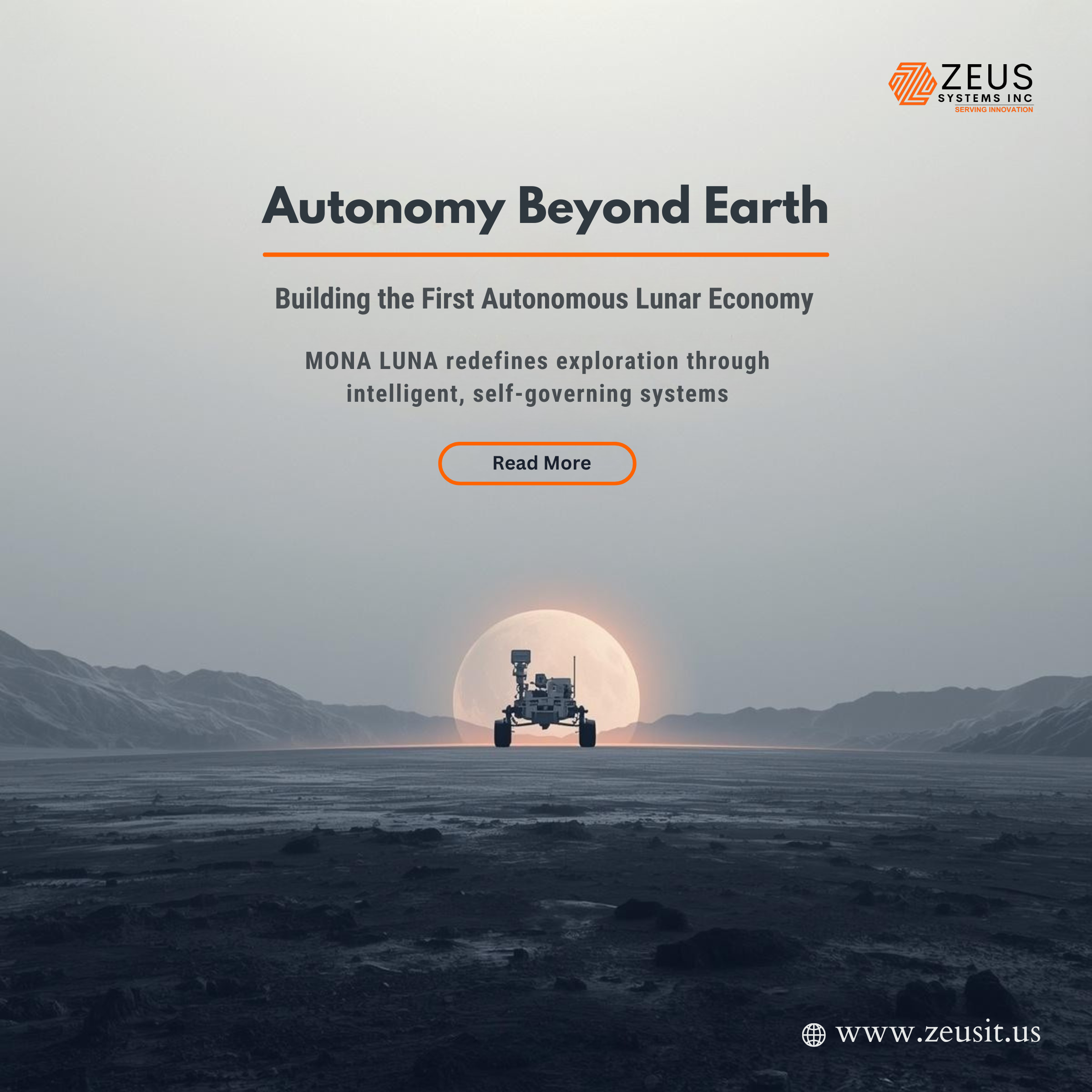
For decades, lunar exploration has been constrained by two fundamental challenges: extreme terrain unpredictability and dependence on human-controlled operations. While missions led by organizations like NASA and ISRO have successfully demonstrated robotic mobility on the Moon, the next leap forward demands something radically different complete autonomy under hostile, unknown conditions.
Enter MONA LUNA a next-generation AI-powered lunar rover system designed not just to explore, but to independently mine, adapt, and build the foundations of permanent off-world habitats without human intervention.
This is not an incremental improvement. It represents a paradigm shift: from remote-controlled machines to self-governing extraterrestrial industrial agents.
The Problem: The Moon Is Not Just Empty It’s Unpredictable
Unlike Earth, the Moon presents a chaotic and unforgiving landscape:
Jagged regolith with inconsistent density
Craters with unstable slopes exceeding 30 degrees
Electrostatic dust that interferes with sensors
Extreme temperature gradients (-173°C to +127°C)
Communication delays and blackout zones
Traditional rovers rely heavily on pre-mapped routes and human decision loops, which break down in such environments. Even slight terrain miscalculations can lead to immobilization a fate suffered by multiple historical missions.
MONA LUNA addresses this not by improving mapping but by eliminating the need for certainty altogether.
MONA LUNA: A Self-Evolving Intelligence System
At its core, MONA LUNA is not a rover it is a distributed AI cognition platform embedded within a physical mobility system.
Key Architectural Layers
Perceptual Layer (LUNA-SENSE)
Multi-spectral terrain scanning
Subsurface radar for detecting voids and ice deposits
Dust-penetrating LiDAR alternatives
Cognitive Layer (MONA Core AI)
Real-time terrain reasoning using probabilistic physics models
Self-learning navigation policies via reinforcement evolution
Contextual risk assessment (not just obstacle avoidance)
Execution Layer (Adaptive Mobility System)
Shape-shifting wheel-leg hybrid actuators
Dynamic traction redistribution
Micro-adjustment balancing at millisecond intervals
Swarm Intelligence Protocol (Optional Multi Rover Mode)
Collective decision-making without central control
Resource allocation based on emergent needs
Failure compensation via peer adaptation
AI Navigation: Beyond Pathfinding
Traditional navigation answers: “How do I get from A to B?” MONA LUNA instead asks: “What is the safest, most energy-efficient, and mission-optimal way to exist within this terrain?”
1. Terrain Understanding as a Living Model
Instead of static mapping, MONA LUNA builds a continuously evolving terrain consciousness:
Each grain interaction updates soil behavior models
Slopes are not angles they are probabilistic collapse zones
Shadows are analyzed for temperature traps and energy risks
2. Predictive Failure Simulation
Before taking a step, the AI runs thousands of micro-simulations:
Wheel sink probability
Slip vectors under varying torque
Structural stress under uneven load
This enables preemptive adaptation, not reactive correction.
3. Emotional AI Without Emotion
A groundbreaking concept: MONA LUNA uses synthetic “survival instincts”:
“Caution bias” increases in unknown zones
“Exploration drive” rises when resource probability spikes
“Fatigue modeling” limits risk when energy reserves drop
This mimics biological resilience without human input.
Conquering Uneven Terrain: The Mobility Revolution
MONA LUNA’s hardware is inseparable from its intelligence.
Hybrid Wheel-Leg System
Wheels morph into clawed structures for steep climbs
Independent articulation allows movement even if 50% of contact points fail
Capable of traversing:
Loose dust plains
Rocky ejecta fields
Crater walls
Micro-Adaptive Suspension
Instead of passive suspension:
Each joint reacts in real time to terrain feedback
AI redistributes weight dynamically
Prevents tipping even on shifting surfaces
Self-Recovery Mechanisms
If immobilized:
The rover reconfigures its geometry
Uses controlled vibrations to escape regolith traps
Calls swarm units (if available) for cooperative extraction
Resource Mining: The True Mission
Exploration is no longer the goal resource independence is.
Target Resources
Water ice (for fuel and life support)
Helium-3 (future fusion potential)
Rare earth metals
Autonomous Mining Workflow
Detection Subsurface scanning identifies high-probability resource zones
Validation AI performs micro-drills and analyzes samples in situ
Extraction
Precision excavation minimizes energy waste
Dust suppression techniques prevent contamination
Processing Onboard refinement into usable forms (e.g., water extraction, oxygen separation)
Storage or Deployment Materials are either stored or used immediately for infrastructure
Zero-Human Oversight: The Ultimate Leap
The defining feature of MONA LUNA is its ability to operate indefinitely without human control.
How This Is Achieved
Autonomous Goal Setting The system redefines mission priorities based on environmental feedback
Self-Healing Software AI rewrites parts of its own code within safe boundaries
Hardware Redundancy Intelligence Instead of backup systems, it uses adaptive repurposing (e.g., converting a failed sensor into a limited-function substitute)
Ethical Constraint Layer Ensures mission alignment without human intervention
Building Permanent Off-World Habitats
MONA LUNA is not just a miner it is a precursor to extraterrestrial civilization.
Infrastructure Capabilities
Autonomous construction using regolith-based 3D printing
Terrain leveling for landing zones
Subsurface habitat carving for radiation protection
Energy Systems
Solar field deployment optimized by AI
Thermal energy storage in lunar regolith
Habitat Preparation
Oxygen generation from lunar soil
Water extraction and storage
Structural integrity testing for human arrival
The Bigger Vision: A Self-Sustaining Lunar Ecosystem
Imagine a network of MONA LUNA units:
Mining resources continuously
Building infrastructure autonomously
Repairing and replicating systems
Expanding operations without Earth intervention
This transforms the Moon into:
A self-sustaining industrial outpost before humans even arrive.
Challenges and Ethical Considerations
Risks
AI decision drift over long durations
Resource over-extraction without oversight
System-wide failure in swarm logic
Ethical Questions
Should AI have autonomy in extraterrestrial environments?
Who owns resources mined without human presence?
Can self-evolving systems remain aligned with human intent?
These questions will define not just space exploration but the future of intelligence itself.
Conclusion: The Dawn of Autonomous Cosmic Industry
MONA LUNA represents a fundamental shift:
From exploration exploitation (in the constructive sense)
From control trust in autonomous intelligence
From temporary missions permanent presence
If successful, it will mark the moment humanity stopped visiting space and started living and building beyond Earth.
For decades, the architecture of industrial enterprises followed a rigid separation. Information Technology (IT) governed data, analytics, and enterprise systems, while Operational Technology (OT) controlled the physical processes of machines, robotics, and industrial automation.
This separation once made sense.
IT systems were designed for information processing, scalability, and decision-making, while OT systems were engineered for deterministic control, reliability, and real-time physical operations.
But Industry 4.0 is dismantling this boundary.
Factories are no longer static production sites; they are becoming living computational ecosystems—networks of robots, sensors, analytics engines, and autonomous decision systems.
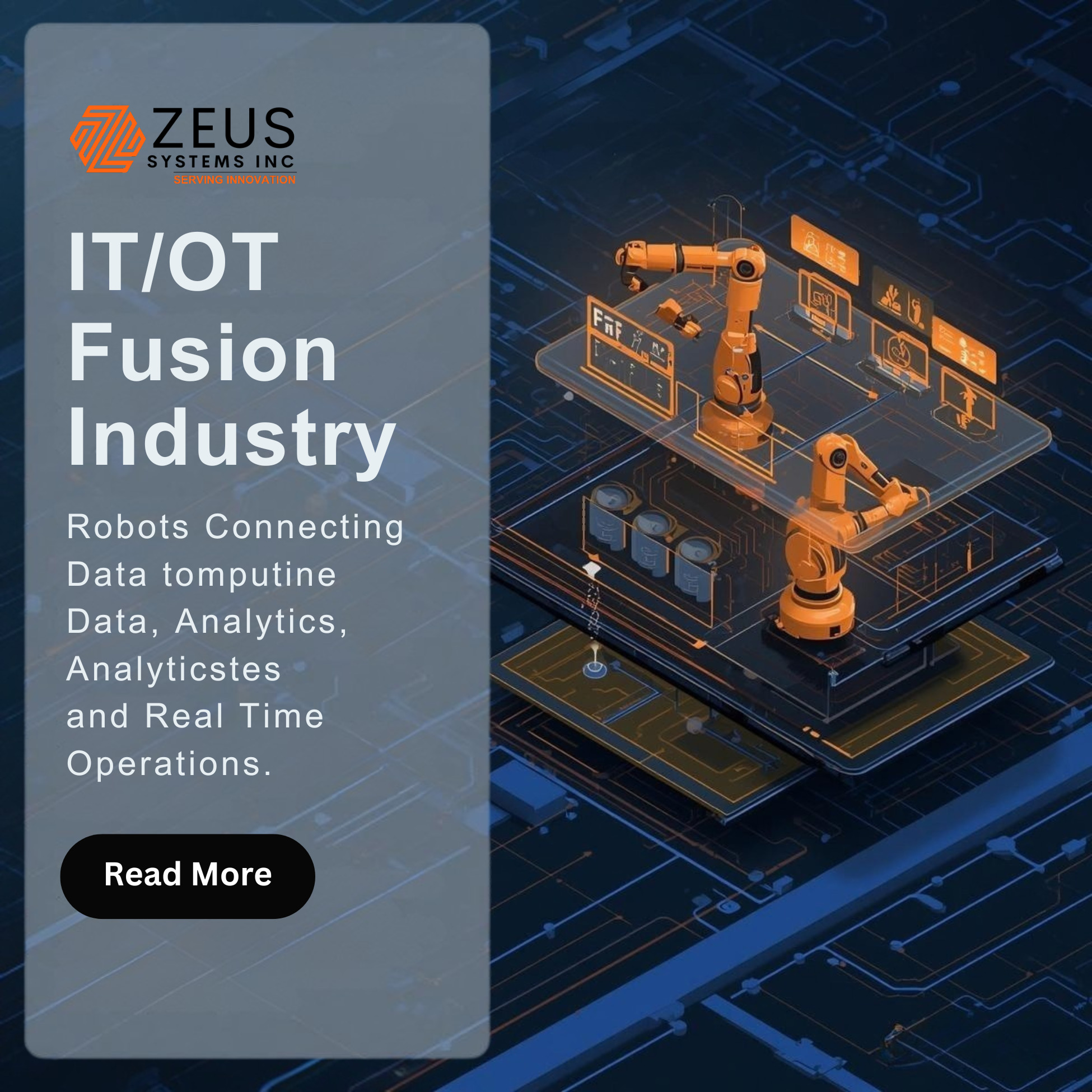
At the center of this transformation is IT/OT fusion, where versatile industrial robots combine real-time operational control with cloud-scale data analytics.
This convergence is driving a new wave of industrial automation valued at tens of billions of dollars globally, enabling capabilities that were previously impossible:
Autonomous predictive maintenance
Self-optimizing production lines
Real-time supply chain adaptation
Digital twins and simulation-driven manufacturing
Self-healing factory infrastructure
In this new industrial paradigm, robots are no longer just mechanical arms.
They are intelligent cyber-physical agents.
The Evolution from Automation to Intelligent Autonomy
Traditional industrial robots were deterministic machines.
They executed predefined sequences:
Pick → Place → Weld → Repeat
Their behavior was governed by:
PLC controllers
hard-coded motion paths
static process parameters
Any change required manual reprogramming.
This architecture created three major limitations:
Lack of adaptability
Limited process visibility
Reactive maintenance
Factories could only respond to problems after they occurred.
The rise of Industrial Internet of Things (IIoT) and advanced analytics is changing this paradigm.
Today’s robotic systems operate within a data-rich environment where machines continuously exchange operational data with enterprise systems and analytics platforms.
Instead of isolated equipment, factories are becoming connected intelligence networks.
What IT/OT Fusion Actually Means
To understand the magnitude of this transformation, we must understand the difference between the two worlds being fused.
Operational Technology (OT)
OT refers to systems that interact with physical processes.
Examples include:
PLCs (Programmable Logic Controllers)
SCADA systems
industrial robots
machine sensors
manufacturing equipment
OT systems are optimized for:
real-time control
reliability
deterministic response
Information Technology (IT)
IT systems manage:
enterprise data
analytics
cloud infrastructure
ERP/MES platforms
machine learning models
IT focuses on:
scalability
data processing
integration
decision intelligence
IT/OT Convergence
IT/OT convergence integrates these domains so that operational machines generate real-time data that feeds analytics systems, which in turn influence machine behavior.
This integration enables:
predictive maintenance
performance optimization
adaptive production scheduling
real-time decision-making.
In essence:
OT executes. IT analyzes. Fusion allows machines to self-optimize.
The Rise of Versatile Industrial Robots
The next generation of robotics is fundamentally different from the rigid industrial robots of the past.
These machines are versatile robotic platforms, characterized by:
1. Sensor-rich perception
Robots are equipped with:
vibration sensors
thermal cameras
torque sensors
LiDAR
vision systems
These sensors generate massive streams of operational data.
2. Edge computing capabilities
Instead of sending all data to the cloud, robots process information locally using edge AI processors.
This enables sub-millisecond decision loops.
3. Cloud-connected intelligence
Operational data flows into cloud analytics systems where machine learning models detect patterns across entire factory networks.
4. Autonomous decision loops
Robots can adjust:
motion paths
production speed
calibration
maintenance schedules
This creates a continuous feedback loop between digital analytics and physical action.
Architecture of a Self-Adaptive Factory
The modern adaptive factory operates through four interconnected layers.
1. Sensing Layer (OT Infrastructure)
This layer includes:
industrial sensors
robots
PLC controllers
vision systems
Machines generate operational data such as:
vibration frequency
motor temperature
cycle time
torque loads
2. Edge Intelligence Layer
Edge gateways process data locally using:
AI inference models
anomaly detection algorithms
streaming analytics
This layer enables instant operational decisions.
3. Cloud Analytics Layer
Aggregated factory data is analyzed using:
machine learning
predictive models
digital twins
data lakes
These systems detect patterns across entire production lines.
4. Control Feedback Layer
Insights generated by analytics are sent back to machines.
Robots then autonomously adjust:
process parameters
operational timing
maintenance intervals
This creates a closed-loop adaptive manufacturing system.
Predictive Maintenance: The First Major Breakthrough
One of the most transformative outcomes of IT/OT fusion is predictive maintenance.
Traditional maintenance models fall into three categories:
Model
Approach
Drawback
Reactive
Fix after failure
Downtime
Preventive
Fixed schedule maintenance
Over-maintenance
Predictive
Data-driven predictions
Requires analytics
Predictive maintenance analyzes sensor data such as:
vibration patterns
temperature fluctuations
electrical load variations
These signals reveal early signs of mechanical degradation.
Machine learning models can detect failure patterns days or weeks before breakdowns occur.
This enables factories to schedule maintenance before failure happens, dramatically reducing downtime.
Research in intelligent manufacturing demonstrates how AI systems can combine multiple sensor streams to detect tool wear, equipment degradation, and operational anomalies with high accuracy.
Autonomous Failure Anticipation
The next step beyond predictive maintenance is autonomous failure anticipation.
In this model, the system not only predicts failures but also acts automatically.
Example scenario:
A robot detects abnormal vibration in a motor bearing.
Edge AI confirms anomaly patterns.
Cloud analytics predicts failure in 96 hours.
The system automatically:
orders replacement parts
schedules maintenance during planned downtime
adjusts production load to reduce stress on the machine
This is known as a self-healing production environment.
Factories transition from maintenance planning to autonomous operational resilience.
Digital Twins and Simulation-Based Manufacturing
Another powerful outcome of IT/OT convergence is the rise of digital twins.
A digital twin is a virtual replica of a physical factory or machine.
It continuously synchronizes with real-world operational data.
This allows manufacturers to:
simulate production changes
test robotics configurations
predict process bottlenecks
optimize workflows
Modern robotics deployments increasingly rely on digital simulation before physical installation to anticipate performance issues and optimize workflows.
This dramatically reduces deployment risk and commissioning time.
Real-Time Factory Adaptation
The most revolutionary capability of IT/OT fusion is real-time adaptive manufacturing.
Factories can now respond dynamically to:
supply chain disruptions
demand fluctuations
equipment health changes
energy optimization requirements
Example scenario:
A sudden spike in product demand triggers:
ERP systems adjusting production targets
MES systems reallocating resources
Robots modifying task assignments
Automated scheduling across assembly lines
The result is self-adjusting production ecosystems.
Market Momentum: The Multi-Billion Dollar Transformation
The economic impact of IT/OT convergence is enormous.
Several industry forces are driving this growth:
Industrial robotics expansion
Factories worldwide are rapidly deploying advanced robotics systems.
Smart manufacturing initiatives
Governments and enterprises are investing heavily in Industry 4.0 programs.
AI-driven automation
Machine learning models now power predictive operations.
Edge computing adoption
Processing data at the machine level reduces latency and bandwidth demands.
Together, these forces are pushing robotics installations into a multi-billion-dollar global market, with adaptive and intelligent robotics representing the fastest growing segment.
Organizational Transformation: The Human Factor
Technology alone cannot drive IT/OT fusion.
It also requires organizational transformation.
Historically:
IT teams focused on enterprise systems
OT teams focused on industrial reliability
These groups operated in separate silos.
Industry discussions often highlight that the biggest challenge in IT/OT convergence is not technical compatibility but organizational alignment and collaboration between teams.
Successful organizations create cross-disciplinary engineering teams that include:
software engineers
robotics specialists
data scientists
industrial engineers
The factory of the future is as much a software system as a mechanical one.
Cybersecurity Challenges in Converged Environments
Integrating IT and OT also introduces new cybersecurity risks.
Traditional OT systems were:
isolated
air-gapped
closed networks
Connecting them to cloud platforms and enterprise networks expands the attack surface.
A compromised industrial control system could disrupt production or damage equipment.
Therefore modern IT/OT architectures require:
zero-trust security models
network segmentation
real-time anomaly detection
secure industrial communication protocols
Security becomes a core pillar of digital manufacturing infrastructure.
The Emergence of Autonomous Factories
The long-term trajectory of IT/OT fusion leads to a radical concept:
The Autonomous Factory
In an autonomous factory:
machines self-monitor
robots self-adjust
systems self-heal
production self-optimizes
Human engineers transition from operators to orchestrators of intelligent systems.
Factories become adaptive cyber-physical organisms capable of evolving in real time.
The Next Frontier: Cognitive Robotics
The next phase of industrial robotics will introduce cognitive capabilities.
Future robots will integrate:
generative AI planning
multimodal perception
reinforcement learning
real-time digital twins
These systems will not simply execute instructions.
They will reason about manufacturing objectives.
For example:
Instead of programming:
Pick component A → place in slot B
Engineers will specify goals:
Optimize assembly throughput with minimal energy usage
The robotic system will determine how to achieve that objective autonomously.
Conclusion: The Industrial Intelligence Era
The convergence of IT and OT is not merely a technological upgrade.
It represents the birth of industrial intelligence.
By merging:
robotics
data analytics
AI
edge computing
cloud platforms
Factories are evolving into self-aware production ecosystems.
Versatile robots are the physical embodiment of this transformation.
They translate digital insight into mechanical action.
As these systems mature, the future factory will no longer rely on static programming or reactive maintenance.
Instead, it will function as a living, learning system capable of anticipating problems, adapting to change, and continuously optimizing itself.
The fusion of IT and OT is not simply the next phase of automation. It is the foundation of the autonomous industrial age.
The Penguin-Inspired Lab Robot That Could Redefine Autonomous Science
The Convergence of Biology, AI Cognition, and Robotics
For decades, laboratory automation has followed a predictable trajectory: robotic arms, conveyor systems, and sterile automated workstations performing repetitive tasks with mechanical precision. But a new wave of bio-inspired robotics and embodied artificial intelligence is beginning to redefine how machines interact with the physical world.
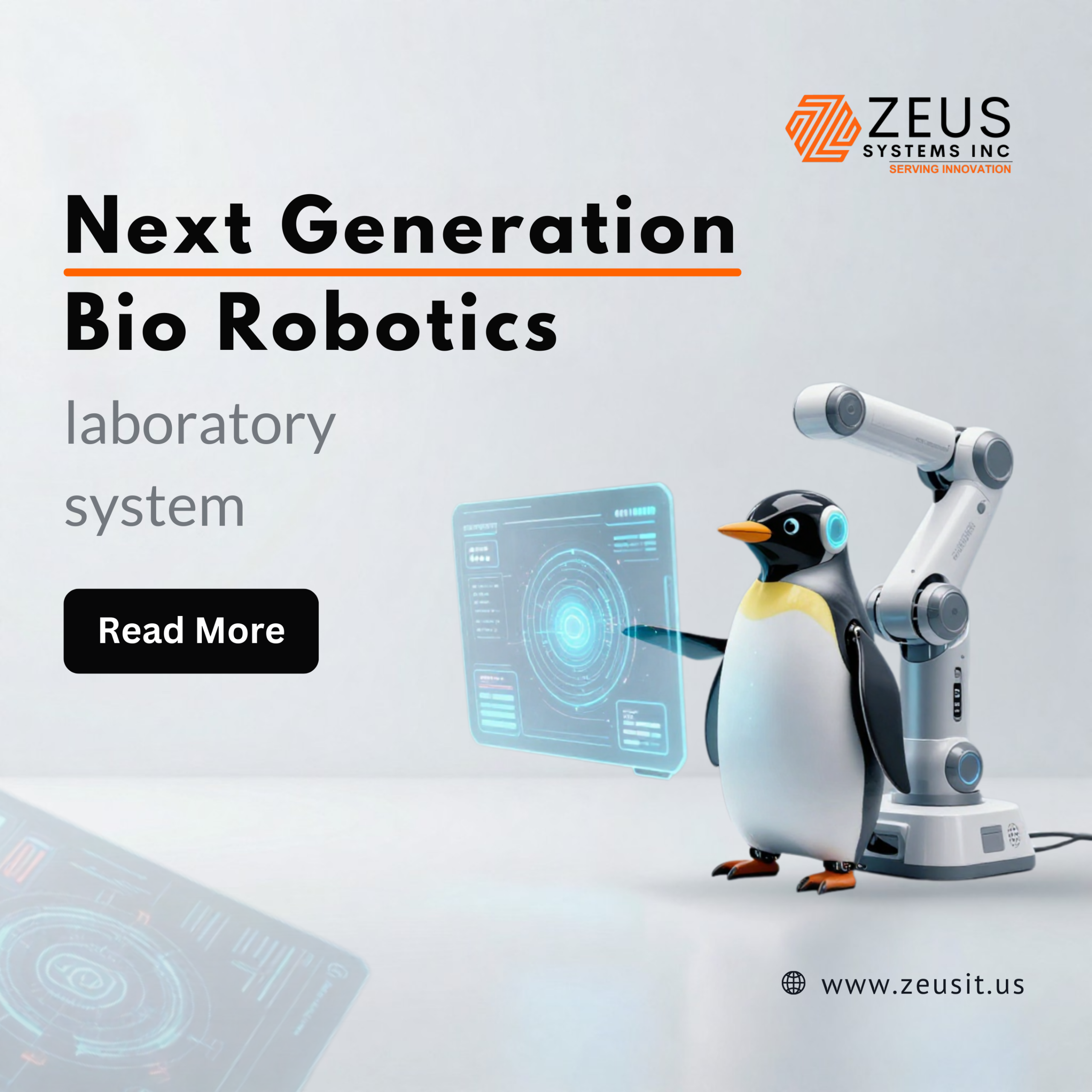
One experimental concept emerging at the intersection of these disciplines is White Rabbit Bio-Robotics, a next-generation hybrid robotic platform envisioned by the innovation lab Penguins Innovate. The concept fuses organic-inspired locomotion, AI reasoning, and vision-language-action cognition to produce an acrobatic robotic system capable of performing delicate laboratory tasks with unprecedented agility.
The robot’s intelligence layer is powered by a cognitive framework inspired by Vision-Language-Action (VLA) models, which integrate perception, language reasoning, and physical action in a unified system. These architectures enable robots to interpret instructions, understand their environment, and execute complex physical tasks autonomously.
In essence, White Rabbit represents a radical shift: from rigid automation to embodied robotic intelligence.
The Birth of Bio-Robotic Penguins
Traditional lab robots resemble industrial machinery—heavy, precise, but fundamentally limited. They perform predefined tasks but struggle with unstructured environments.
Researchers behind the White Rabbit concept took a different approach.
Instead of designing robots like machines, they began designing them like animals.
The inspiration came from one of nature’s most efficient movement specialists: the penguin. Penguins combine stability, balance, and energy efficiency in harsh environments. Their gait allows them to traverse ice, swim underwater, and maintain remarkable equilibrium.
This biological insight led to a new robotics architecture: Bio-Robotic Penguins.
Unlike wheeled robots or rigid robotic arms, the White Rabbit robot moves using a bio-mechanical gait system modeled after penguin locomotion. Its structure integrates:
dynamic balance control
adaptive limb articulation
compliant materials that mimic muscle-tendon elasticity
The result is a robot capable of micro-precision movements combined with acrobatic balance—a capability rarely seen in lab automation systems.
The Spirit AI Cognition Layer
Physical agility alone is not enough. Laboratory work requires context, interpretation, and reasoning.
To achieve this, White Rabbit integrates a hypothetical cognitive architecture known as Spirit AI, a vision-language-action intelligence system.
VLA models are a rapidly evolving category of AI that merges perception, language understanding, and robotic control into a single neural system. These models can understand natural language instructions, interpret visual scenes, and translate them directly into motor actions.
For example, instead of programming a robot with rigid instructions, researchers could simply tell White Rabbit:
“Prepare three microfluidic samples and place them in the centrifuge.”
The Spirit AI system would then:
Visually identify the required lab equipment.
Plan the sequence of actions.
Execute precise motor movements to complete the task.
The fusion of language, vision, and robotics closes the gap between human instruction and machine execution.
Organic Motion: The Secret to Laboratory Precision
One of the most fascinating aspects of White Rabbit is its organic movement system.
Most robots rely on rigid joints and servo motors. While precise, these systems struggle with delicate manipulation tasks such as:
pipetting microscopic volumes
handling fragile biological samples
adjusting instruments in tight laboratory spaces
White Rabbit introduces adaptive soft-actuator joints, which behave more like biological muscles.
These actuators allow the robot to perform:
smooth micro-movements
dynamic balance adjustments
real-time force control
The penguin-inspired locomotion combined with soft robotics enables acrobatic precision, allowing the robot to navigate cluttered laboratory environments while maintaining stability.
Autonomous Laboratory Intelligence
In a typical biotech laboratory, researchers perform hundreds of repetitive tasks daily:
sample preparation
microscopy adjustments
reagent mixing
instrument calibration
White Rabbit is designed to automate these tasks using context-aware autonomy.
Its sensor suite includes:
multi-angle vision systems
tactile sensors
environmental monitoring
spatial mapping algorithms
The system continuously builds a digital twin of the laboratory environment, enabling the robot to adapt to changing conditions.
This level of awareness is critical because laboratory environments are inherently dynamic—equipment moves, experiments change, and protocols evolve.
A New Paradigm: Robotic Scientists
The ultimate goal of White Rabbit is not merely automation.
It is robotic scientific collaboration.
Future iterations could allow the robot to participate in research workflows by:
proposing experimental setups
optimizing lab protocols
autonomously running experiments overnight
Combined with advanced AI reasoning systems, such robots could dramatically accelerate discovery in fields such as:
pharmaceutical development
synthetic biology
materials science
climate research
This vision aligns with emerging research in embodied reasoning, where AI systems combine cognitive reasoning with physical interaction to perform complex tasks.
The Hardware Architecture
The White Rabbit system is designed around a modular hardware platform.
Key components include:
1. Bio-Dynamic Locomotion Frame
penguin-inspired balance mechanics
compliant joint structures
2. Multi-Modal Sensor Array
high-resolution cameras
depth sensors
tactile feedback sensors
3. Neural Robotics Processor
edge AI processor for real-time inference
GPU acceleration for vision models
4. Environmental Mapping System
spatial AI
object recognition
5. Adaptive Manipulation Arms
soft robotic grippers
precision pipetting modules
From Smart Devices to Embodied AI
The idea of intelligent physical devices is already beginning to emerge in consumer technology.
For example, the smart AI device white rabbit smart automation device, developed by Penguins Innovate, demonstrates how AI systems can combine sensors, cameras, and automation to interact with users and adapt to their environment. The device can track movement, respond to voice commands, and integrate multiple smart-home functions into a single AI-driven system.
While designed for consumer environments, such technologies hint at how AI-driven hardware could evolve toward fully autonomous embodied systems.
White Rabbit Bio-Robotics represents the next step in that trajectory.
Why Bio-Robotics Is the Future
Biology has spent millions of years optimizing motion, balance, and efficiency.
Robotics researchers are increasingly realizing that the most advanced machines may not look like machines at all.
Instead, they may resemble living organisms.
Bio-robotic systems offer several advantages:
Energy efficiency Organic motion requires less energy than rigid mechanical systems.
Adaptability Soft structures can handle unpredictable environments.
These traits make bio-robotics particularly suited for scientific laboratories and healthcare environments.
The Coming Age of Autonomous Laboratories
Imagine a laboratory operating 24 hours a day with minimal human intervention.
Researchers define hypotheses.
Robots design experiments.
AI systems analyze results.
White Rabbit-style robots could serve as the physical workforce of this autonomous research ecosystem.
Such systems could dramatically accelerate discovery timelines.
Drug discovery that currently takes 10–15 years might shrink to months.
Materials development could happen in continuous automated cycles.
Challenges Ahead
Despite its promise, the path toward bio-robotic laboratory assistants is complex.
Several technical hurdles remain:
Robust reasoning in physical environments
AI must reliably translate abstract instructions into precise actions.
Safety in biological laboratories
Robots must operate safely around hazardous materials.
Standardized robotic protocols
Laboratory workflows vary widely between institutions.
However, rapid advances in AI and robotics suggest these challenges may soon be overcome.
The Next Frontier of Robotics
White Rabbit Bio-Robotics represents a powerful idea:
robots that move like animals, think like scientists, and work like tireless laboratory assistants.
The fusion of bio-inspired mechanics, embodied AI cognition, and vision-language-action intelligence could usher in a new era where machines do more than automate tasks—they participate in discovery.
If realized, systems like White Rabbit may mark the beginning of the Autonomous Science Revolution. And in that future, laboratories may no longer be run solely by human researchers—but by collaborative ecosystems of humans and intelligent bio-robots.
As robotic systems increasingly enter unstructured human environments, traditional paradigms based on extensive labeled datasets and task-specific engineering are no longer adequate. Inspired by biological intelligence — which thrives on learning from sparse experience — this article proposes a framework for minimal-data robot learning that combines few-shot learning, self-supervised trial-generation, and dynamic embodiment adaptation. We argue that the next breakthrough in robotic autonomy will not come from larger models trained on bigger datasets, but from systems that learn more with less — leveraging principles from neural plasticity, motor synergies, and intrinsic motivation. We introduce the concept of “Neural/Physical Coupled Memory” (NPCM) and propose new research directions that transcend current state of the art.
1. The Problem: Robots Learn Too Much From Too Much
Contemporary robot learning relies heavily on:
Large labeled datasets (supervised imitation learning),
Simulated task replay with domain randomization,
Reward-based reinforcement learning requiring thousands of episodes.
However, biological organisms often learn tasks in minutes, not millions of trials, and generalize abilities to novel contexts without explicit instruction. Robots, by contrast, are brittle outside their training distribution.
We propose a new paradigm: bio-inspired minimal data learning, where robotic systems can acquire robust, generalizable behaviors using very few real interactions.
2. Biological Inspirations for Minimal Data Learning
Biology demonstrates several principles that can transform robot learning:
a. Sparse but Structured Experiences
Humans do not need millions of repetitions to learn to grasp a cup — structured interactions and feedback rich perception facilitate learning.
b. Motor Synergy Primitives
Biological motor control reuses synergies — low-dimensional action primitives. Efficient robot control can similarly decompose motion into reusable modules.
c. Intrinsic Motivation
Animals explore driven by curiosity, novelty, and surprise — not explicit external rewards. This suggests integrating self-guided exploration in robots to form internal representations.
d. Memory Consolidation
Unlike replay buffers in RL, biological memory consolidates through sleep and biological processes. Robots could simulate a similar offline structural consolidation to strengthen representations after minimal real interactions.
3. Core Contributions: New Concepts and Frameworks
3.1 Neural/Physical Coupled Memory (NPCM)
We introduce NPCM, a unified memory architecture that binds:
Neural representations — abstract task features,
Physical dynamics — embodied context such as joint states, force feedback, and proprioception.
Unlike current neural networks, NPCM would store embodied experience traces that encode both sensory observations and the physical consequences of actions. This enables:
Recall of how interactions felt and changed the world;
Rapid adaptation of strategies when faced with novel constraints;
Continuous update of the action–consequence manifold without large replay datasets.
Example: A robot learns to balance a flexible object by encoding not just actions but the change in physical stability — enabling transfer to other unstable objects with minimal new examples.
3.2 Self-Supervised Trial Generation (SSTG)
Instead of collecting labeled data, robots can generate self-supervised pseudo-tasks through controlled perturbations. These perturbations produce diverse interaction outcomes that enrich representation learning without human annotation.
Key difference from standard methods:
Not random exploration — perturbations are guided by intrinsic uncertainty;
Data is structured by outcome classes discovered by the agent itself;
Self-supervised goals emerge dynamically from prediction errors.
This yields few-shot learning seeds that the robot can combine into larger capabilities.
3.3 Cross-Modal Synergy Transfer (CMST)
Biology seamlessly integrates vision, touch, and proprioception. We propose a mechanism to transfer skill representations across modalities such that learning in one sensory channel immediately improves others.
Novel point: Most multi-modal work fuses data at input level; CMST fuses at a structural representation level, allowing:
Learned visual affordances to immediately bootstrap tactile understanding;
Motor actions to reorganize proprioceptive maps dynamically.
4. Innovative Applications
4.1 Task-Agnostic Skill Libraries
Instead of storing task labels, the robot builds experience graphs — small collections of interaction motifs that can recombine into new task solutions.
Hypothesis: Robots that store interaction motifs rather than task policies will:
Require fewer examples to generalize;
Be robust to novel constraints;
Discover behaviors humans did not predefine.
4.2 Embodied Cause-Effect Prediction
Robots actively predict the physical consequences of actions relative to their current body configuration. This embodied prediction allows inference of affordances without external supervision. Minimal data becomes sufficient if prediction systems capture the physics priors of actions.
5. A Roadmap for Minimal Data Robot Autonomy
We propose five research thrusts:
NPCM Architecture Development: Integrate neural and physical memory traces.
Guided Self-Supervision Algorithms: From curiosity to intrinsic task discovery.
Hierarchical Motor Synergy Libraries: Reusable, composable motor modules.
Human-Robot Shared Representations: Enabling robots to internalize human corrections with minimal examples.
6. Challenges and Ethical Considerations
Safety in self-supervised perturbations: Systems must bound exploration to safe regions.
Representational transparency: Embodied memories must be interpretable for debugging.
Transfer understanding: Robots must not overgeneralize from few examples where contexts differ significantly.
7. Conclusion: Learning Less to Learn More The future of robot learning lies not in bigger datasets but in smarter learning mechanisms. By emulating how biological organisms learn from minimal data, leveraging sparse interactions, intrinsic motivation, and coupled memory structures, robots can become capable agents in unseen environments with unprecedented efficiency.
Cross-Disciplinary Synthesis Papers: Integrating Cognitive Science, Design Ethics, and Systems Engineering to Reframe AI Safety and Reliability
The rapid integration of AI into socio-technical systems reveals a fundamental truth: traditional safety frameworks are no longer adequate. AI is not just a software artifact — it interacts with human cognition, social systems, and complex engineering infrastructures in nonlinear and unpredictable ways. To confront this reality, we propose a New Synthesis Paradigm for AI Safety and Reliability — one that inherently bridges cognitive science, design ethics, and systems engineering. This triadic synthesis reframes safety from a risk-mitigation checklist into a dynamic, embodied, human-centered, ethically grounded, system-adaptive discipline. This article identifies theoretical gaps across each domain and proposes integrative frameworks that can drive future research and responsible deployment of AI.
1. Introduction — Why a New Synthesis is Required
For decades, AI safety efforts have been dominated by technical compliance (robustness metrics, verification proofs, adversarial testing). These are necessary but insufficient. The real challenges AI poses today are fundamentally human-system challenges — failures that emerge not from code errors alone, but from how systems interact with human cognition, values, and complex environments.
Three domains — cognitive science, design ethics, and systems engineering — offer deep insights into human–machine interaction, ethical value structures, and complex reliability dynamics, respectively. Yet, these domains largely operate in isolation. Our core thesis is that without a synthesized meta-framework, AI safety will continue to produce fragmented solutions rather than robust, anticipatory intelligence governance.
2. Cognitive Dynamics of Trustworthy AI
2.1 Human Cognitive Models vs. AI Decision Architectures
AI systems today are optimized for performance metrics — accuracy, latency, throughput. Human cognition, however, functions on heuristic reasoning, bounded rationality, and social meaning-making. When AI decisions contradict cognitive expectations, trust fractures.
Proposal:Cognitive Alignment Metrics (CAM) — a new set of safety indicators that measure how well AI explanations, outputs, and interactions fit human cognitive models, not just technical correctness.
Groundbreaking Aspect: CAM proposes internal cognitive resonance scoring, evaluating AI behavior based on how interpretable and psychologically meaningful decisions are to different cognitive archetypes.
2.2 Cognitive Load and Safety Thresholds
Humans overwhelmed by AI complexity make more errors — a form of interactive unreliability that current reliability engineering ignores.
Proposal: Establish Cognitive Load Safety Thresholds (CLST) — formal limits to AI complexity in user interfaces that exceed human processing capacities.
3. Ethics by Design — Beyond Fairness and Cost Functions
Current ethical AI debates center on fairness metrics, bias audits, or constrained optimization with ethical weighting. These remain too static and decontextualized.
3.1 Embedded Ethical Agency
AI should not merely avoid bias; it should participate in ethical reasoning ecosystems.
Proposal:Ethics Participation Layers (EPL) — modular ethical reasoning modules that adapt moral evaluations based on cultural contexts, stakeholder inputs, and real-time consequences, not fixed utility functions.
3.2 Ethical Legibility
An AI is “safe” only if its ethical reasoning is legible — not just explainable but ethically interpretable to diverse stakeholders.
This introduces a new field: Moral Transparency Engineering — the design of AI systems whose ethical decision structures can be audited and interrogated by humans with different moral frameworks.
4. Systems Engineering — AI as Dynamic Ecology
Traditional systems engineering treats components in well-defined interaction loops; AI introduces non-stationary feedback loops, emergent behaviors, and shifting goals.
4.1 Emergent Coupling and Cascade Effects
AI systems influence social behavior, which then changes input distributions — a feedback redistribution loop.
Proposal:Emergent Reliability Maps (ERM) — analytical tools for modeling how AI induces higher-order effects across socio-technical environments. ERMs capture cascade dynamics, where small changes in AI outputs can generate large, unintended system-wide effects.
4.2 Adaptive Safety Engineering
Safety is not a static constraint but a continually evolving property.
Introduce Safety Adaptation Zones (SAZ) — zones of system operation where safety indicators dynamically reconfigure according to environment shifts, human behavior changes, and ethical context signals.
5. The Triadic Synthesis Framework
We propose Cognitive–Ethical–Systemic (CES) Synthesis, which merges cognitive alignment, ethical participation, and systemic dynamics into a unified operational paradigm.
5.1 CES Core Principles
Human-Centered Predictive Modeling: AI must be assessed not just for correctness, but for human cognitive resonance and predictive intelligibility.
Ethical Co-Governance: AI systems should embed ethical reasoning capabilities that interact with human stakeholders in real-time, including mechanisms for dissent, negotiation, and moral contestation.
Dynamic Systems Reliability: Reliability is a time-adaptive property, contingent on feedback loops and environmental coupling, requiring continuous monitoring and adjustment.
5.2 Meta-Safety Metrics
We propose a new set of multi-dimensional indicators:
Cognitive Affinity Index (CAI)
Ethical Responsiveness Quotient (ERQ)
Systemic Emergence Stability (SES)
Together, they form a safety reliability vector rather than a scalar score.
6. Implementation Roadmap (Research Agenda)
To operationalize the CES Framework:
Build Cognitive Affinity Benchmarks by collaborating with neuroscientists and UX researchers.
Develop Ethical Participation Libraries that can be plugged into AI reasoning pipelines.
Simulate Emergent Systems using hybrid agent-based and control systems models to validate ERMs and SAZs.
7. Conclusion — A New Era of Meaningful AI Safety AI safety must evolve into a synthesis discipline: one that accepts complexity, human cognition, and ethics as equal pillars. The future of dependable AI lies not in tightening constraints around failures, but in amplifying human-aligned intelligence that can navigate moral landscapes and dynamic engineering environments.
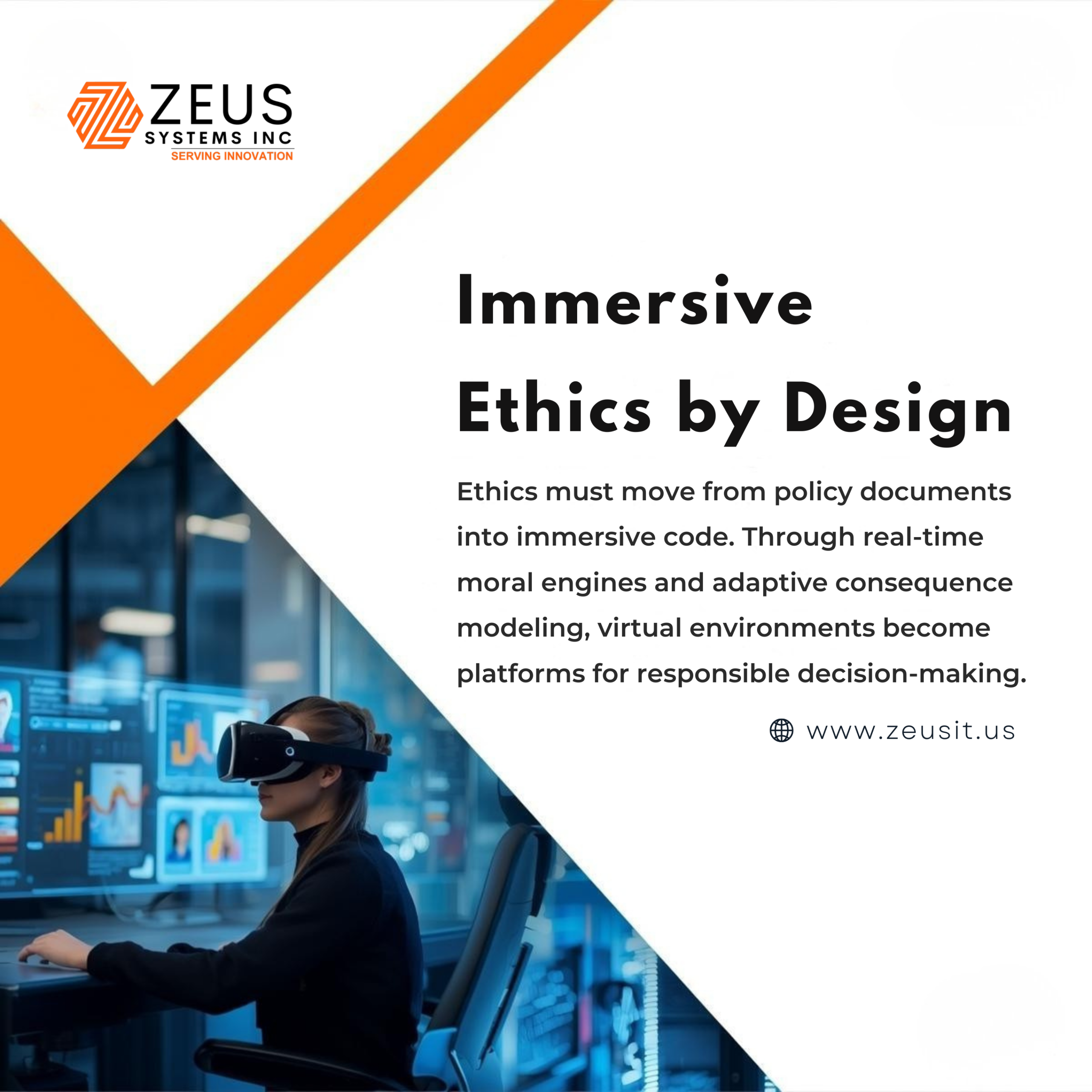
As extended reality (XR) technologies – including virtual reality (VR), augmented reality (AR), and mixed reality (MR) – become ubiquitous, a new imperative emerges: ethics must no longer be an external afterthought or separate educational module. The future of XR demands immersive ethics-by-design: ethical reasoning woven into the very texture of virtual experiences.
While user-centered design, usability, and safety frameworks are relatively established, ethical decision-making within XR — not just about XR — remains nascent. Current research tends to focus on ethical standards (e.g., privacy, consent), yet rarely on ethics as interactive experience and skill embedded into the XR medium itself.
This article proposes a groundbreaking paradigm: XR environments that teach ethics while users live, feel, and practice them in real time, transforming ethics from passive theory to dynamic, embodied reasoning.
1. From Passive Ethics to Immersive Ethical Capacitation
Traditional ethics education – whether in philosophy classes, compliance training, or corporate modules – is static, abstract, and reflective. XR holds the potential to shift:
From:
Abstract principles learned through text and lectures
Delayed ethical reflection (after the fact)
Hypothetical scenarios disconnected from personal consequences
To:
Dynamic ethical scenarios lived in first-person
Immediate feedback loops on moral choices
Consequential outcomes that affect the virtual and real self
In this model, ethics is not talked about – it is experienced.
2. The “Ethical Physics Engine”: A Real-Time Moral Feedback Layer
One of the most radical innovations for this paradigm is the concept of an ethical physics engine – an AI-driven layer analogous to a game’s physics engine, but for ethics:
What It Is
A computational engine embedded within XR that:
Interprets user actions in context
Models ethical frameworks (deontology, utilitarianism, virtue ethics, care ethics)
Provides real-time ethical reasoning feedback
How It Works
Imagine an XR training simulation for public health decision-making:
You choose to allocate limited vaccines
The ethical engine analyzes your choice through multiple ethical lenses
The system adapts the environment, offering consequences and new dilemmas
You see how your choice affects virtual populations, future health outcomes, or trust in virtual communities
This goes beyond “good vs. bad” choices – it displays ethical trade-offs, helping users internalize complex moral reasoning through experience rather than memorization.
3. Curricula That Live Inside XR Worlds, Not Outside Them
Most XR ethics training today is external: users watch videos or go through slide decks before entering an XR environment. This article proposes curricula that unfold within the XR experience itself – nested learning moments woven into the narrative fabric of the virtual world:
Examples of Embedded Curricula
Moral Ecology Zones XR environments where ethical tensions organically arise from the physics, rules, and community behaviors in that world (e.g., resource scarcity, identity conflicts, cooperation vs. competition)
Virtual Consequence Cascades Decisions ripple forward, generating unexpected challenges that reveal ethical interdependence (e.g., choosing to reveal a companion’s secret may gain you access but harms long-term alliance)
Adaptive Ethical Personas NPCs (non-player characters) who change in response to users’ decisions, creating evolving moral landscapes rather than static scripted lessons
4. Ethical Metrics Beyond Performance – Measuring Moral Fluency
Current XR learning systems measure proficiency via task completion, accuracy, or time — but not ethical fluency.
To truly embed ethics by design, XR needs quantitative and qualitative metrics that reflect ethical reasoning and character development.
Proposed Ethical Metrics
Intent Alignment Scores: How aligned are actions with stated goals vs. community well-being?
Moral Dissonance Indicators: How frequently do users face decisions that cause internal conflict?
Virtue Development Tracking: Longitudinal measurement of traits like empathy, fairness, and courage through behavioral patterns
Narrative Impact Scores: How decisions affect the virtual ecosystem (trust levels, cooperation indices, ecosystem health)
These metrics do not judge morality in a simplistic good/bad binary — they model ethical growth trajectories.
5. Ethics as Emergent System, Not Rule Checkbox
Most corporate and academic ethics training relies on rules and policy checklists. Immersive ethics-by-design reframes ethics as an emergent system – like weather patterns, social behaviors, or complex ecosystems.
Rather than “Follow this rule,” learners experience:
Open-ended moral ambiguity
Conflicting values with no clear resolution
Consequences that are systemic, not isolated
This aligns with real life, where ethical decisions rarely have clean answers.
6. Tools That Power Immersive Ethical XR
Below are some speculative tools and systems that could propel this paradigm:
🔹 Moral Ontology Frameworks
AI models organizing ethical principles into interconnected, machine-interpretable networks. These frameworks allow XR engines to reason analogically – mapping principles to lived scenarios dynamically.
🔹 Ethics Narrative Engines
Narrative generation tools that adapt plots in real time based on user moral choices, creating endless unique ethical journeys rather than linear scripts.
🔹 Emotion-Ethics Sensors
Physiological and behavioral sensors (eye tracking, galvanic skin response, gaze patterns) that help the system infer ethical engagement and emotional resonance, adapting complexity accordingly.
🔹 Collective Ethics Simulators
Networked XR spaces where groups co-create narratives, and the system tracks collective ethical dynamics – including conflict, cooperation, and cultural norms evolution.
7. Beyond Individual Learning: Social and Cultural Ethics in XR
Ethics is not just personal – it’s cultural. Immersive ethics-by-design must address:
Cultural plurality: Multiple moral frameworks co-existing
Norm negotiation: How users from different backgrounds negotiate shared norms
Power dynamics: Recognizing and redistributing agency and influence in virtual ecosystems
These themes are especially urgent as XR worlds become social spaces – from community hubs to virtual workplaces.
Conclusion: Towards a Moral Metaverse
The urgent challenge for XR designers, educators, and researchers is no longer “How do we teach ethics?” but:
How do we experience ethics through XR as lived practice, dynamic reflection, and embodied reasoning?
By designing XR systems with:
Real-time moral engines
Embedded curricula woven into narratives
Metrics that value ethical growth
Tools that model emotional, social, and systemic complexity
we can evolve virtual environments into spaces that cultivate not just smarter users – but wiser ones. Immersive ethics-by-design isn’t a future academic aspiration – it is the next essential frontier for responsible XR.