
In the realm of artificial intelligence, few developments have captured the imagination quite like OpenAI’s ChatGPT. Wit ...

info@zeusit.us
+1 (248) 658 8644
In the realm of artificial intelligence, few developments have captured the imagination quite like OpenAI’s ChatGPT. Wit ...
In the realm of technological innovation, cloud technology continues to evolve, captivating hearts and minds alike. With ...
the conversational companion that brings a touch of humanity to our digital interactions. What is Chat GPT?A Conversa ...
A journey to the 3D mapping using drones. The latest trend in 3D mapping using drones revolves around enhanced precis ...
For decades, healthcare digitization has been trapped behind glass—mobile apps, dashboards, telemedicine windows. Even ...
For decades, lunar exploration has been constrained by two fundamental challenges: extreme terrain unpredictability and ...
For decades, the architecture of industrial enterprises followed a rigid separation.Information Technology (IT) governe ...
The Penguin-Inspired Lab Robot That Could Redefine Autonomous Science The Convergence of Biology, AI Cognition, and ...
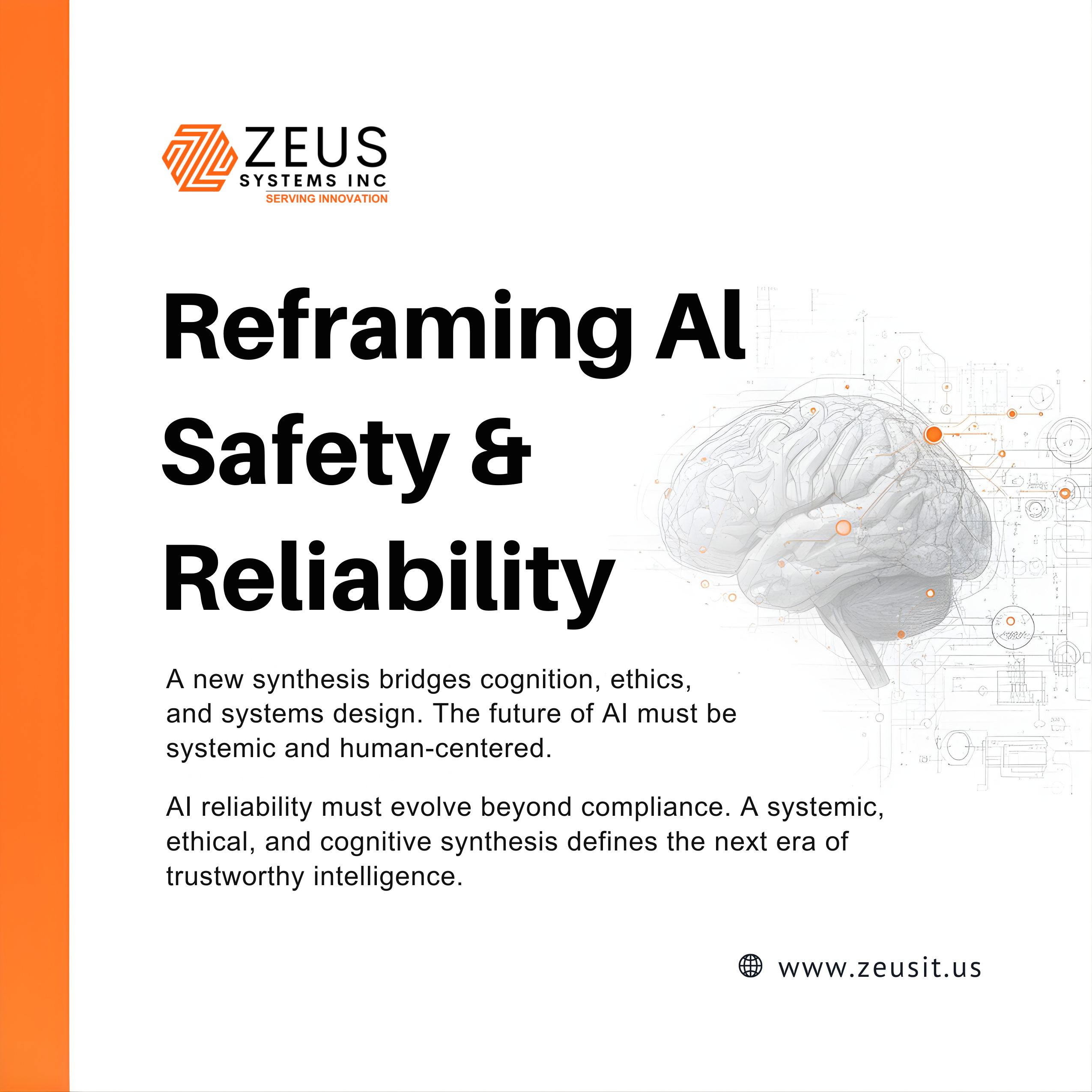
Cross-Disciplinary Synthesis Papers: Integrating Cognitive Science, Design Ethics, and Systems Engineering to Reframe AI Safety and Reliability
The rapid integration of AI into socio-technical systems reveals a fundamental truth: traditional safety frameworks are no longer adequate. AI is not just a software artifact — it interacts with human cognition, social systems, and complex engineering infrastructures in nonlinear and unpredictable ways. To confront this reality, we propose a New Synthesis Paradigm for AI Safety and Reliability — one that inherently bridges cognitive science, design ethics, and systems engineering. This triadic synthesis reframes safety from a risk-mitigation checklist into a dynamic, embodied, human-centered, ethically grounded, system-adaptive discipline. This article identifies theoretical gaps across each domain and proposes integrative frameworks that can drive future research and responsible deployment of AI.
1. Introduction — Why a New Synthesis is Required
For decades, AI safety efforts have been dominated by technical compliance (robustness metrics, verification proofs, adversarial testing). These are necessary but insufficient. The real challenges AI poses today are fundamentally human-system challenges — failures that emerge not from code errors alone, but from how systems interact with human cognition, values, and complex environments.
Three domains — cognitive science, design ethics, and systems engineering — offer deep insights into human–machine interaction, ethical value structures, and complex reliability dynamics, respectively. Yet, these domains largely operate in isolation. Our core thesis is that without a synthesized meta-framework, AI safety will continue to produce fragmented solutions rather than robust, anticipatory intelligence governance.
2. Cognitive Dynamics of Trustworthy AI
2.1 Human Cognitive Models vs. AI Decision Architectures
AI systems today are optimized for performance metrics — accuracy, latency, throughput. Human cognition, however, functions on heuristic reasoning, bounded rationality, and social meaning-making. When AI decisions contradict cognitive expectations, trust fractures.
2.2 Cognitive Load and Safety Thresholds
Humans overwhelmed by AI complexity make more errors — a form of interactive unreliability that current reliability engineering ignores.
3. Ethics by Design — Beyond Fairness and Cost Functions
Current ethical AI debates center on fairness metrics, bias audits, or constrained optimization with ethical weighting. These remain too static and decontextualized.
3.1 Embedded Ethical Agency
AI should not merely avoid bias; it should participate in ethical reasoning ecosystems.
3.2 Ethical Legibility
An AI is “safe” only if its ethical reasoning is legible — not just explainable but ethically interpretable to diverse stakeholders.
4. Systems Engineering — AI as Dynamic Ecology
Traditional systems engineering treats components in well-defined interaction loops; AI introduces non-stationary feedback loops, emergent behaviors, and shifting goals.
4.1 Emergent Coupling and Cascade Effects
AI systems influence social behavior, which then changes input distributions — a feedback redistribution loop.
4.2 Adaptive Safety Engineering
Safety is not a static constraint but a continually evolving property.
5. The Triadic Synthesis Framework
We propose Cognitive–Ethical–Systemic (CES) Synthesis, which merges cognitive alignment, ethical participation, and systemic dynamics into a unified operational paradigm.
5.1 CES Core Principles
5.2 Meta-Safety Metrics
We propose a new set of multi-dimensional indicators:
Together, they form a safety reliability vector rather than a scalar score.
6. Implementation Roadmap (Research Agenda)
To operationalize the CES Framework:
7. Conclusion — A New Era of Meaningful AI Safety AI safety must evolve into a synthesis discipline: one that accepts complexity, human cognition, and ethics as equal pillars. The future of dependable AI lies not in tightening constraints around failures, but in amplifying human-aligned intelligence that can navigate moral landscapes and dynamic engineering environments.