
In the realm of artificial intelligence, few developments have captured the imagination quite like OpenAI’s ChatGPT. Wit ...

info@zeusit.us
+1 (248) 658 8644
In the realm of artificial intelligence, few developments have captured the imagination quite like OpenAI’s ChatGPT. Wit ...
In the realm of technological innovation, cloud technology continues to evolve, captivating hearts and minds alike. With ...
the conversational companion that brings a touch of humanity to our digital interactions. What is Chat GPT?A Conversa ...
A journey to the 3D mapping using drones. The latest trend in 3D mapping using drones revolves around enhanced precis ...
For decades, lunar exploration has been constrained by two fundamental challenges: extreme terrain unpredictability and ...
For decades, the architecture of industrial enterprises followed a rigid separation.Information Technology (IT) governe ...
The Penguin-Inspired Lab Robot That Could Redefine Autonomous Science The Convergence of Biology, AI Cognition, and ...
As robotic systems increasingly enter unstructured human environments, traditional paradigms based on extensive labeled ...
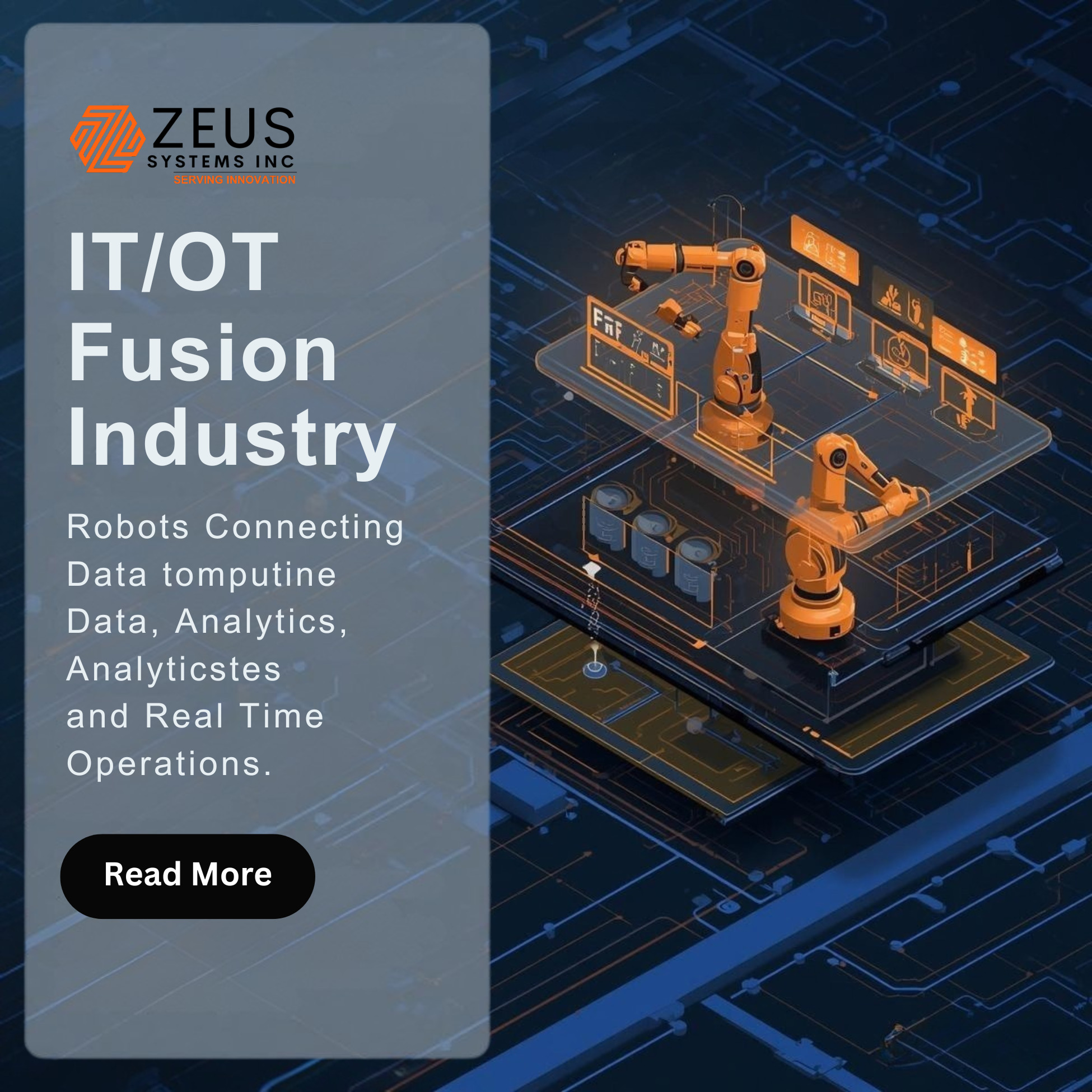
For decades, the architecture of industrial enterprises followed a rigid separation.
Information Technology (IT) governed data, analytics, and enterprise systems, while Operational Technology (OT) controlled the physical processes of machines, robotics, and industrial automation.
This separation once made sense.
IT systems were designed for information processing, scalability, and decision-making, while OT systems were engineered for deterministic control, reliability, and real-time physical operations.
But Industry 4.0 is dismantling this boundary.
Factories are no longer static production sites; they are becoming living computational ecosystems—networks of robots, sensors, analytics engines, and autonomous decision systems.
At the center of this transformation is IT/OT fusion, where versatile industrial robots combine real-time operational control with cloud-scale data analytics.
This convergence is driving a new wave of industrial automation valued at tens of billions of dollars globally, enabling capabilities that were previously impossible:
In this new industrial paradigm, robots are no longer just mechanical arms.
They are intelligent cyber-physical agents.
The Evolution from Automation to Intelligent Autonomy
Traditional industrial robots were deterministic machines.
They executed predefined sequences:
Pick → Place → Weld → Repeat
Their behavior was governed by:
Any change required manual reprogramming.
This architecture created three major limitations:
Factories could only respond to problems after they occurred.
The rise of Industrial Internet of Things (IIoT) and advanced analytics is changing this paradigm.
Today’s robotic systems operate within a data-rich environment where machines continuously exchange operational data with enterprise systems and analytics platforms.
Instead of isolated equipment, factories are becoming connected intelligence networks.
What IT/OT Fusion Actually Means
To understand the magnitude of this transformation, we must understand the difference between the two worlds being fused.
Operational Technology (OT)
OT refers to systems that interact with physical processes.
Examples include:
OT systems are optimized for:
Information Technology (IT)
IT systems manage:
IT focuses on:
IT/OT Convergence
IT/OT convergence integrates these domains so that operational machines generate real-time data that feeds analytics systems, which in turn influence machine behavior.
This integration enables:
In essence:
OT executes.
IT analyzes.
Fusion allows machines to self-optimize.
The Rise of Versatile Industrial Robots
The next generation of robotics is fundamentally different from the rigid industrial robots of the past.
These machines are versatile robotic platforms, characterized by:
1. Sensor-rich perception
Robots are equipped with:
These sensors generate massive streams of operational data.
2. Edge computing capabilities
Instead of sending all data to the cloud, robots process information locally using edge AI processors.
This enables sub-millisecond decision loops.
3. Cloud-connected intelligence
Operational data flows into cloud analytics systems where machine learning models detect patterns across entire factory networks.
4. Autonomous decision loops
Robots can adjust:
This creates a continuous feedback loop between digital analytics and physical action.
Architecture of a Self-Adaptive Factory
The modern adaptive factory operates through four interconnected layers.
1. Sensing Layer (OT Infrastructure)
This layer includes:
Machines generate operational data such as:
2. Edge Intelligence Layer
Edge gateways process data locally using:
This layer enables instant operational decisions.
3. Cloud Analytics Layer
Aggregated factory data is analyzed using:
These systems detect patterns across entire production lines.
4. Control Feedback Layer
Insights generated by analytics are sent back to machines.
Robots then autonomously adjust:
This creates a closed-loop adaptive manufacturing system.
Predictive Maintenance: The First Major Breakthrough
One of the most transformative outcomes of IT/OT fusion is predictive maintenance.
Traditional maintenance models fall into three categories:
| Model | Approach | Drawback |
| Reactive | Fix after failure | Downtime |
| Preventive | Fixed schedule maintenance | Over-maintenance |
| Predictive | Data-driven predictions | Requires analytics |
Predictive maintenance analyzes sensor data such as:
These signals reveal early signs of mechanical degradation.
Machine learning models can detect failure patterns days or weeks before breakdowns occur.
This enables factories to schedule maintenance before failure happens, dramatically reducing downtime.
Research in intelligent manufacturing demonstrates how AI systems can combine multiple sensor streams to detect tool wear, equipment degradation, and operational anomalies with high accuracy.
Autonomous Failure Anticipation
The next step beyond predictive maintenance is autonomous failure anticipation.
In this model, the system not only predicts failures but also acts automatically.
Example scenario:
This is known as a self-healing production environment.
Factories transition from maintenance planning to autonomous operational resilience.
Digital Twins and Simulation-Based Manufacturing
Another powerful outcome of IT/OT convergence is the rise of digital twins.
A digital twin is a virtual replica of a physical factory or machine.
It continuously synchronizes with real-world operational data.
This allows manufacturers to:
Modern robotics deployments increasingly rely on digital simulation before physical installation to anticipate performance issues and optimize workflows.
This dramatically reduces deployment risk and commissioning time.
Real-Time Factory Adaptation
The most revolutionary capability of IT/OT fusion is real-time adaptive manufacturing.
Factories can now respond dynamically to:
Example scenario:
A sudden spike in product demand triggers:
The result is self-adjusting production ecosystems.
Market Momentum: The Multi-Billion Dollar Transformation
The economic impact of IT/OT convergence is enormous.
Several industry forces are driving this growth:
Industrial robotics expansion
Factories worldwide are rapidly deploying advanced robotics systems.
Smart manufacturing initiatives
Governments and enterprises are investing heavily in Industry 4.0 programs.
AI-driven automation
Machine learning models now power predictive operations.
Edge computing adoption
Processing data at the machine level reduces latency and bandwidth demands.
Together, these forces are pushing robotics installations into a multi-billion-dollar global market, with adaptive and intelligent robotics representing the fastest growing segment.
Organizational Transformation: The Human Factor
Technology alone cannot drive IT/OT fusion.
It also requires organizational transformation.
Historically:
These groups operated in separate silos.
Industry discussions often highlight that the biggest challenge in IT/OT convergence is not technical compatibility but organizational alignment and collaboration between teams.
Successful organizations create cross-disciplinary engineering teams that include:
The factory of the future is as much a software system as a mechanical one.
Cybersecurity Challenges in Converged Environments
Integrating IT and OT also introduces new cybersecurity risks.
Traditional OT systems were:
Connecting them to cloud platforms and enterprise networks expands the attack surface.
A compromised industrial control system could disrupt production or damage equipment.
Therefore modern IT/OT architectures require:
Security becomes a core pillar of digital manufacturing infrastructure.
The Emergence of Autonomous Factories
The long-term trajectory of IT/OT fusion leads to a radical concept:
The Autonomous Factory
In an autonomous factory:
Human engineers transition from operators to orchestrators of intelligent systems.
Factories become adaptive cyber-physical organisms capable of evolving in real time.
The Next Frontier: Cognitive Robotics
The next phase of industrial robotics will introduce cognitive capabilities.
Future robots will integrate:
These systems will not simply execute instructions.
They will reason about manufacturing objectives.
For example:
Instead of programming:
Pick component A → place in slot B
Engineers will specify goals:
Optimize assembly throughput with minimal energy usage
The robotic system will determine how to achieve that objective autonomously.
Conclusion: The Industrial Intelligence Era
The convergence of IT and OT is not merely a technological upgrade.
It represents the birth of industrial intelligence.
By merging:
Factories are evolving into self-aware production ecosystems.
Versatile robots are the physical embodiment of this transformation.
They translate digital insight into mechanical action.
As these systems mature, the future factory will no longer rely on static programming or reactive maintenance.
Instead, it will function as a living, learning system capable of anticipating problems, adapting to change, and continuously optimizing itself.
The fusion of IT and OT is not simply the next phase of automation. It is the foundation of the autonomous industrial age.