
In the realm of artificial intelligence, few developments have captured the imagination quite like OpenAI’s ChatGPT. Wit ...

info@zeusit.us
+1 (248) 658 8644
In the realm of artificial intelligence, few developments have captured the imagination quite like OpenAI’s ChatGPT. Wit ...
In the realm of technological innovation, cloud technology continues to evolve, captivating hearts and minds alike. With ...
the conversational companion that brings a touch of humanity to our digital interactions. What is Chat GPT?A Conversa ...
A journey to the 3D mapping using drones. The latest trend in 3D mapping using drones revolves around enhanced precis ...
For decades, the architecture of industrial enterprises followed a rigid separation.Information Technology (IT) governe ...
The Penguin-Inspired Lab Robot That Could Redefine Autonomous Science The Convergence of Biology, AI Cognition, and ...
As robotic systems increasingly enter unstructured human environments, traditional paradigms based on extensive labeled ...
Cross-Disciplinary Synthesis Papers: Integrating Cognitive Science, Design Ethics, and Systems Engineering to Reframe A ...
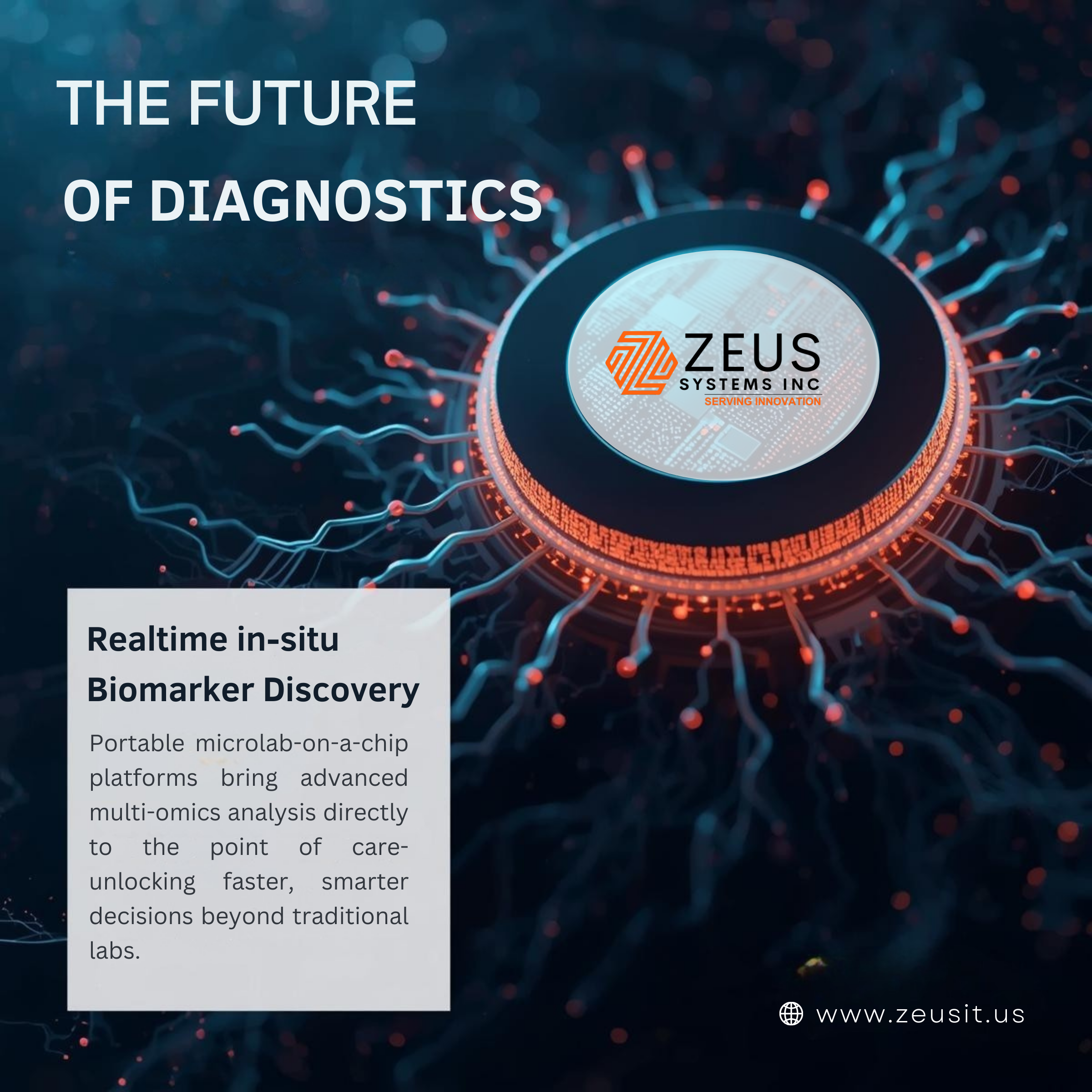
In a world increasingly shaped by sudden health crises, climate-induced disease shifts, and highly mobile populations, the traditional model of centralized laboratory diagnostics is approaching obsolescence. What if every front-line medic, field scientist, or global traveler could access real-time, in situ biomarker discovery and comprehensive omics insights — without relying on infrastructure? What if portable platforms could conduct on-device multi-omics analysis, instantly translate molecular signatures into clinical decisions, and adapt autonomously to new pathogens and biological states?
Today’s frontier is not merely miniaturization of lab instruments. The next leap is microlab-on-a-chip systems that think – and learn – on the edge.
The Paradigm Shift: From Central Labs to Cognitive Microlabs
Traditional Point of Care (PoC) diagnostics focus on predefined markers – glucose, specific antigens, CRP levels. These rely on centralized calibration, fixed assays, and frequent expert oversight. Real-time in situ biomarker discovery transforms this model by enabling:
This approach turns each device into a self-learning biosensing agent rather than a passive assay reader.
Future-Ready Core Innovations
Here are the transformative technologies that underpin this vision:
1. Autonomous Discovery Algorithms
Current biochips detect what they are programmed to detect. Tomorrow’s chips leverage:
This means a chip that says: “This pattern doesn’t match anything known – flag as novel, and alert for clinical review.”
2. Multi-Omics Integration On-Device
Current portable platform omics are siloed (e.g., DNA sequences on one machine, proteins on another). The next generation will:
This integrated lens enables mechanistic insight – not just presence/absence data.
3. Nanostructured Adaptive Interfaces
Sensing interfaces will be programmable at the nano scale. Consider:
Effectively, the sensor “reshapes” itself to better fit the biology it’s measuring – a form of physical adaptivity, not just software.
4. On-Chip Genetic Circuitry for In-Situ Self-Optimization
Borrowing from synthetic biology, future chips will embed genetic logic circuits that:
This introduces a form of computational biology directly within the sensing apparatus.
Redefining Clinical Decisions in the Field
In remote settings – disaster zones, rural clinics, space missions – the demand is not just fast results but actionable decisions. Real-time in situ systems will:
Rather than relying on judgment calls, clinicians gain evidence-graded intelligence instantaneously.
Beyond Human Medicine: A Planetary Health Lens
This is not only a tool for humans. Imagine:
Here, microlab-on-a-chip systems operate as planetary biosensors, embedding health intelligence into the fabric of our environments.
Ethical and Global Equity Considerations
With such power comes responsibility. These systems raise questions:
Design principles must mandate privacy-first architectures, open algorithm auditability, and equitable distribution frameworks.
Envisioning the Next Decade
What we propose is not incremental refinement – it’s a reimagining of biosensing and clinical decision-making:
| Today’s Standard | Future Microlab Paradigm |
| Lab-centralized assays | Distributed, autonomous discovery |
| Predefined target panels | Adaptive, unknown biomarker detection |
| Siloed omics | Integrated multi-omics on chip |
| Data export for analysis | On-device interpretation & action |
| Static calibration | Self-optimizing biochemical circuitry |
This evolution turns every chip into a frontier diagnostics platform – a sentinel of health.
Conclusion: The Dawn of Intelligent Bioplatforms Real-time in situ biomarker discovery with microlab-on-a-chip is more than a technology trend; it is a new operating system for biological understanding. Portable platforms performing on-device omics will usher in a world where health intelligence is immediate, adaptive, and universally deployable – a world where life’s molecular whispers can be heard before they become roars.