
In the realm of artificial intelligence, few developments have captured the imagination quite like OpenAI’s ChatGPT. Wit ...

info@zeusit.us
+1 (248) 658 8644
In the realm of artificial intelligence, few developments have captured the imagination quite like OpenAI’s ChatGPT. Wit ...
In the realm of technological innovation, cloud technology continues to evolve, captivating hearts and minds alike. With ...
the conversational companion that brings a touch of humanity to our digital interactions. What is Chat GPT?A Conversa ...
A journey to the 3D mapping using drones. The latest trend in 3D mapping using drones revolves around enhanced precis ...
For decades, healthcare digitization has been trapped behind glass—mobile apps, dashboards, telemedicine windows. Even ...
For decades, lunar exploration has been constrained by two fundamental challenges: extreme terrain unpredictability and ...
For decades, the architecture of industrial enterprises followed a rigid separation.Information Technology (IT) governe ...
The Penguin-Inspired Lab Robot That Could Redefine Autonomous Science The Convergence of Biology, AI Cognition, and ...
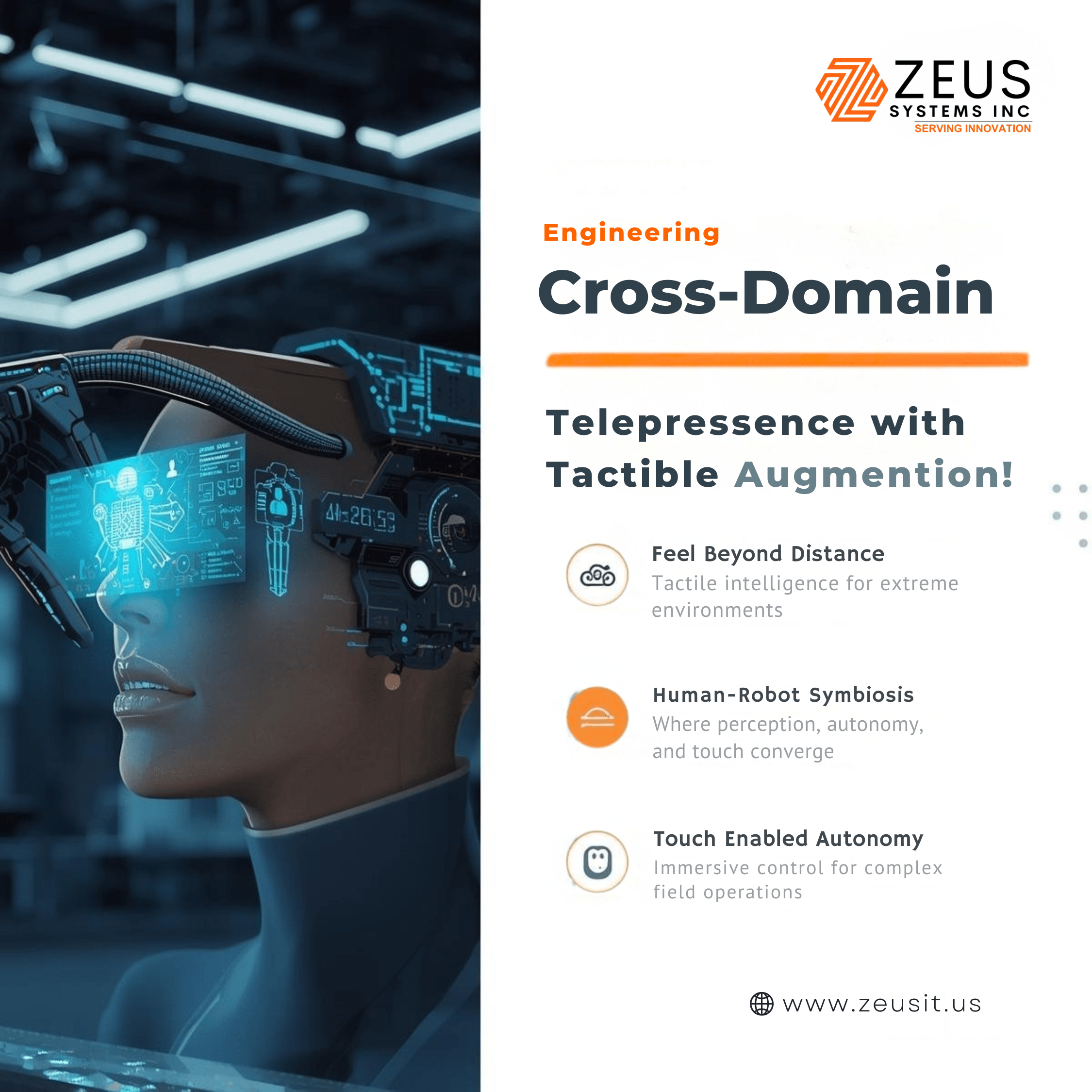
In a world where human presence is not always feasible – whether beneath ocean trenches, centuries-old archaeological ruins, or the unstable remains of disaster zones – robotic telepresence has opened new frontiers. Yet current systems are limited: they either focus on visual immersion, rely on physical isolation, or adopt simplistic remote control models. What if we transcended these limitations by blending tactile telepresence, immersive AR/VR, and coordinated swarm robotics into a single, unified paradigm?
This article charts a visionary landscape for Cross-Domain Robotic Telepresence with Tactile Augmentation, proposing systems that not only see and move but feel, think together, and adapt organically to the environment – enabling human-robot symbiosis across domains once considered unreachable.
The New Frontier of Telepresence: Beyond Sight and Sound
Traditional telepresence emphasizes visual and audio fidelity. However, human interaction with the world is deeply rooted in touch. From the weight of an artifact in the palm to the resistance of rubble during excavation, haptic feedback is fundamental to context and decision-making.
Tactile Augmentation: The Next Layer of Telepresence
Imagine a remote system that conveys:
This requires multilayered haptic channels:
These systems partner with human operators through wearable haptic suits that teach the robot how to feel and respond, rather than simply directing it.
AR/VR: Immersive Situational Understanding
Remote robots have sights and sensors, but situational understanding often lacks depth and context. Here, AR/VR fusion becomes the cognitive bridge between robot sensor arrays and human intuition.
Augmented Remote Perception
Operators wear AR/VR interfaces that integrate:
In deep-sea archaeology, for example, an AR interface could highlight probable artifact zones based on historical and geological datasets – guiding the operator’s focus beyond the raw video feed.
Synthetic Presence
Through embodied avatars and spatial audio, operators feel present in the remote domain, minimizing cognitive load and increasing engagement. This Presence Feedback Loop is critical for high-stakes decisions where milliseconds matter.
Swarm Robotics: Distributed Agency Across Challenging Terrains
Large, complex environments often outstrip the capabilities of a single robot. Swarm robotics — many small, autonomous agents working in concert – is naturally scalable, fault-tolerant, and adaptable.
A New Model: Human-Guided Swarm Cognition
Instead of micromanaging each robot, the system introduces:
Swarms become tactile proxies – small agents that scan, probe, and report nuanced data which the system synthesizes into a comprehensive tactile/ar map (T-Map).
Example Applications
The Tactile Telepresence Architecture
At the core of this vision is a new software-hardware architecture that unifies perception, action, and feedback:
1. Hybrid Sensor Mesh
Robots are equipped with:
Each contributes to a contextual data layer that informs both AI and human operators.
2. Predictive Feedback Loop
Using predictive AI, systems anticipate tactile responses before they fully materialize, reducing latency and enhancing operator feeling of presence.
3. Cognitive Shared Autonomy
Robots are not dumb extensions; they are partners. Shared autonomy lets robots propose actions, with the operator guiding, approving, or iterating.
4. Tele-Haptic Layer
This is the experiential layer:
This layer makes the remote world tangible.
Pushing the Boundaries: Novel Research Directions
1. Tactile Predictive Coding
Using deep networks to infer unseen surface properties based on limited interaction — enabling smoother exploration with fewer probes.
2. Swarm Tactility Synthesis
Aggregating tactile data from hundreds of micro-bots into coherent sensory maps that a human can interpret through haptic rendering.
3. Cross-Domain Adaptation
Systems learn to transfer haptic insights from one domain to another:
4. Emotional Telepresence Metrics
Beyond physical sensations, integrating emotional response metrics (stress estimate, operator confidence) into the control loop to adapt mission pacing and feedback intensity.
Ethical and Societal Dimensions
With such systems, we must ask:
Ethics frameworks need to evolve in lockstep with these technologies.
Conclusion: Toward a New Era of Remote Embodiment
Cross-domain robotic telepresence with tactile augmentation is not an incremental improvement – it is a paradigm shift. By fusing tactile feedback, immersive AR/VR, and swarm intelligence:
This vision lays the groundwork for autonomous exploration in places where humans once only dreamed of going. The engineering challenges are immense – but so too are the discoveries awaiting us beneath oceans, within ruins, and beyond the boundaries of what was once possible.