
In the realm of artificial intelligence, few developments have captured the imagination quite like OpenAI’s ChatGPT. Wit ...

info@zeusit.us
+1 (248) 658 8644
In the realm of artificial intelligence, few developments have captured the imagination quite like OpenAI’s ChatGPT. Wit ...
In the realm of technological innovation, cloud technology continues to evolve, captivating hearts and minds alike. With ...
the conversational companion that brings a touch of humanity to our digital interactions. What is Chat GPT?A Conversa ...
A journey to the 3D mapping using drones. The latest trend in 3D mapping using drones revolves around enhanced precis ...
For decades, lunar exploration has been constrained by two fundamental challenges: extreme terrain unpredictability and ...
For decades, the architecture of industrial enterprises followed a rigid separation.Information Technology (IT) governe ...
The Penguin-Inspired Lab Robot That Could Redefine Autonomous Science The Convergence of Biology, AI Cognition, and ...
As robotic systems increasingly enter unstructured human environments, traditional paradigms based on extensive labeled ...
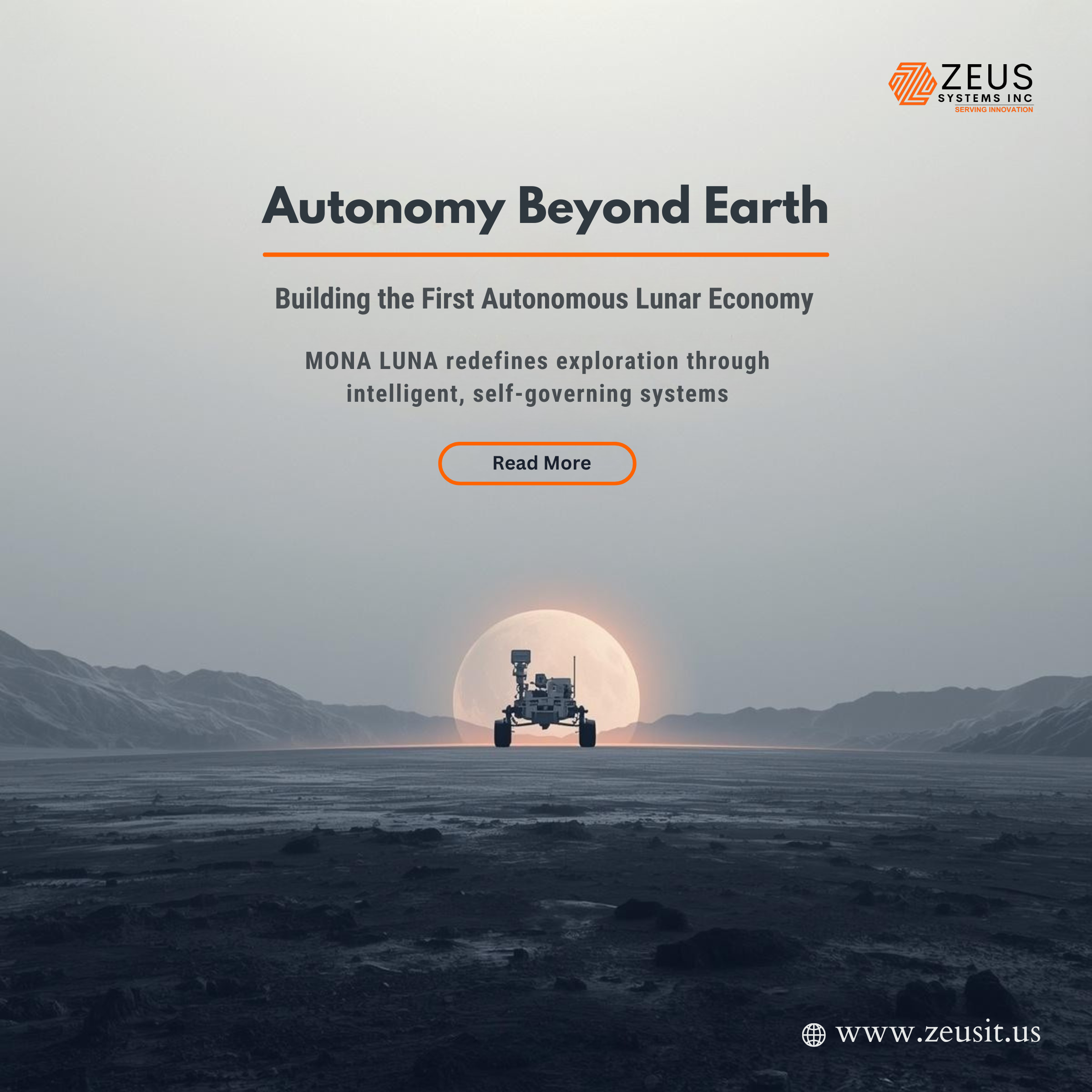
For decades, lunar exploration has been constrained by two fundamental challenges: extreme terrain unpredictability and dependence on human-controlled operations. While missions led by organizations like NASA and ISRO have successfully demonstrated robotic mobility on the Moon, the next leap forward demands something radically different complete autonomy under hostile, unknown conditions.
Enter MONA LUNA a next-generation AI-powered lunar rover system designed not just to explore, but to independently mine, adapt, and build the foundations of permanent off-world habitats without human intervention.
This is not an incremental improvement. It represents a paradigm shift: from remote-controlled machines to self-governing extraterrestrial industrial agents.
The Problem: The Moon Is Not Just Empty It’s Unpredictable
Unlike Earth, the Moon presents a chaotic and unforgiving landscape:
Traditional rovers rely heavily on pre-mapped routes and human decision loops, which break down in such environments. Even slight terrain miscalculations can lead to immobilization a fate suffered by multiple historical missions.
MONA LUNA addresses this not by improving mapping but by eliminating the need for certainty altogether.
MONA LUNA: A Self-Evolving Intelligence System
At its core, MONA LUNA is not a rover it is a distributed AI cognition platform embedded within a physical mobility system.
Key Architectural Layers
AI Navigation: Beyond Pathfinding
Traditional navigation answers: “How do I get from A to B?”
MONA LUNA instead asks:
“What is the safest, most energy-efficient, and mission-optimal way to exist within this terrain?”
1. Terrain Understanding as a Living Model
Instead of static mapping, MONA LUNA builds a continuously evolving terrain consciousness:
2. Predictive Failure Simulation
Before taking a step, the AI runs thousands of micro-simulations:
This enables preemptive adaptation, not reactive correction.
3. Emotional AI Without Emotion
A groundbreaking concept: MONA LUNA uses synthetic “survival instincts”:
This mimics biological resilience without human input.
Conquering Uneven Terrain: The Mobility Revolution
MONA LUNA’s hardware is inseparable from its intelligence.
Hybrid Wheel-Leg System
Micro-Adaptive Suspension
Instead of passive suspension:
Self-Recovery Mechanisms
If immobilized:
Resource Mining: The True Mission
Exploration is no longer the goal resource independence is.
Target Resources
Autonomous Mining Workflow
Zero-Human Oversight: The Ultimate Leap
The defining feature of MONA LUNA is its ability to operate indefinitely without human control.
How This Is Achieved
Building Permanent Off-World Habitats
MONA LUNA is not just a miner it is a precursor to extraterrestrial civilization.
Infrastructure Capabilities
Energy Systems
Habitat Preparation
The Bigger Vision: A Self-Sustaining Lunar Ecosystem
Imagine a network of MONA LUNA units:
This transforms the Moon into:
A self-sustaining industrial outpost before humans even arrive.
Challenges and Ethical Considerations
Risks
Ethical Questions
These questions will define not just space exploration but the future of intelligence itself.
Conclusion: The Dawn of Autonomous Cosmic Industry
MONA LUNA represents a fundamental shift:
If successful, it will mark the moment humanity stopped visiting space and started living and building beyond Earth.