
In the realm of artificial intelligence, few developments have captured the imagination quite like OpenAI’s ChatGPT. Wit ...

info@zeusit.us
+1 (248) 658 8644
In the realm of artificial intelligence, few developments have captured the imagination quite like OpenAI’s ChatGPT. Wit ...
In the realm of technological innovation, cloud technology continues to evolve, captivating hearts and minds alike. With ...
the conversational companion that brings a touch of humanity to our digital interactions. What is Chat GPT?A Conversa ...
A journey to the 3D mapping using drones. The latest trend in 3D mapping using drones revolves around enhanced precis ...
The next revolution in energy may not be built on empty land. It may already be parked outside our homes. Imagine a ...
The LEGO Computer: Could the Next Supercomputer Be Assembled From Chips Made by Different Companies? The future of c ...
How Telemedicine Is Becoming a Living Healthcare System For decades, healthcare has been organized around a simple u ...
Beyond Prediction: When Artificial Intelligence Becomes Biology's Creative Partner For decades, computational biolog ...
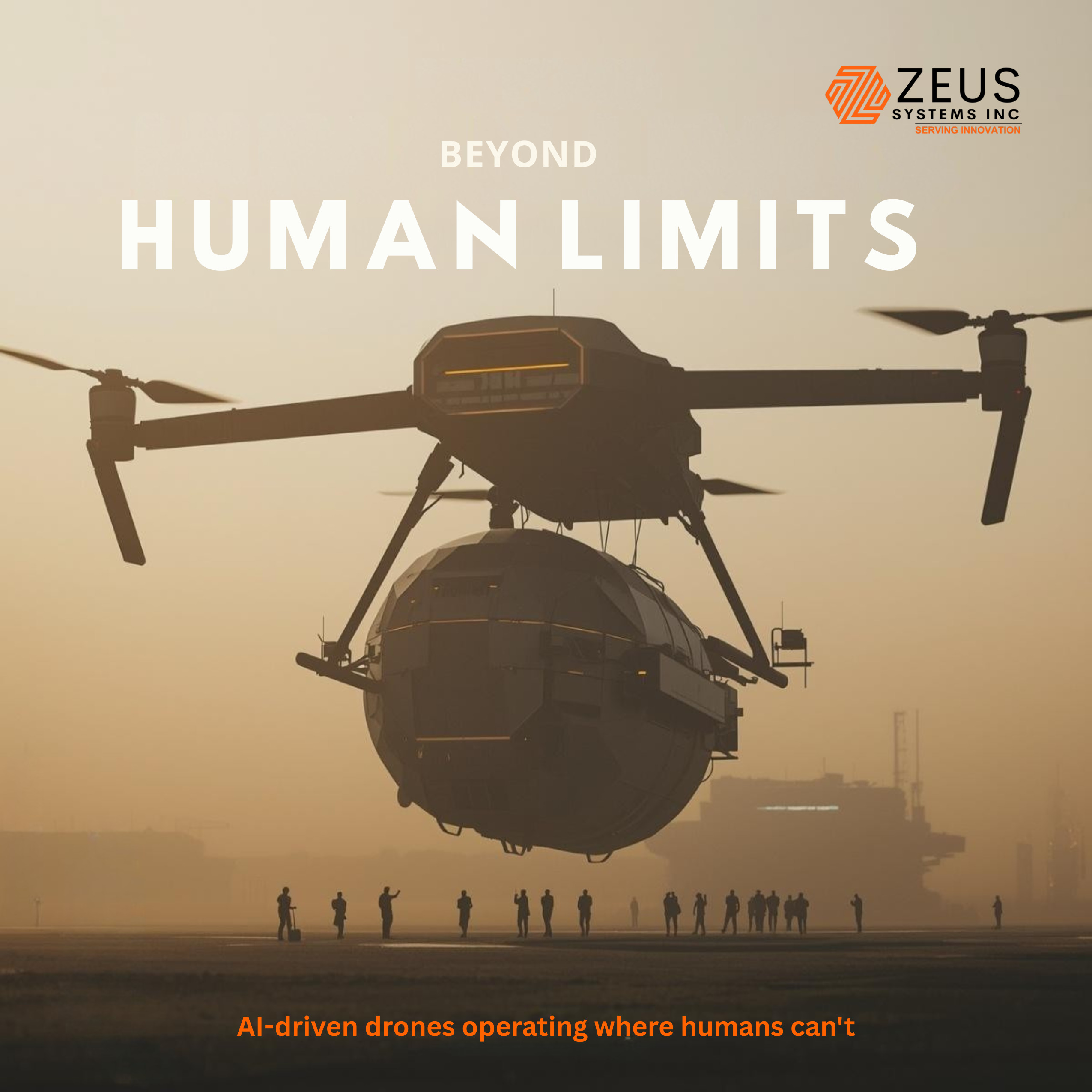
For years, drones have hovered on the edge of transforming logistics-promising faster deliveries, reduced human risk, and access to unreachable terrains. Yet, most existing systems are constrained by payload limits, fragile control systems, and rigid pre-programmed intelligence. They perform well in controlled environments but falter under real-world volatility: high winds, uneven loads, dynamic obstacles, or extreme climates.
Enter a new class of aerial systems: Heavy-Duty AI Xer Drones-machines that combine force-controlled actuators, adaptive structural intelligence, and generative AI-driven payload optimization. These drones don’t just carry loads; they understand them, adapt to them, and reconfigure themselves mid-flight to surpass traditional physical and computational limits.
This is not an incremental improvement. It’s a paradigm shift.
The Xer Drone Architecture: Designed for Extremes
At the core of this innovation is the Xer Drone, a modular, heavy-lift aerial platform engineered for harsh, unpredictable environments such as:
Unlike conventional drones that rely on fixed propulsion-to-weight ratios, Xer drones integrate force-controlled actuators across their propulsion arms and payload interfaces.
What Makes Force-Controlled Actuators Different?
Traditional drones use position-controlled motors—meaning they attempt to maintain a fixed speed or position regardless of external forces. Xer drones, however, incorporate actuators that:
This allows the drone to behave less like a rigid machine and more like a self-balancing organism, continuously negotiating with its environment.
Generative AI in Flight: Beyond Static Intelligence
The most groundbreaking element is the integration of onboard generative AI models—not for content creation, but for real-time decision synthesis.
Traditional AI vs Generative Flight Intelligence
| Capability | Traditional Drone AI | Xer Drone Generative AI |
| Path Planning | Predefined or reactive | Continuously re-generated |
| Payload Handling | Fixed parameters | Dynamic reconfiguration |
| Environmental Response | Rule-based | Scenario-simulated adaptation |
| Learning | Offline training | On-the-fly model refinement |
The generative AI system inside Xer drones performs continuous simulation loops mid-flight, predicting multiple future states based on:
It then generates optimal control strategies in real time, rather than selecting from pre-coded options.
Self-Optimizing Payloads: Breaking the Weight Barrier
One of the most radical breakthroughs is the concept of mid-flight payload optimization.
The Problem with Payload Limits
Traditional drones are bound by strict payload ceilings determined by:
Exceed these, and the drone becomes unstable or crashes.
Xer Drone Solution: Adaptive Payload Intelligence
Instead of treating payload as a static burden, Xer drones treat it as a dynamic system variable.
Using embedded sensors and AI modeling, the drone can:
This enables Xer drones to carry loads previously considered unsafe or impossible, effectively redefining payload limits without violating mechanical constraints.
Harsh Environment Mastery
What truly sets Xer drones apart is their ability to function where other systems fail.
Environmental Adaptation Capabilities
The drone doesn’t just react—it anticipates.
Swarm Intelligence: Collective Optimization
Xer drones are not limited to individual performance. When deployed in fleets, they exhibit collaborative generative intelligence.
Swarm Capabilities
Imagine multiple drones carrying a single भारी industrial component, each adjusting its force output in harmony, guided by a shared generative model.
Safety and Ethical Control Layers
With such autonomy comes risk. Xer drones integrate multi-layered safety systems:
This ensures that while the system is autonomous, it remains accountable.
Real-World Use Cases
1. Disaster Relief
Delivering medical supplies into collapsed urban zones where terrain shifts unpredictably.
2. Industrial Logistics
Transporting parts across active mining sites with uneven load dynamics.
3. Military Operations
Supplying remote units in high-risk environments without exposing human pilots.
4. Space Analog Missions
Testing payload adaptability in Mars-like terrains on Earth.
The Physics-Intelligence Convergence
What makes Xer drones revolutionary is not just AI, nor just hardware—but the fusion of both into a single adaptive system.
This convergence allows drones to operate beyond fixed design limitations, entering a realm where machines continuously redefine their own capabilities.
Challenges Ahead
Despite the promise, several hurdles remain:
However, these are engineering and policy challenges—not conceptual limitations.
Conclusion: A New Frontier in Autonomous Systems
Heavy-Duty AI Xer Drones represent a shift from programmed machines to self-evolving systems. By combining force-controlled actuation with generative AI, they unlock a new category of logistics—one that thrives in uncertainty rather than avoiding it.
This is not just about delivering packages.
It’s about redefining what machines can carry, how they think, and where they can go.
The sky is no longer the limit. It’s the testing ground.