
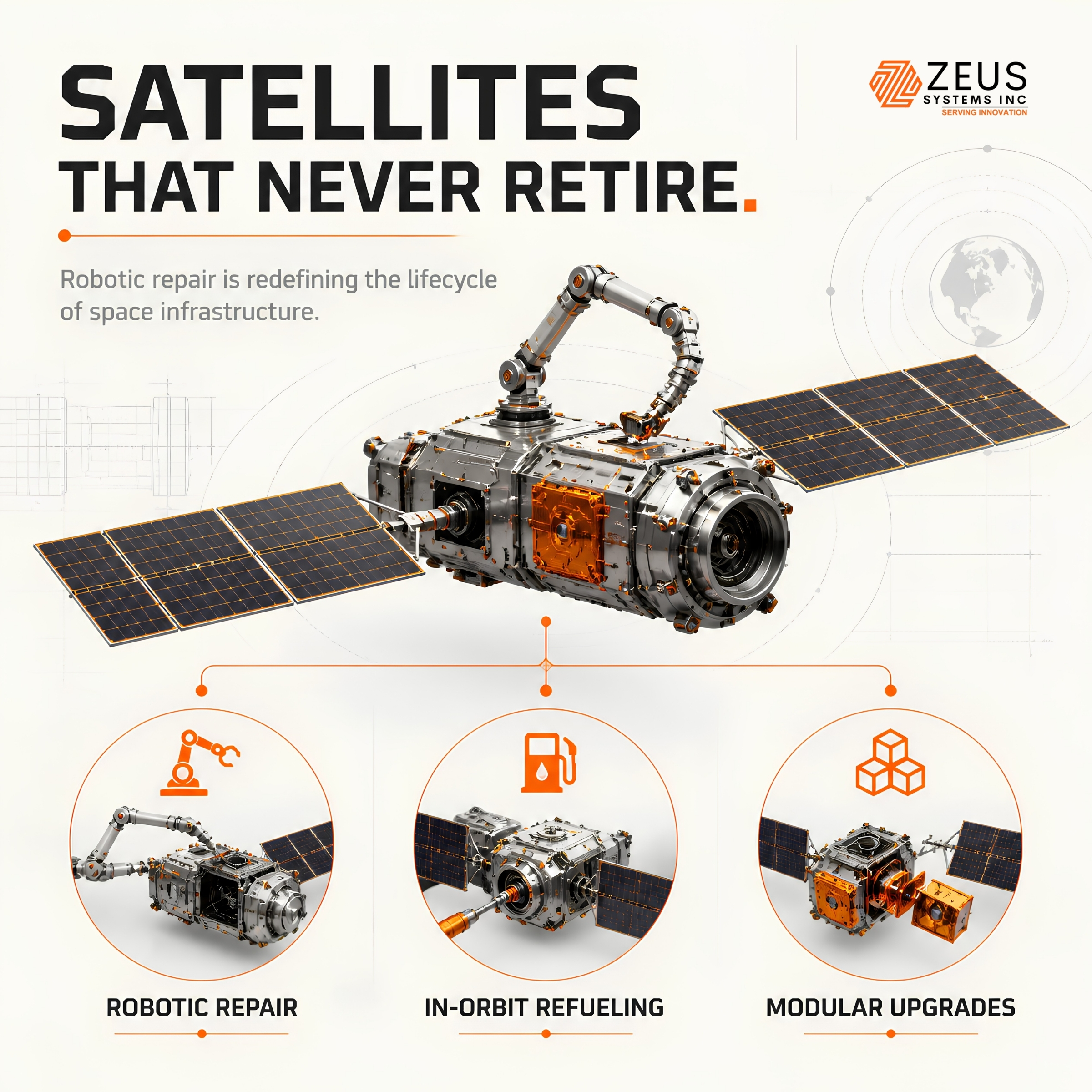
What if the next revolution in space technology isn’t launching better satellites, but building a way to keep the ones we already have alive?
Imagine a satellite launched in 2035 experiencing a propulsion failure in 2044. In today’s conventional model, that failure could mean losing a multimillion-dollar asset, disrupting critical services, and accelerating the need for a replacement launch. Now imagine a different outcome: an autonomous robotic spacecraft approaches, inspects the fault, replaces a modular component, replenishes the satellite’s fuel, and installs a more capable communications unit. The satellite returns to service—not as the machine it was at launch, but as a better version of itself.
This is the future of satellite servicing, and it signals a profound change in how humanity builds and operates infrastructure beyond Earth.
For decades, satellites have followed a strangely unforgiving lifecycle: manufacture, launch, operate, run out of fuel or fail, and eventually retire. Even when the payload remains functional, a depleted propulsion system or a single failing component can compromise an otherwise valuable spacecraft. The economics of space have rewarded launching replacements more often than maintaining assets already in orbit.
That logic is beginning to change.
From disposable hardware to living infrastructure
The emerging field of in-space servicing, assembly, and manufacturing is turning orbit into a potential maintenance environment rather than a graveyard for aging technology. Robotic spacecraft can approach satellites, inspect their condition, dock with compatible systems, and—increasingly sophisticated mission architectures—perform interventions that once seemed impossible without astronauts.
The shift is already moving beyond theory. Northrop Grumman’s Mission Extension Vehicles have demonstrated the ability to dock with operational geostationary satellites and provide additional propulsion and attitude control. In July 2026, a new milestone followed: the company’s Mission Robotic Vehicle, carrying DARPA’s robotic servicing technology, launched with three Mission Extension Pods designed to extend satellite operations. The vehicle is intended to support more advanced robotic work, including inspections, anomaly resolution, relocation, and upgrades. Its launch is a beginning, not proof that every repair capability is operational at scale. Sources: DARPA; Northrop Grumman
The deeper opportunity, however, is not simply extending a satellite’s lifespan. It is separating a satellite’s useful life from the lifespan of its original hardware.
A communications satellite could receive a propulsion upgrade without replacing its entire platform. An Earth-observation spacecraft might gain a new processing module that improves how it handles sensor data. A scientific instrument could potentially be recalibrated, supplemented, or replaced while the spacecraft remains in service. These are different levels of technical maturity, but together they point toward a new principle: launch the infrastructure once; improve its capabilities over time.
The orbital mechanic: robots that do more than dock
Refueling is the most intuitive starting point. Satellites frequently retire not because their primary instruments stop working, but because they can no longer maintain their orbit or orientation with the propellant remaining. A robotic servicer that can transfer fuel could turn a hard operational deadline into a manageable maintenance event.
Yet refueling legacy satellites is difficult. Many were never designed with accessible fuel ports, standardized connections, or robotic servicing in mind. Opening valves, manipulating delicate structures, and transferring propellant in microgravity demand precision, specialized hardware, and carefully controlled autonomous operations. NASA’s OSAM-1 project, intended to demonstrate robotic refueling and in-space assembly, was discontinued in 2024 after significant technical, cost, and schedule challenges. That setback matters: it shows that the future of servicing depends not just on sophisticated robots, but on making spacecraft economically and technically serviceable from the start. Source: NASA
The next generation of orbital mechanics will therefore need more than robotic arms. It will need machine vision, reliable relative navigation, fault diagnosis, tool-changing systems, and software capable of operating safely around expensive, fragile assets. In some scenarios, human operators will supervise the mission; in others, onboard autonomy will be essential because communication delays, operational constraints, and the sheer complexity of close-proximity manoeuvres make continuous manual control impractical.
The most transformative development may be the move from one-off rescue missions to reusable servicing platforms. Instead of designing a bespoke spacecraft to save one failing satellite, operators could eventually deploy robotic vehicles with modular tools, standardized interfaces, and mission software that supports multiple clients. Refueling, inspection, repositioning, and selected repairs could become separate services delivered through a shared orbital infrastructure.
That is when satellite maintenance begins to resemble an industry rather than an experiment.
The software update that changes a spacecraft’s future
Hardware repair is only half the story. The more radical possibility is that satellites could become upgradeable systems.
Today’s technology companies understand that a product’s value does not end at launch. Software updates can improve performance, patch vulnerabilities, introduce capabilities, and extend usefulness without replacing the underlying device. Satellites could adopt a related model—but with a critical difference: some improvements require physical intervention, not just a remote software update.
Imagine an orbital servicing platform that combines diagnostics with robotic intervention. It identifies a degraded subsystem, checks whether the satellite’s design supports a replacement, selects the correct tool, and installs a validated module. A new processing unit might enable more sophisticated onboard analytics; a replacement communications component could support a new operating mode; an additional propulsion package could increase mission flexibility.
This suggests a different product architecture: spacecraft designed around replaceable modules, accessible connection points, published servicing interfaces, and software that can verify the identity and compatibility of installed hardware.
The strategic advantage would be significant. Satellite operators could plan upgrades as part of a product roadmap instead of treating launch day as the moment when the hardware configuration becomes effectively permanent. Manufacturers could sell not only spacecraft, but also upgrade packages, maintenance contracts, and guaranteed servicing compatibility.
In that world, the competitive question changes. It is no longer simply, “How capable is this satellite on launch day?” It becomes, “How much better can this satellite become during its operational life?”