
In the realm of artificial intelligence, few developments have captured the imagination quite like OpenAI’s ChatGPT. Wit ...

info@zeusit.us
+1 (248) 658 8644
In the realm of artificial intelligence, few developments have captured the imagination quite like OpenAI’s ChatGPT. Wit ...
In the realm of technological innovation, cloud technology continues to evolve, captivating hearts and minds alike. With ...
the conversational companion that brings a touch of humanity to our digital interactions. What is Chat GPT?A Conversa ...
A journey to the 3D mapping using drones. The latest trend in 3D mapping using drones revolves around enhanced precis ...
The next revolution in energy may not be built on empty land. It may already be parked outside our homes. Imagine a ...
The LEGO Computer: Could the Next Supercomputer Be Assembled From Chips Made by Different Companies? The future of c ...
How Telemedicine Is Becoming a Living Healthcare System For decades, healthcare has been organized around a simple u ...
Beyond Prediction: When Artificial Intelligence Becomes Biology's Creative Partner For decades, computational biolog ...
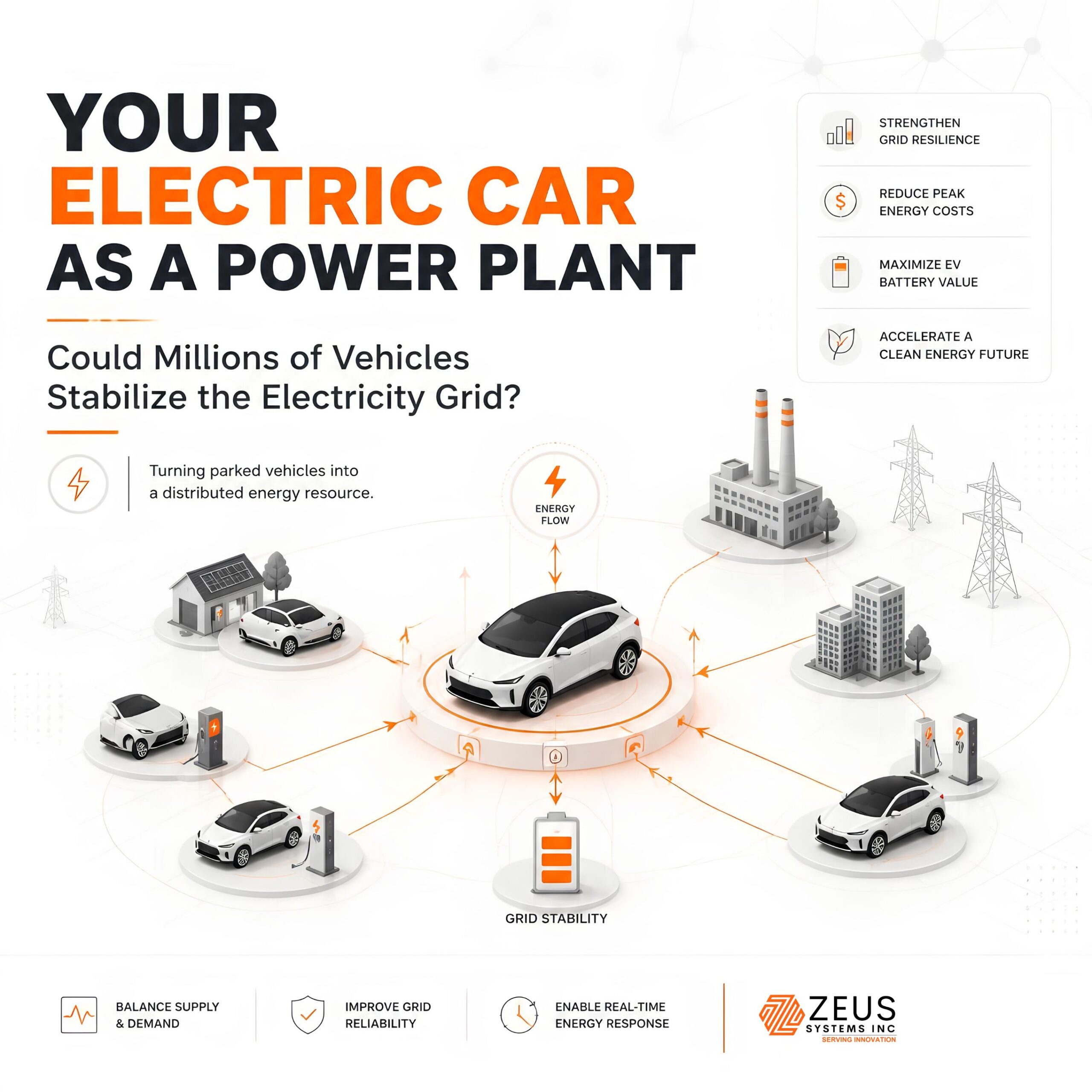
The next revolution in energy may not be built on empty land. It may already be parked outside our homes.
Imagine a summer evening at 7:30 p.m. Millions of households switch on their air conditioners, factories are still operating, and solar generation is falling with the setting sun. Electricity demand climbs just as the grid begins losing one of its cheapest sources of daytime power. Traditionally, utilities would respond by activating expensive generators, drawing on stationary batteries, or importing electricity from neighbouring regions.
Now imagine a different response.
Across the city, thousands of parked electric vehicles quietly release small amounts of stored electricity. A car outside an apartment building contributes 3 kilowatts. Another in a corporate parking lot contributes 5. A fleet of electric taxis, temporarily resting between shifts, supplies additional power. No individual vehicle carries the burden of keeping the lights on. Collectively, however, these vehicles help flatten the demand spike.
The extraordinary part is that the vehicles do not need to become full-time power plants. They need to become intelligent participants in an electricity system that knows when to charge, when to discharge, and when to remain untouched.
This is the emerging promise of vehicle-to-grid technology, or V2G. But its greatest potential lies beyond connecting batteries to power lines. It lies in reimagining the relationship between mobility, electricity, software and ownership.
From Millions of Batteries to One Distributed Power System
An electric vehicle is typically viewed as a machine that consumes electricity to move people and goods. Yet its battery is also a substantial energy-storage asset. When connected to compatible bidirectional charging equipment, it can send electricity back to a building or the grid.
Consider a hypothetical fleet of one million electric vehicles, each equipped with a 60-kWh battery. Their combined nominal storage capacity would be 60 gigawatt-hours (GWh). If only 20% of that fleet were connected, available for grid participation, and able to provide an average of 3 kW each, the fleet could deliver approximately 600 megawatts (MW) of power.
That is a meaningful amount of dispatchable power. It is not, however, a guarantee of 600 MW at every moment, nor does it mean the fleet could sustain that output indefinitely. Actual performance would depend on vehicle availability, battery charge levels, charger capacity, network constraints and drivers’ mobility requirements.
This distinction reveals the real opportunity: the grid does not need access to every battery, all the time. It needs reliable access to enough batteries, in the right places, at the right moments.
The proposed transformation is therefore not simply about connecting vehicles. It is about coordinating their flexibility as a single, distributed resource. Thousands of small, independent decisions—delaying a charge, reducing a charging rate, or releasing a limited amount of stored energy—could become one coordinated response to changing electricity demand.
The International Energy Agency identifies smart charging and V2G as potential tools for reducing peak demand, supporting grid services and limiting some future network investments. The technology is progressing, although commercial availability and interoperability remain significant barriers. IEA, Vehicle-to-grid technology.
The Breakthrough May Be Software, Not Batteries
The most compelling innovation may not be a battery with greater capacity. It may be a software layer that treats connected vehicles as a continuously changing reservoir of energy flexibility.
Consider a hypothetical system called a mobility-aware energy orchestration network. Its purpose would be to coordinate vehicles without compromising the reason they exist: transportation.
Instead of asking, “How much electricity can we extract from these cars?”, the system would ask four more useful questions:
The system could then assign different roles to different vehicles. A car expected to leave shortly might pause charging to avoid a local demand spike. A fleet vehicle with several hours before its next shift might discharge a small amount of energy. Vehicles connected near a congested distribution transformer might be scheduled differently from those connected to a network with abundant spare capacity.
This suggests a new design principle: coordinate energy around human mobility, rather than forcing human mobility to accommodate energy management.
The concept could be extended into a distributed flexibility marketplace. Utilities would request a defined amount of power for a particular location and time. Aggregators would assemble eligible vehicles into a virtual power plant, while software would allocate charging and discharging among participants according to availability, price, battery-health limits and driver preferences.
The distinctive opportunity is not that every car becomes a generator. It is that every compatible car becomes a potential, conditional contributor to a larger system.
Can Millions of Vehicles Actually Stabilize the Grid?
The answer depends on what we mean by stabilize.
Electricity grids must balance supply and demand continuously. They also need to maintain acceptable frequency and voltage, avoid overloading equipment, and recover from unexpected disruptions. Coordinated EV charging can help by shifting demand away from constrained periods. Bidirectional vehicles can go further by supplying power and, where suitably equipped and controlled, supporting certain grid services.
But energy capacity and power capacity are different things. A fleet may hold enormous amounts of energy on paper while being unable to deliver it at the moment of greatest need. Many vehicles may be travelling, unplugged, nearly empty or reserved by their owners for emergencies. A fleet concentrated in one neighbourhood cannot automatically resolve a transmission bottleneck elsewhere.
Nor can EV batteries replace every function of conventional generation, transmission infrastructure or stationary storage. They are a flexible resource, not a universal solution.
There is also a financial paradox. Every discharge-and-recharge cycle introduces losses, and additional battery cycling may accelerate degradation. If compensation does not cover electricity costs, conversion losses, equipment expenses and battery wear, drivers may have little reason to participate. Poorly coordinated charging could even create new peaks if millions of vehicles respond to the same price signal simultaneously.
The winning system would therefore need more than an intelligent algorithm. It would require dependable communications, interoperable vehicles and chargers, grid-aware controls, cybersecurity, transparent compensation and enforceable guarantees that drivers retain sufficient charge for their journeys.
The grid must be able to count on the service without assuming it owns the battery.
The Ownership Question: Who Controls the Energy in Your Car?
A more difficult challenge may be social rather than technical.
If an electricity provider can use a privately owned vehicle to support the grid, who decides when the battery discharges? What happens when a driver needs to leave unexpectedly? Who pays for degradation? And can an aggregator change a charging schedule without clearly explaining the financial and practical consequences?
These questions will determine whether V2G becomes mainstream or remains confined to carefully managed pilot projects.
A credible model would begin with driver-defined boundaries: a minimum departure charge, a time by which that charge must be reached, a maximum permitted discharge, and the option to withdraw from grid participation. Compensation would reflect the service provided, while the software would record energy flows and make payments auditable.
Privacy matters equally. An energy-management platform that knows when a car is plugged in, when it leaves, and how much charge it needs can reveal patterns of daily life. Data minimisation, secure authentication and limits on access must be foundational features, not afterthoughts.
In this future, trust becomes part of the infrastructure. A technically perfect system that drivers do not trust will never achieve the participation required to deliver meaningful grid benefits.
The Road Ahead: A Power Plant That Moves
The most realistic path forward is gradual. Smart charging can deliver value even when a vehicle cannot export electricity: charging can be shifted toward periods of abundant renewable generation or lower demand. Bidirectional systems can then add more capabilities where vehicles, chargers, electricity markets and local networks support them.
Commercial deployment will depend on standardisation, grid interconnection rules, viable business models and compatibility across manufacturers. The IEA’s 2026 assessment highlights both the growing potential of V2G and the fact that bidirectional capability and interoperability are still far from universal.
Ultimately, the future electricity system may not be divided neatly into power plants, batteries and consumers. A single electric vehicle could occupy all three roles at different times: a consumer while charging, a storage device while parked, and a source of electricity when conditions permit.
That does not mean millions of vehicles will eliminate blackouts or make conventional power infrastructure unnecessary. It means a resource already being purchased for transportation could also provide a valuable energy service—provided the economics, technology and governance are designed around real human needs.
Perhaps the most consequential shift is this: the next generation of energy infrastructure may not be defined only by what we build, but by how intelligently we coordinate what we already own.
Your electric car may never look like a power plant. Yet, when millions of vehicles become connected, controllable and fairly compensated, the parking lot itself could begin to function like an energy asset.
The question is no longer simply whether a car can return electricity to the grid. It is whether we can build an electricity system intelligent enough to use that capability without compromising the freedom, reliability and trust that make electric mobility valuable in the first place.