
In the realm of artificial intelligence, few developments have captured the imagination quite like OpenAI’s ChatGPT. Wit ...

info@zeusit.us
+1 (248) 658 8644
In the realm of artificial intelligence, few developments have captured the imagination quite like OpenAI’s ChatGPT. Wit ...
In the realm of technological innovation, cloud technology continues to evolve, captivating hearts and minds alike. With ...
the conversational companion that brings a touch of humanity to our digital interactions. What is Chat GPT?A Conversa ...
A journey to the 3D mapping using drones. The latest trend in 3D mapping using drones revolves around enhanced precis ...
For decades, the architecture of industrial enterprises followed a rigid separation.Information Technology (IT) governe ...
The Penguin-Inspired Lab Robot That Could Redefine Autonomous Science The Convergence of Biology, AI Cognition, and ...
As robotic systems increasingly enter unstructured human environments, traditional paradigms based on extensive labeled ...
Cross-Disciplinary Synthesis Papers: Integrating Cognitive Science, Design Ethics, and Systems Engineering to Reframe A ...
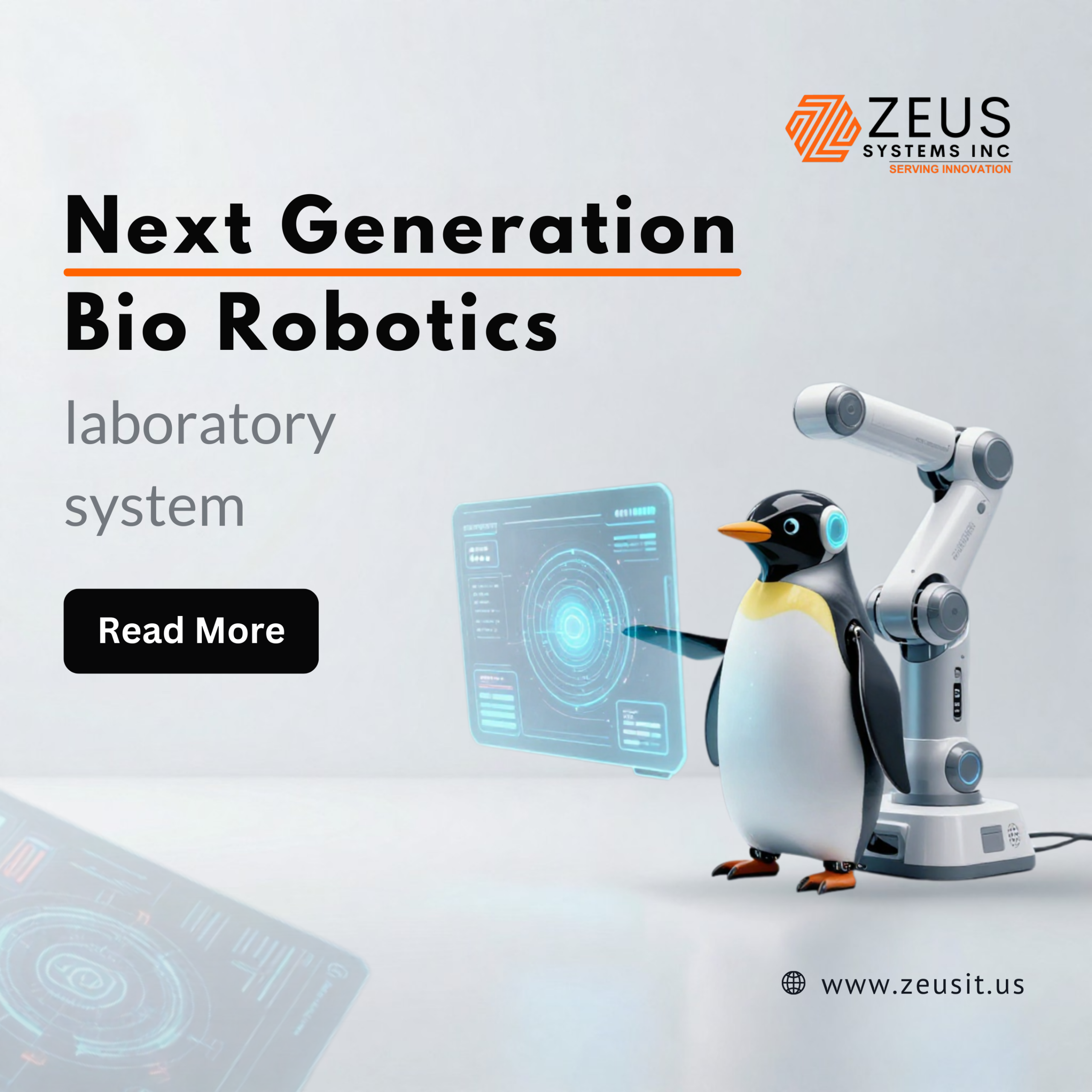
The Penguin-Inspired Lab Robot That Could Redefine Autonomous Science
The Convergence of Biology, AI Cognition, and Robotics
For decades, laboratory automation has followed a predictable trajectory: robotic arms, conveyor systems, and sterile automated workstations performing repetitive tasks with mechanical precision. But a new wave of bio-inspired robotics and embodied artificial intelligence is beginning to redefine how machines interact with the physical world.
One experimental concept emerging at the intersection of these disciplines is White Rabbit Bio-Robotics, a next-generation hybrid robotic platform envisioned by the innovation lab Penguins Innovate. The concept fuses organic-inspired locomotion, AI reasoning, and vision-language-action cognition to produce an acrobatic robotic system capable of performing delicate laboratory tasks with unprecedented agility.
The robot’s intelligence layer is powered by a cognitive framework inspired by Vision-Language-Action (VLA) models, which integrate perception, language reasoning, and physical action in a unified system. These architectures enable robots to interpret instructions, understand their environment, and execute complex physical tasks autonomously.
In essence, White Rabbit represents a radical shift: from rigid automation to embodied robotic intelligence.
The Birth of Bio-Robotic Penguins
Traditional lab robots resemble industrial machinery—heavy, precise, but fundamentally limited. They perform predefined tasks but struggle with unstructured environments.
Researchers behind the White Rabbit concept took a different approach.
Instead of designing robots like machines, they began designing them like animals.
The inspiration came from one of nature’s most efficient movement specialists: the penguin. Penguins combine stability, balance, and energy efficiency in harsh environments. Their gait allows them to traverse ice, swim underwater, and maintain remarkable equilibrium.
This biological insight led to a new robotics architecture: Bio-Robotic Penguins.
Unlike wheeled robots or rigid robotic arms, the White Rabbit robot moves using a bio-mechanical gait system modeled after penguin locomotion. Its structure integrates:
The result is a robot capable of micro-precision movements combined with acrobatic balance—a capability rarely seen in lab automation systems.
The Spirit AI Cognition Layer
Physical agility alone is not enough. Laboratory work requires context, interpretation, and reasoning.
To achieve this, White Rabbit integrates a hypothetical cognitive architecture known as Spirit AI, a vision-language-action intelligence system.
VLA models are a rapidly evolving category of AI that merges perception, language understanding, and robotic control into a single neural system. These models can understand natural language instructions, interpret visual scenes, and translate them directly into motor actions.
For example, instead of programming a robot with rigid instructions, researchers could simply tell White Rabbit:
“Prepare three microfluidic samples and place them in the centrifuge.”
The Spirit AI system would then:
The fusion of language, vision, and robotics closes the gap between human instruction and machine execution.
Organic Motion: The Secret to Laboratory Precision
One of the most fascinating aspects of White Rabbit is its organic movement system.
Most robots rely on rigid joints and servo motors. While precise, these systems struggle with delicate manipulation tasks such as:
White Rabbit introduces adaptive soft-actuator joints, which behave more like biological muscles.
These actuators allow the robot to perform:
The penguin-inspired locomotion combined with soft robotics enables acrobatic precision, allowing the robot to navigate cluttered laboratory environments while maintaining stability.
Autonomous Laboratory Intelligence
In a typical biotech laboratory, researchers perform hundreds of repetitive tasks daily:
White Rabbit is designed to automate these tasks using context-aware autonomy.
Its sensor suite includes:
The system continuously builds a digital twin of the laboratory environment, enabling the robot to adapt to changing conditions.
This level of awareness is critical because laboratory environments are inherently dynamic—equipment moves, experiments change, and protocols evolve.
A New Paradigm: Robotic Scientists
The ultimate goal of White Rabbit is not merely automation.
It is robotic scientific collaboration.
Future iterations could allow the robot to participate in research workflows by:
Combined with advanced AI reasoning systems, such robots could dramatically accelerate discovery in fields such as:
This vision aligns with emerging research in embodied reasoning, where AI systems combine cognitive reasoning with physical interaction to perform complex tasks.
The Hardware Architecture
The White Rabbit system is designed around a modular hardware platform.
Key components include:
1. Bio-Dynamic Locomotion Frame
2. Multi-Modal Sensor Array
3. Neural Robotics Processor
4. Environmental Mapping System
5. Adaptive Manipulation Arms
From Smart Devices to Embodied AI
The idea of intelligent physical devices is already beginning to emerge in consumer technology.
For example, the smart AI device white rabbit smart automation device, developed by Penguins Innovate, demonstrates how AI systems can combine sensors, cameras, and automation to interact with users and adapt to their environment. The device can track movement, respond to voice commands, and integrate multiple smart-home functions into a single AI-driven system.
While designed for consumer environments, such technologies hint at how AI-driven hardware could evolve toward fully autonomous embodied systems.
White Rabbit Bio-Robotics represents the next step in that trajectory.
Why Bio-Robotics Is the Future
Biology has spent millions of years optimizing motion, balance, and efficiency.
Robotics researchers are increasingly realizing that the most advanced machines may not look like machines at all.
Instead, they may resemble living organisms.
Bio-robotic systems offer several advantages:
Energy efficiency
Organic motion requires less energy than rigid mechanical systems.
Adaptability
Soft structures can handle unpredictable environments.
Precision
Muscle-like actuators enable delicate manipulation.
These traits make bio-robotics particularly suited for scientific laboratories and healthcare environments.
The Coming Age of Autonomous Laboratories
Imagine a laboratory operating 24 hours a day with minimal human intervention.
Researchers define hypotheses.
Robots design experiments.
AI systems analyze results.
White Rabbit-style robots could serve as the physical workforce of this autonomous research ecosystem.
Such systems could dramatically accelerate discovery timelines.
Drug discovery that currently takes 10–15 years might shrink to months.
Materials development could happen in continuous automated cycles.
Challenges Ahead
Despite its promise, the path toward bio-robotic laboratory assistants is complex.
Several technical hurdles remain:
Robust reasoning in physical environments
AI must reliably translate abstract instructions into precise actions.
Safety in biological laboratories
Robots must operate safely around hazardous materials.
Standardized robotic protocols
Laboratory workflows vary widely between institutions.
However, rapid advances in AI and robotics suggest these challenges may soon be overcome.
The Next Frontier of Robotics
White Rabbit Bio-Robotics represents a powerful idea:
robots that move like animals, think like scientists, and work like tireless laboratory assistants.
The fusion of bio-inspired mechanics, embodied AI cognition, and vision-language-action intelligence could usher in a new era where machines do more than automate tasks—they participate in discovery.
If realized, systems like White Rabbit may mark the beginning of the Autonomous Science Revolution. And in that future, laboratories may no longer be run solely by human researchers—but by collaborative ecosystems of humans and intelligent bio-robots.