
In the realm of artificial intelligence, few developments have captured the imagination quite like OpenAI’s ChatGPT. Wit ...

info@zeusit.us
+1 (248) 658 8644
In the realm of artificial intelligence, few developments have captured the imagination quite like OpenAI’s ChatGPT. Wit ...
In the realm of technological innovation, cloud technology continues to evolve, captivating hearts and minds alike. With ...
the conversational companion that brings a touch of humanity to our digital interactions. What is Chat GPT?A Conversa ...
A journey to the 3D mapping using drones. The latest trend in 3D mapping using drones revolves around enhanced precis ...
Beyond Firewalls, Beyond Detection The Rise of Autonomous Defense Intelligence Abstract For nearly half a century ...
For nearly a decade, the artificial intelligence industry has been trapped inside a singular belief: intelligence emerg ...
Introduction: The AI Industry's Invisible Emergency The world is focused on bigger AI models, larger data centers, a ...
The semiconductor industry in 2026 is no longer advancing through transistor shrinkage alone. That era—the elegant simp ...
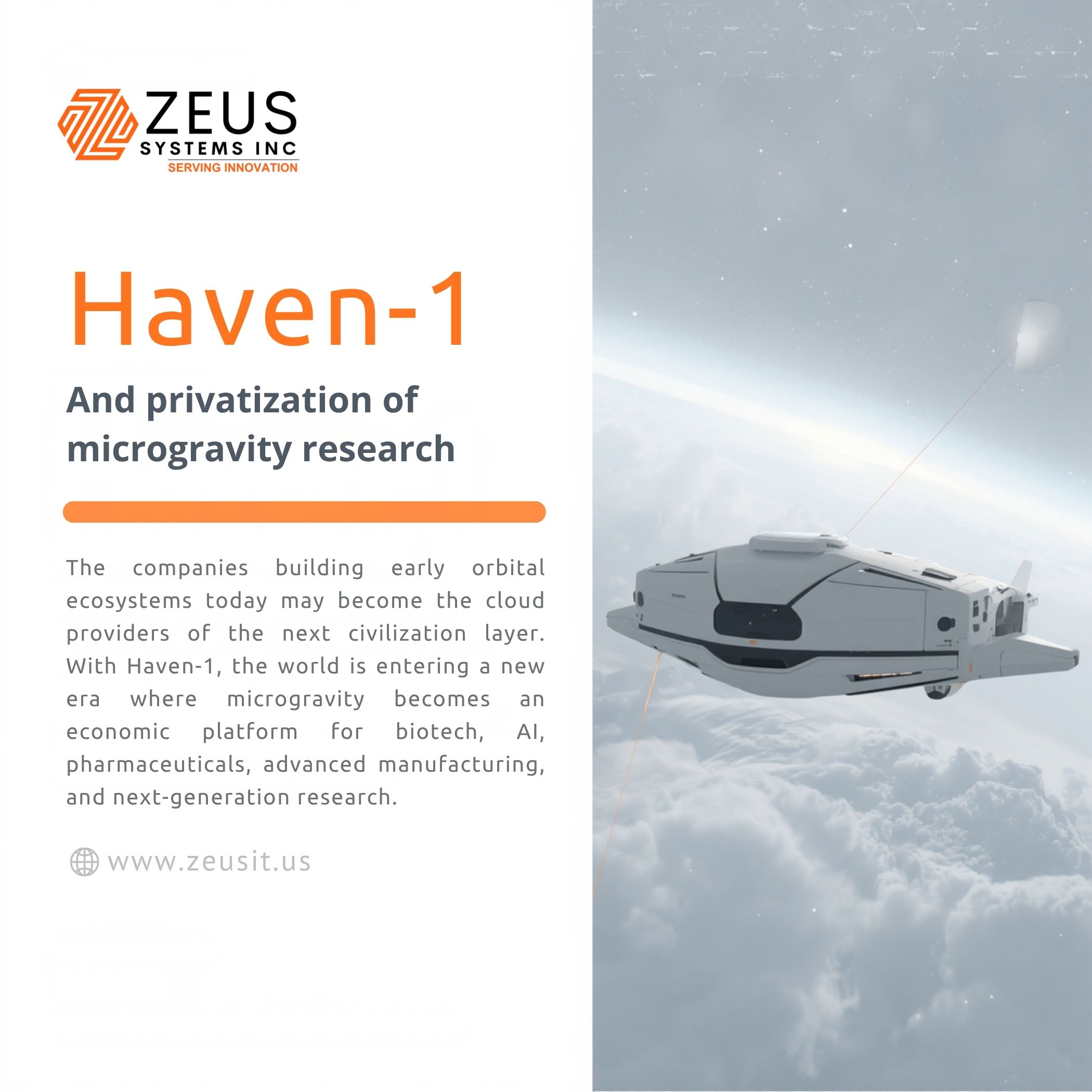
For more than half a century, microgravity was a geopolitical luxury.
Access to orbit belonged to governments, military agencies, and a small circle of elite astronauts operating inside nation-state infrastructure like the NASA-backed International Space Station. Scientific experiments in space were rare, bureaucratically allocated, and politically symbolic. The orbital laboratory was never designed to become a scalable industrial economy. It was designed to prove technological superiority.
That era is ending.
The emergence of Vast Space and its commercial station Haven-1 represents something far larger than a new spacecraft. It marks the transition of low-Earth orbit from a state-controlled frontier into a programmable economic layer — one where pharmaceutical companies, AI labs, semiconductor firms, climate-tech startups, defense contractors, biotech unicorns, and cloud infrastructure giants can directly purchase orbital experimentation capacity the same way they purchase cloud compute today.
This is not merely “space commercialization.”
It is the privatization of gravity itself.
And once gravity becomes optional, entire industries begin redesigning matter from first principles.
According to reports from Vast Space, Haven-1 is intended to operate as the world’s first commercial microgravity research and manufacturing platform, offering dedicated payload slots, crew-assisted experimentation, and high-bandwidth Starlink-enabled connectivity for industrial research operations.
The implications are difficult to overstate.
The End of Government Monopoly in Orbit
The twentieth-century space economy was vertically centralized.
Governments built rockets. Governments controlled launch schedules. Governments selected astronauts. Governments determined scientific priorities. Governments owned the laboratories. Even private aerospace contractors operated as extensions of national objectives.
The ISS, despite its scientific brilliance, was fundamentally a diplomatic machine disguised as infrastructure.
Every experiment required:
• multinational approval,
• years-long review cycles,
• constrained launch manifests,
• rigid astronaut timelines,
• and political negotiation.
This model was survivable when space was symbolic.
It becomes catastrophic when space becomes economically productive.
The problem is simple: innovation cycles in AI, biotech, materials science, and quantum engineering move exponentially faster than government procurement systems.
A pharmaceutical company cannot wait four years for orbital protein crystallization access while venture-backed competitors iterate monthly.
A semiconductor company cannot pause next-generation wafer experimentation because astronaut scheduling windows are politically constrained.
A generative-AI robotics company cannot optimize autonomous manufacturing systems under Earth gravity alone if orbital production unlocks radically superior geometries.
The ISS was never built for the speed of private capital.
Haven-1 is.
Reports indicate the station will include modular laboratory systems with payload lockers capable of supporting healthcare, pharmaceutical, biotechnology, and advanced material research.
That changes the entire equation.
Because the moment orbital research becomes commercially schedulable, space stops being exploration.
It becomes infrastructure.
Why Microgravity Is Economically Revolutionary
Most people misunderstand microgravity.
They imagine astronauts floating.
Industries see something else entirely:
a manufacturing environment impossible to reproduce on Earth.
Gravity quietly distorts almost every industrial process humans use:
• crystal formation,
• fluid dynamics,
• combustion,
• alloy mixing,
• tissue growth,
• sedimentation,
• molecular layering,
• biological assembly,
• thermal distribution,
• nanostructure alignment.
Remove gravity, and matter behaves differently.
Sometimes radically differently.
Protein crystals grown in microgravity can achieve structural perfection difficult to produce on Earth. This matters because modern drug discovery increasingly depends on understanding molecular geometry with extreme precision.
Microgravity has already demonstrated promise in:
• cancer drug modeling,
• stem-cell growth,
• retinal tissue engineering,
• organoid development,
• fiber optics,
• semiconductor materials,
• ultra-pure optical manufacturing,
• advanced alloys,
• and biological printing.
Historically, these experiments were limited by access scarcity.
Now imagine orbital lab subscriptions.
Imagine:
• “Space-as-a-Service” APIs,
• cloud-scheduled orbital experimentation,
• AI-managed autonomous payload systems,
• pharmaceutical companies running parallel orbital trials,
• machine-learning models optimizing crystal growth in real time,
• and biotech firms continuously manufacturing high-value compounds in LEO.
The economic architecture begins resembling cloud computing more than aerospace.
That is the real disruption.
Haven-1 Is Not Competing With the ISS
It Is Competing With AWS
This is the conceptual mistake nearly every mainstream analysis makes.
People compare Haven-1 to the ISS because both are space stations.
But economically, Haven-1 resembles cloud infrastructure platforms far more than government habitats.
The ISS was a destination.
Haven-1 is a service layer.
Its real competitors are not astronauts.
Its competitors are:
• hyperscale compute providers,
• pharmaceutical R&D ecosystems,
• autonomous robotics firms,
• industrial simulation platforms,
• and next-generation manufacturing clouds.
The parallel to early cloud computing is almost exact.
Before cloud infrastructure:
• companies owned servers,
• infrastructure costs were enormous,
• experimentation was slow,
• and only large institutions could scale computing.
Then cloud providers abstracted complexity.
Suddenly startups could rent infrastructure instantly.
Innovation exploded.
Haven-1 could do the same for orbital science.
Instead of nations owning the entire stack:
• launch,
• station,
• crew,
• experimentation,
• data retrieval,
• manufacturing logistics,
companies will increasingly rent orbital capability on demand.
Microgravity becomes programmable.
And once a physical environment becomes programmable, software economics follow.
The Rise of Orbital Venture Capitalism
The next decade may produce an entirely new category of startup:
the orbital-native company.
Not aerospace companies.
Orbital-native companies.
There is a difference.
An aerospace company builds transportation systems.
An orbital-native company builds products that only make sense in microgravity.
This distinction matters enormously.
Examples may include:
• zero-gravity pharmaceutical synthesis,
• orbital semiconductor fabrication,
• biological tissue manufacturing,
• vacuum-native nanomaterials,
• AI-directed autonomous laboratories,
• ultra-pure optical fiber production,
• and radiation-trained machine-learning systems.
Today, most startups optimize for Earth constraints.
Tomorrow, some startups will optimize for physics environments unavailable on Earth.
That changes venture economics permanently.
The most valuable firms of the 2030s may not simply “operate in space.”
They may require space to exist.
Big Tech’s Silent Interest in Orbit
Publicly, major technology firms discuss AI.
Privately, many are increasingly confronting the physical limits of terrestrial infrastructure.
AI systems demand:
• unprecedented compute,
• advanced cooling,
• specialized materials,
• energy density,
• and high-performance manufacturing.
Space changes several of these variables.
Microgravity may enable:
• new chip architectures,
• ultra-efficient thermal systems,
• superior photonic materials,
• advanced communications hardware,
• and orbital data-processing systems.
Meanwhile, persistent low-latency connectivity via systems like SpaceX’s Starlink architecture could turn orbital stations into networked industrial nodes rather than isolated laboratories.
This is where the story becomes far bigger than “space tourism.”
The long-term objective is not rich civilians floating in orbit.
The long-term objective is creating an industrial layer above Earth.
Pharma May Become the First True Space Industry
Among all sectors, pharmaceuticals may experience the fastest transformation.
Why?
Because the economics are asymmetric.
A single breakthrough drug can generate tens of billions of dollars.
If orbital crystallization improves efficacy even marginally, the return on investment becomes extraordinary.
Microgravity allows researchers to study proteins and biological systems without convection and sedimentation effects interfering with molecular organization.
In practical terms:
• cleaner crystal structures,
• more precise molecular mapping,
• improved drug targeting,
• and potentially faster therapeutic development.
For pharmaceutical giants, this is not speculative science fiction.
It is competitive advantage.
And unlike national agencies, private companies optimize for monetizable breakthroughs, not symbolic missions.
That changes research velocity dramatically.
The Privatization of Scientific Priorities
This transition also introduces uncomfortable questions.
When governments dominate orbital research, science is at least partially aligned with public-interest frameworks.
When private infrastructure dominates, profitability becomes the filtering mechanism.
That creates risks:
• wealthy corporations monopolizing orbital access,
• pharmaceutical exclusivity around microgravity-developed treatments,
• defense-sector experimentation hidden behind commercial secrecy,
• proprietary biological datasets generated in orbit,
• and techno-economic inequality between nations with orbital access and those without it.
Space may evolve into the ultimate gated economy.
A future where:
• gravity becomes a premium feature,
• orbital patents dominate medicine,
• and access to certain manufacturing environments belongs only to trillion-dollar firms.
This is not impossible.
It is economically logical.
Historically, infrastructure ownership determines civilizational power.
Railroads did.
Electric grids did.
Cloud computing did.
AI compute clusters do.
Orbital infrastructure will too.
The New Geopolitics of Low-Earth Orbit
The geopolitical implications are staggering.
For decades, states controlled strategic space infrastructure.
Now venture-backed firms are entering the arena with extraordinary speed.
According to reporting, Vast aims to position Haven-1 as a precursor to larger commercial stations that could eventually replace portions of ISS functionality after its planned retirement around 2030.
That means governments may increasingly depend on private orbital infrastructure the same way modern economies depend on privately owned cloud platforms.
Imagine:
• national laboratories hosted on corporate stations,
• defense research conducted through commercial contracts,
• sovereign biotech projects running on privately managed orbital systems,
• or AI companies controlling the largest microgravity datasets in history.
The boundary between state power and corporate power begins dissolving.
This mirrors what happened with:
• social media,
• cloud infrastructure,
• semiconductor supply chains,
• and AI training systems.
But this time, the battleground is orbit.
Haven-1 and the Birth of the Orbital Attention Economy
There is another layer almost nobody discusses:
media psychology.
The first commercial station will become an always-on content ecosystem.
Think about the implications:
• livestreamed orbital science,
• influencer astronauts,
• branded experiments,
• pharmaceutical launches from orbit,
• AI-generated educational simulations,
• direct-to-consumer space commerce,
• entertainment partnerships,
• and persistent immersive spatial media.
Space is becoming culturally monetizable.
The ISS was institutionally distant.
Commercial stations will be emotionally optimized.
Human-centric interiors, panoramic domes, direct internet connectivity, and private-sector storytelling indicate that companies already understand this.
Orbit is becoming a consumer interface.
Why This Could Trigger the Largest Industrial Shift Since the Internet
The internet digitized information.
Commercial orbital infrastructure may industrialize physics environments.
That distinction matters.
The internet transformed how humans communicate.
Microgravity commercialization could transform how humans manufacture reality itself.
The downstream effects could reshape:
• medicine,
• materials science,
• robotics,
• energy systems,
• biotechnology,
• AI hardware,
• agriculture,
• and eventually off-world civilization.
What cloud computing did for software, orbital infrastructure may do for matter.
And just as early internet observers underestimated how profoundly networks would reorganize society, modern observers may be underestimating the significance of privatized microgravity.
Because the true breakthrough is not the station.
The breakthrough is the transition from rare access to persistent access.
Once access becomes persistent:
• experimentation compounds,
• industries emerge,
• capital accelerates,
• infrastructure scales,
• and entirely new economic categories appear.
Civilizations change when constraints disappear.
Microgravity may be one of the largest constraints removals in industrial history.
The Hidden Question Nobody Is Asking
The biggest question is not whether Haven-1 succeeds technically.
The deeper question is this:
Who owns the operating system of orbit?
Will low-Earth orbit become:
• an open scientific commons,
• a corporate cloud layer,
• a privatized industrial economy,
• a militarized logistics zone,
• or some unstable hybrid of all four?
Because history shows that whoever controls infrastructure eventually shapes culture, economics, law, and human possibility itself.
Railroads shaped nations.
Cloud platforms shaped the internet.
AI infrastructure is shaping cognition.
Commercial space stations may shape the next phase of civilization.
And for the first time in history, humanity is not merely exploring space.
It is beginning to industrialize the absence of gravity.
That is the true significance of Haven-1.
Not as a spacecraft.
But as the opening chapter of the post-terrestrial economy.