
In the realm of artificial intelligence, few developments have captured the imagination quite like OpenAI’s ChatGPT. Wit ...

info@zeusit.us
+1 (248) 658 8644
In the realm of artificial intelligence, few developments have captured the imagination quite like OpenAI’s ChatGPT. Wit ...
In the realm of technological innovation, cloud technology continues to evolve, captivating hearts and minds alike. With ...
the conversational companion that brings a touch of humanity to our digital interactions. What is Chat GPT?A Conversa ...
A journey to the 3D mapping using drones. The latest trend in 3D mapping using drones revolves around enhanced precis ...
Imagine a world where thousands of flying robots make decisions together, without waiting for instructions from a centr ...
The next revolution in computing may not introduce a better way to interact with machines. It may make interaction itse ...
What if the next revolution in space technology isn't launching better satellites, but building a way to keep the ones ...
The next revolution in energy may not be built on empty land. It may already be parked outside our homes. Imagine a ...
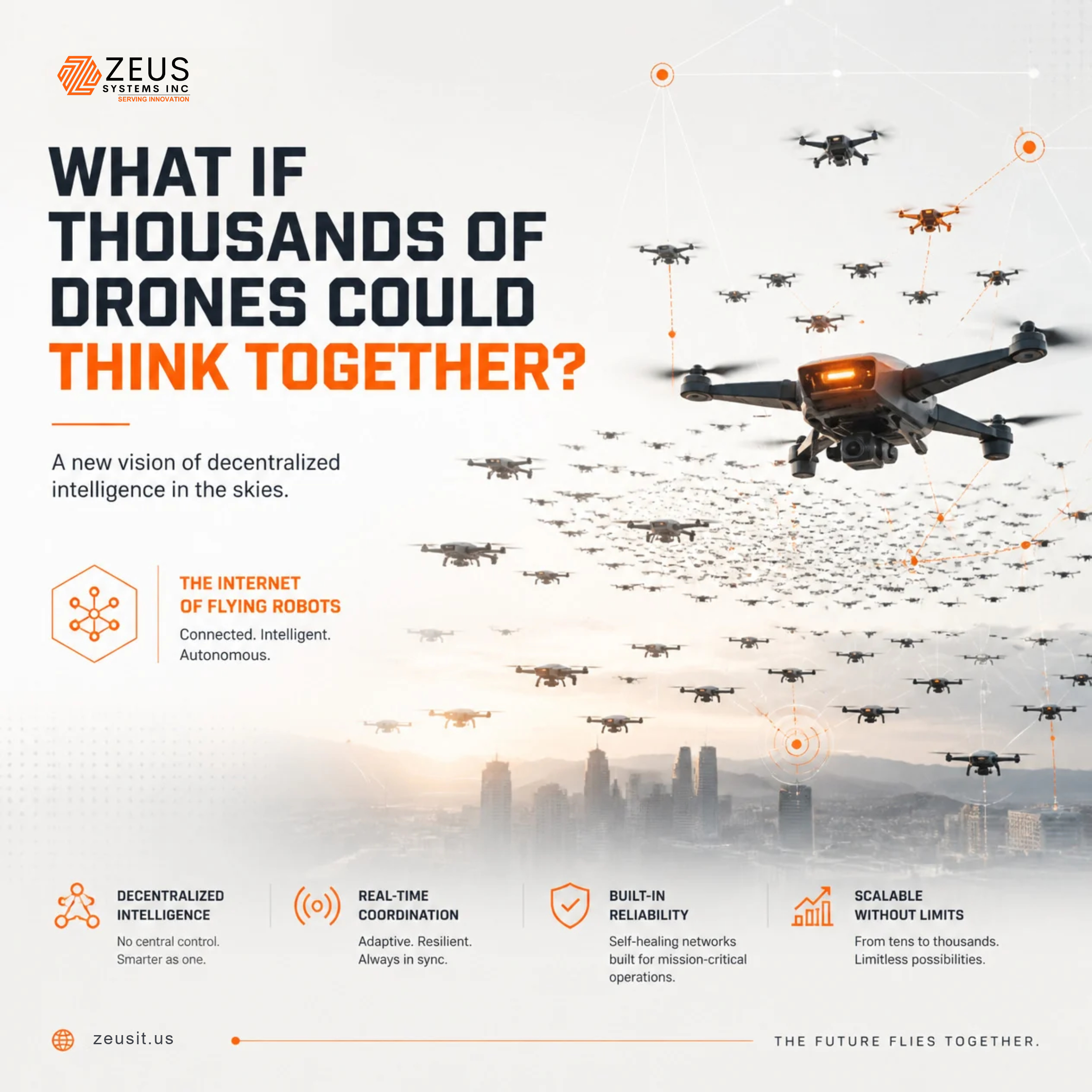
Imagine a world where thousands of flying robots make decisions together, without waiting for instructions from a central computer. Not a fleet controlled by one operator. Not a collection of machines following a fixed plan. But an intelligent, constantly adapting network in the sky.
We have spent decades building an internet that connects people, computers, phones, and machines. Now imagine extending that idea beyond screens and cables, into the physical world.
What if the next evolution of the internet was not something we accessed through a device, but something that could move, observe, respond, and organize itself above us?
Welcome to the idea of an Internet of Flying Robots.
What if the sky had its own internet?
Today, most large-scale drone operations depend on some form of centralized coordination. A central platform may assign tasks, monitor locations, process information, and manage the overall operation.
It works, but it creates an interesting limitation.
What happens when the network becomes too large, the environment changes too quickly, or communication with the central system becomes unavailable?
A different approach is possible.
Imagine thousands of drones operating as independent participants in a shared network. Each drone understands its immediate surroundings, communicates relevant information with nearby drones, and makes local decisions while contributing to a much larger collective objective.
No single machine needs to understand everything happening across the sky.
Instead, intelligence emerges from the interaction between thousands of smaller systems.
This is the fascinating possibility of decentralized aerial intelligence.
Intelligence without a brain in the middle
The most interesting part of this idea is not the number of drones. It is the absence of a central decision-maker.
In a traditional system, intelligence often flows from the center to the edge. A central controller decides what should happen, and individual devices execute those decisions.
A decentralized aerial network could reverse this relationship.
Each drone becomes a small decision-making participant. It shares information, recognizes changes in its surroundings, and adjusts its behavior based on locally available information and shared network conditions.
Think about a sudden change in weather over a large area.
Instead of waiting for a central system to process every individual update, nearby drones could exchange observations. Other parts of the network could receive relevant information through neighboring participants.
The network would continuously update its understanding of the environment.
The important distinction is that coordination would not depend on one machine having complete control.
This is not science fiction in its underlying principles. Distributed computing, swarm robotics, peer-to-peer communication, and multi-agent systems already explore parts of this concept. The breakthrough would be bringing them together into a reliable, large-scale aerial infrastructure.
What could this actually change?
Consider a major natural disaster.
Roads are blocked. Communication infrastructure is damaged. Emergency teams have limited visibility into what is happening across the affected area.
A decentralized aerial network could offer a different kind of response.
Flying robots could collectively support environmental observation, identify changes in conditions, relay communication, and help emergency teams understand where assistance may be needed.
One drone might lose communication with another. That should not automatically make the entire network useless. The wider system could continue operating through alternative communication paths, provided enough connectivity remains.
Now take the same concept beyond disaster response.
The real opportunity is not replacing humans with thousands of machines. It is giving humans a new layer of visibility and responsiveness that was previously difficult to achieve.
The internet becomes physical
Here is where the concept becomes much more interesting.
The internet we know today primarily transfers information. A flying robotic internet could connect information with physical action.
A sensor detects something. A nearby machine interprets it. Another machine receives the relevant information. The network adapts its collective behavior.
Information would no longer simply travel between computers. It could influence how thousands of physical devices interact with the world.
This introduces a new way of thinking about infrastructure.
Instead of building a separate, fixed system for every task, we could eventually develop a shared aerial infrastructure that changes its purpose according to real-world needs.
In one situation, it might support environmental monitoring. In another, it might help emergency services. During normal operations, it could contribute to scientific observation.
The same underlying network could serve different purposes.
That is a much bigger idea than simply making drones fly together.
But can we trust a network without a central controller?
This is the question that deserves more attention than the technology itself.
Removing a central controller does not automatically make a system smarter, safer, or more reliable.
Thousands of autonomous machines introduce difficult questions.
Who is responsible when something goes wrong? How do we prevent conflicting decisions? How can the network distinguish reliable information from incorrect or manipulated information? What happens when communication is interrupted or individual machines behave unpredictably?
There are also questions about privacy, surveillance, airspace regulation, cybersecurity, and public consent.
A truly decentralized aerial internet would need strong safety boundaries, identity and authentication mechanisms, accountability, and ways for authorized human operators to intervene.
Decentralization should not mean the absence of responsibility.
In fact, the larger the network becomes, the more important governance and safety become.
The next internet might not be on a screen
We often describe technological progress in terms of faster processors, smarter AI, and more connected devices.
But perhaps the next major shift will come from changing how intelligence is organized.
What if intelligence did not need to live in one powerful computer?
What if it could emerge from thousands of independent machines sharing limited information, making local decisions, and contributing to a common understanding of the physical world?
The Internet of Flying Robots represents that possibility.
It is still an emerging vision, not a fully realized technology. Making it practical will require advances in distributed intelligence, communication reliability, energy efficiency, safety engineering, and regulation.
But the direction is worth exploring.
We built an internet that allowed information to move freely across the world.
Perhaps the next challenge is building one that allows intelligent machines to coordinate responsibly within it.
And when that happens, the sky may no longer be just a space above our connected world. It could become the next layer of the internet itself.